Welcome to Pompeii
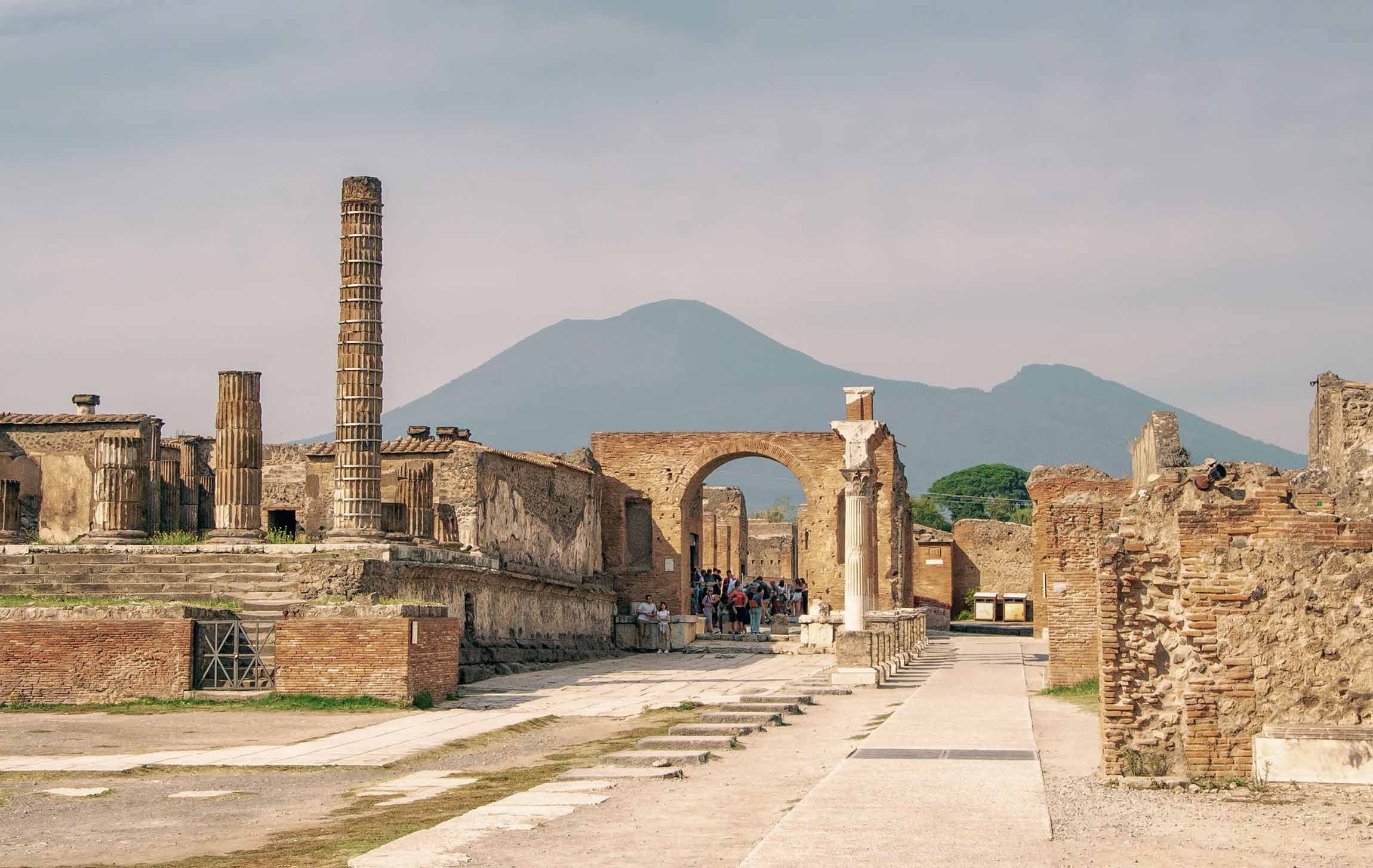
Welcome to Pompeii, a city frozen in time. In 79 CE, Mount Vesuvius buried the city under nearly 6 meters of ash and debris in a violent eruption, preserving an extraordinary record of the ancient world. At the heart of Pompeii was the Forum, its main public square and the center of daily life. Join us as we explore some of its most iconic buildings and discover what they reveal about the people who lived here before the eruption changed everything.
Stop 1. Temple of Jupiter
At the far end of the Forum stands the Temple of Jupiter, one of Pompeii’s most recognizable landmarks. Its commanding position at the head of the square made it impossible to miss, while Mount Vesuvius rises behind it as a powerful reminder of the eruption that buried the city. Though it was a place of worship, the temple also expressed Pompeii’s connection to Rome. With statues of major deities and a prominent place in the Forum, it brought together religion, power, and public identity in one striking monument.
Stop 2. The Basilica
The Basilica was one of the busiest buildings in Pompeii. This was where legal cases were heard, business was discussed, and important decisions were made. Imagine the space filled with merchants, officials, and citizens waiting their turn. The Basilica reminds us that Pompeii was not just a beautiful city—it was a working city, full of activity, conversation, and everyday human drama.
Stop 3. The Human Cost
Looking across Pompeii's ruins, it can be difficult to grasp the human scale of the disaster. Here, that tragedy becomes real. This cast preserves the final position of a young girl, thought to have been between 13 and 19 years old. She was found lying face down in the street, her head resting on her arm, buried beneath layers of volcanic ash. We don't know her name or her story. But nearly 2,000 years later, her final moments are a powerful reminder that the ruins of Pompeii belonged to real people whose lives were suddenly interrupted by the eruption.
Stop 4. Temple of Apollo
The Sanctuary of Apollo shows that Pompeii’s story began long before the Roman colony. This was already an important sacred place, revealing an older past beneath the Roman city we see today. Even as Pompeii changed under Roman rule, Apollo’s sanctuary remained a key part of civic and religious life. It reminds us that Pompeii was not built all at once. It was shaped over centuries, layer by layer, by the people who lived and worshipped here.
Stop 5. The Macellum
On the East side of the Forum stood the Macellum, Pompeii’s public market. This was where people came to buy fresh food, including meat and fish, and where the everyday business of feeding a city took place. It’s easy to imagine the sounds and smells of this place when it was full of life. The Macellum helps us picture Pompeii not just as a ruin, but as a living town where ordinary people shopped, worked, and gathered each day.
Stop 6. The Eumachia building
One of the Forum’s most impressive buildings was paid for by Eumachia, a wealthy and powerful woman of Pompeii. Her name is still tied to this space, making her one of the most visible figures in the city today. Her building was a statement of status, success, and public pride. It also reminds us that Pompeii’s story was shaped not only by emperors and officials, but by local people who left their mark on the city.
Stop 7. Reading the Forum
As we look across Pompeii once more, these ruins begin to feel less like empty buildings and more like parts of a living city—a place where people worshipped, worked, shopped, argued, and built their lives. The eruption destroyed that world, but it also preserved an extraordinary record of it. Nearly 2,000 years later, archaeology continues to reveal not just how Pompeii was built, but how its people lived. That is what makes Pompeii so remarkable: behind every street, building, and object is a human story.