Restoring a Staircase to the Gods
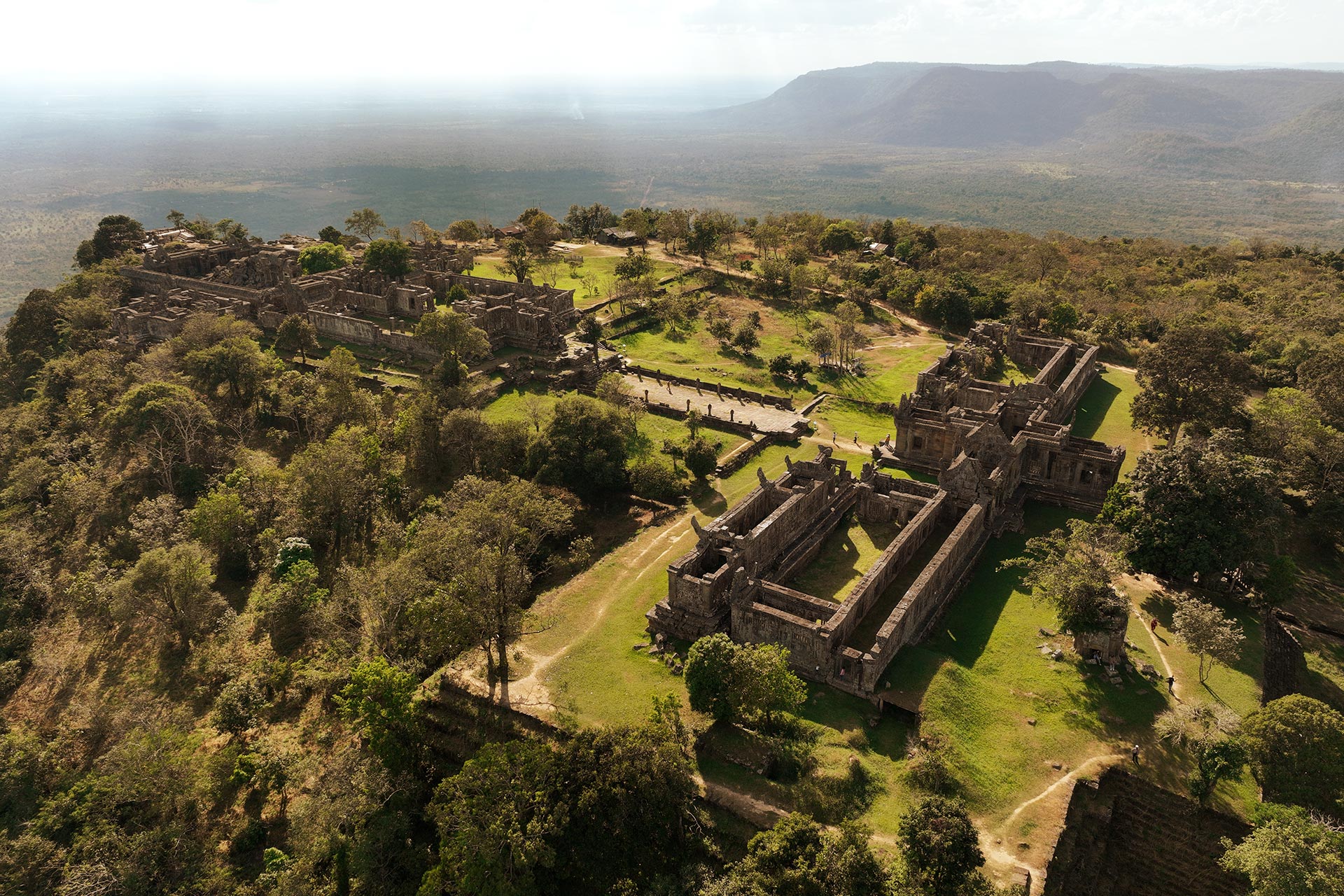
Welcome to Preah Vihear. A majestic temple perched high in the densely forested mountains of northern Cambodia. Constructed between the ninth and 12th century C.E. by the kings of Angkor, this masterwork stands as a testament to the power of the Khmer Empire and their devotion to the Hindu gods. Today, historic efforts are underway to restore and preserve this sacred site, ensuring its enduring legacy. Our tour will focus on a central hub of international collaboration at the Grand Northern Staircase. We will hear from local experts and preservation champions Amparo Garcia and Sorimeas Norm, from the US Embassy in Phnom Penh, as well as Doctor Ea Darith, Thim Mengley and Oh Sman, leaders and experts from the National Authority for Preah Vihear, NAPV. Embark with us on a journey of discovery and preservation at Preah Vihear Temple.
Stop 1. Atop the Mountain
Even before we ascend the stairs, the first step of the Grand staircase is already one of the highest points in the region. The Dangrek mountains are the longest range in the country, and at the crest of this range spans the 800 meter long ancient complex. Construction began in the early 10th century and continued through a successive line of the kings of Angkor, considered the devarajas, god kings. Most of the development is often contributed to by King Suryavarman I (1006–1050) and Suryavarman II (1113–1150). These works were done to honor the Hindu god Shiva, often depicted as dual deities of the mountain Sikhresvara and Bhadresvara. Each successive king would add to the mountaintop temple by building Gopuras or monument or entrance towers, creating this unique linear sanctuary.
Amparo Garcia
Hello. My name is Amparo Garcia, and I'm the cultural affairs officer at the U.S. Embassy in Phnom Penh, Cambodia. Through the Ambassador's Fund for Cultural Preservation, we have donated almost $800,000 to preserve the northern staircase of Preah Vihear temple. This ninth century temple, which we are here today, is one of the historic temples that Cambodia has. Many people know about Angkor Wat, but in the northern part of Cambodia, we have this historic temple, Preah Vihear, in Preah Vihear province. The northern staircase encompasses much of this temple and with U.S. support to the Cambodian government, with the national authority for Preah Vihear has been able to continue the restoration. U.S. funding has started in 2018 and continues to this day. We hope to continue to work with the Cambodian government and the Cambodian people to restore the rich cultural heritage that Cambodia has and teach the next generation about the importance of culture.
Dr. Ea Darith
Hello! My name is Ea Darith Director of the Department of Conservation and Archaeology of National Authority of Preah Vihear This area of Preah Vihear temple is important zone that has been inscribed on the World Heritage list Therefore, Preah Vihear Temple is included in the World Heritage List according to Criteria I as is related to the architectural design of the temple with the cultural landscape at the temple of Preah Vihear This is the highlight of the Temple of Preah Vihear with universal value inscribed on the UNESCO World Heritage list
Stop 2. Guardians of the Temple
Ornate carvings from Hindu mythology found throughout the stairway and temple were nearly erased after 1000 years of erosion. Today, they are being restored to their original grandeur. Here we see some of the best examples in the form of lion statues serving as guardians to sacred places and symbols of ancient royalty and divinity. They are often found flanking staircases and guarding entrances and detailed balustrades. These same lions have watched over all visitors, from ancient royal processions to present day pilgrims and tourists. Incredible efforts of expert stonemasons will ensure they maintain this stoic visual.
Stop 3. Restoration Today
As we climb the stairs, we can see the convergence of historic engineering and modern practices. Ancient workers excavated to the bedrock to serve as a solid foundation, then quarried and transported local sandstone for the staircase and surrounding structures. Even this monumental works are not immune to nature's destructive powers. Over the past millennium, heavy rains, plant growth and human activities have slowly worn away the sandstone. Today, stewards with the NAPV work to restore damaged sections of the staircase while preserving the authentic form of the original sandstone steps, striking an impressive balance between new construction and preserved original form. The result is so exact, it is often difficult to tell the difference between old and new steps made by these highly skilled workers. Can you spot the differences?
Dr. Ea Darith
To build on the slope, the rock needs to be cut according to the staircases or the level of the temple and other areas need to be replenished where there is no rock So the damage is due to the slope that was damaged by a rain Because when it rains, it drips into the temple foundation or the stairway foundation causing the replenished soil for the staircase to flow And when the soil flows away, it collapses, damaging the stair This is one of the reasons for the damage to the stairs and the temple The second is the root of the tree The root of the tree has at some point taken root in the structure of the temple and the staircase Causing the rock to crack or lift So So when the rain comes, it goes through the lifted rock It takes away the soil. It collapsed. And another reason is due to the insect sometimes the termite can bring the soil from the ground under the stairs or under the temple, which also causes the temple to collapse Another reason is the age factor For thousands of years it has caused the damaged, the degraded, and the broken
Thim Mengly
I am Thim Mengly, an Engineer I currently work for the Preah Vihear National Authority in the Department of Conservation and Archaeology Also in charge of working with AFCP-sponsored project to repair the ancient stairs north of Preah Vihear temple and we also organized a pilot project in which we tried a single-level staircase in the first phase and then we have received recommendations from national and international experts to continue to repair the next phase is now to reach 6 levels of stairs and three lion sculptures We are also restoring the drainage system which is an important structure to prevent rainwater from affecting the foundation of the stairs As in the past, in terms of the team encountered the first is the geography, the construction site is not on a flat surface but on a steep slope And we hope that the old structure will be revived through renovations Make the building strong and beautiful return to the original state
Ol Sam An
Hello! My name is Ol Sam An I am an archaeologist working in the Department of Conservation and Archaeology at Preah Vihear National Authority The temple of Preah Vihear stretches from south to north And this mountain also has a slope from south to north and from west bend to east The temple of Preah Vihear is almost 100% sandstone And all these stones were cut on the mountain of Preah Vihear temple to be built at once The construction of the foundation below is based on natural rock The temple of Preah Vihear, we see the construction of two stairs The first was built from the east the second from the north on the axis of the temple body itself In particular, for the study of archaeological excavations in the north ancient staircase at the time of our repair, we see the same thing Where there is a cascade, the foundation is filled with sand and natural rock breaks into the foundation As an archaeologist, I have also been involved in research work with restoration and conservation projects The ancient staircase is an important part of the conservation work
Stop 4. Naga and Nature
We are now at the zenith of the northern staircase, which gives way to the recently restored Naga parapet. These towering, intricately crafted, serpent-like effigies hold profound significance in Hindu and Buddhist practices. Nagas are considered divine beings, often associated with water, fertility, protection, and prosperity. Devotees leave offerings at the feet of these statues as a gesture of respect and gratitude, seeking blessings for their families in an act that symbolizes a connection with the spiritual realm. The restoration of these Naga statues is a testament to the enduring battle against the elements. These struggles underscore the importance of preservation in the face of nature's relentless forces. As they oversee the ongoing efforts of their caretakers. the Nagas remind us of the power of water in shaping the landscape and the challenges it poses to the built environment.
Stop 5. International Collaboration
The work being done throughout Preah Vihear here represents the best of internationally collaborative restoration and preservation efforts. Since 2018, a strong partnership between the United States and Cambodian governments has made strides in restoring the staircase. Through joint initiatives and shared expertise Both nations are committed to ensuring the longevity and cultural significance of this treasured Khmer temple by pooling resources and knowledge. The NAPV, alongside many international partners, has led comprehensive restoration plans addressing structural issues and environmental challenges throughout the temple complex. This collaborative approach represents a universal, shared commitment to safeguarding and honoring previous heritage for future generations.
Dr. Ea Darith
Finally, I would like to express my deep gratitude to the U.S. Embassy in Cambodia for its dedicated efforts in cultural work besides supporting the restoration of Preah Vihear Temple and Phnom Bak Kheng temples in the Angkor area The U.S. government is also working hard to reclaim the lost Cambodian statues in the United States to Cambodia and has been a strong supporter of the cultural sector in Cambodia I would also like to thank the governments of India, China, Belgium, France, Japan and other countries for their contribution to the restoration and preservation of Cambodia's cultural heritage Finally, I'd like to thank the Royal Government of Cambodia who always pays great attention to culture, education and training of human resources and it will preserve the World Heritage for a long time to come Thank you!
Soreimeas Norn
I am very proud to see the progress of the AFCP project, Especially in the Preah Vihear area, directly with the cooperation of the Preah Vihear authorities We see that over the last 5 years Because it requires a high level of commitment and dedication Through this project, we see that the officials involved are very proud to have the opportunity to preserve as well as restore the heritage We see the presence of various students who come to explore the value of heritage, the value of conservation work In this way, they begin to cultivate the idea of loving and protecting their own heritage, and can also come up with new ideas, or ideas that they can become engineers or conservationists in the future who can also continue to play this important role in the future