Qassiarsuk Greenland
[Music] Welcome to Qassiarsuk, a subarctic settlement in southern Greenland, whose rich history stretches back more than a millennia. Nestled at the end of a fjord and protected from the elements, these rolling hills have proven to be some of Greenland's most conducive farmland. Norse settlers chose this location to begin their settlement of the New World, and Inuit communities continue the tradition today after generations of farming the land. On this journey you will hear from local guides Aqqaluaq-Ole Frederiksen and Tupaarnaq Egede, as well as local farmer Frederik Egede, whose families have farmed this land for generations.
Stop 1. Resilience in a subarctic landscape
Norse settlers who migrated to southern Greenland in the late 10th century displayed remarkable adaptability by modifying existing farming techniques to suit the less forgiving subarctic conditions. They relied on a mixed economy of animal husbandry, especially sheep and goats, along with limited crop cultivation and hunting to sustain their communities and livestock. Today's modern farms are similar in many ways to their predecessors, but Inuit communities are faced with new challenges in a warming climate, including less predictable rainfall patterns and elevated risks of extreme weather events.
Aqqaluaq-Ole Frederiksen
What makes it differently is that we farm in a climate that is sub-Arctic, meaning that it's a bit colder than the rest of the world, which makes it a little bit different, like we have shorter seasons of summer, longer seasons of winter, and that's what makes it a bit different.
Tupaarnaq Egede
So when I was a child, the climate was more stable. So we had like very specific seasons. We would know when we could expect spring, summer, fall and winter, but that has not been the case for for several decades now.
Frederik Egede
But when farming is your life, it's impossible to just let it go, it's the core of my heart. Just as the hunters born in this country who only knows about hunting, they live for it. The same applies to fishermen. We are exactly the same. We cannot easily be stopped with what we grew up with and still live with to this day.
Stop 2. Ruins of Brattahlid
The ruins you see before you—stone outlines of a church, farms, longhouses, and other structures—date back to the 14th and 15th centuries. This is thought to be Brattahlid, Erik the Red’s estate and the center of the Eastern Settlement, one of the two main Norse settlements in Greenland. Erik was a Norse explorer and outlaw who explored Greenland’s coasts and fjords for several years before settling in Brattahlid in 986 AD. Erik named the land “Greenland” to attract settlers despite the challenging climate, knowing Iceland was overpopulated. At its peak, estimates suggest that the Eastern Settlements may have supported between 3,000 to 5,000 people.
Tupaarnaq Egede
We have the Inuit archeology and the Viking archeology, and they could be similar to people who don't know to differentiate them because they're both made of stones and turf, but usually the Viking ruins are bigger and more up in the mountain, up in the land, and since the Vikings stayed in one place for a long time, they would use gigantic rocks. So they made sure that they have a safe place to stay, and with Inuit ruins, you also see rocks and turf, as I mentioned, but they're usually closer to the fjord and they're smaller.
Stop 3. Tjodhilde's Church
You’re now standing in front of a replica of Tjodhilde’s Church, named after the wife of Erik the Red. Tjodhilde is said to have played a pivotal role in establishing Christianity in the region. The Icelandic Sagas, the written stories of Viking adventures, tell the story of Tjodhilde converting her husband. Built with turf and timber, the replica church is modest in size and similar in dimensions to the ruins of a small church thought to be the original located nearby. Tjodhilde’s Church holds a unique place in Christian history as the first church in the New World.
Stop 4. Reconstructed Longhouse
In Qassiarsuk, you can visit a faithfully reconstructed Norse longhouse. Longhouses were elongated, rectangular structures typically divided into a living space and a space for animals. The living area usually featured a central hearth for cooking and warmth, with sleeping platforms along the sides while the other end housed livestock, separated by a wooden partition. The Norse settlements featured many individual farmsteads that were quite distant from one another, likely due to the difficult landscape and limited pockets of fertile land. The Norse Greenland settlements initially thrived but eventually declined by the 14th century, influenced by multiple factors that continue to be a subject of ongoing debate.
Aqqaluaq-Ole Frederiksen
[The longhouse described in this video is a centralized-type structure, representing a later design than the reconstructed longhouse in Qassiarsuk.] The life in the longhouse is where the everyday life happened, and there is, if you look at the interior,depending on your status in the community, you would sleep in different places like we have this small room which enclosed it can be locked from the inside. That room, this preserved for the chief or the owner of the farm where he would sleep inside with his wife and probably one of the few people that had some kind of privacy. The rest they would sleep on this long place. And if your status is higher in the society, you would sleep further in where it’s warm and cozy.Whereas if you’re a slave, you would sleep near the door with there’s a little bit breeze and cold,and that is because you would be the first one to wake up earliest in the morning and do some work before everybody wakes up and also you will be the first to be killed if there were an attack from outside, and then we have this room up there and that room is actually reserved for the young ladies which were unmarried, and they would all sleep together and they would actually take the ladder with them when they went to bed.So they won’t get disturbed by the young men.
Stop 5. Leif Eriksson Monument
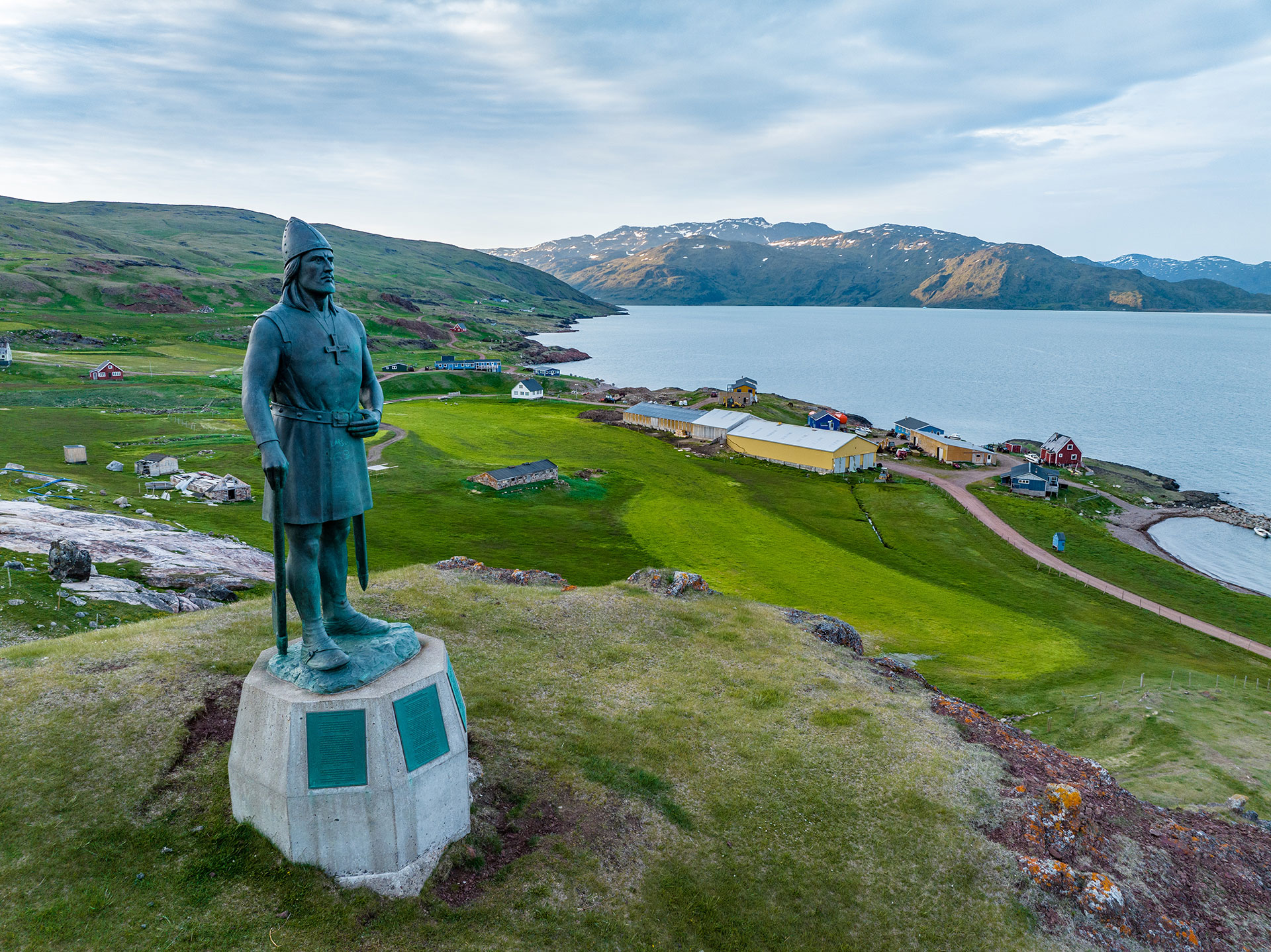
Looking over the modern town of Qassiarsuk, stands a 10ft high imposing bronze statue of Leif Erikson, gazing resolutely towards the horizon. Leif Erikson, the son of Erik the Red and Thjodhild, played a significant role in Greenland’s history, bringing Christianity to the Norse settlers and achieving remarkable feats as an explorer. Leif is celebrated as the first European to step foot on the distant shores of North America approximately 500 years before Columbus. He is believed to have sailed from Greenland to areas of modern-day Canada, possibly landing in places like Newfoundland, which he named Vinland for its fertile land and grapevines
Stop 6. Re-emergence of Farming
In the 19th century, 300 years after the Norse Greenlanders’ decline, farming experienced a revival, led by Inuit woman, Tuperna and her Norwegian husband, Anders Olsen. They settled in Upernaviarsuk and later in Igaliku, adapting Scandinavian livestock and farming techniques to Greenland’s unique conditions, much like the Norse settlers before them. In front of you is a reconstructed Inuit winter house. These sturdy houses are made from stone and turf and supported by wood or whalebone posts. The Inuit, who lived a semi-nomadic life, moved between places, staying in tents or hunting houses with roofs made of animal skin.Today, most farming families in the region can trace their lineage to Tuperna and Anders Olsen.
Aqqaluaq-Ole Frederiksen
Winter House is set, we have two examples of ruins here, actually right near to the Norse ruin, this that the ruins are roughly from 1700 and they are made out of turf. So they were actually used only during the wintertime to keep them warm, and instead of a door they actually had a kind of like a chimney on the ground where you have to crawl in to get into the living area, and there is actually a height difference between the living area and the entrance, and that is to keep the cold out of the Winter House, and they would only use them during the winter, whereas in the summer they would actually sail to different fjords, and that is to hunt because the Inuit they were nomadic people, instead of staying the same area, they would travel all the summer and following the food.
Frederik Egede
Igaliku has been a sheep farming place for a long time. The only small field is the one you see in front of you. But there are much more sheep in winter. And the sheep spread south. Behind the mountains in the south. After rounding this first, then to behind those mountains. Also, west towards Qaqortukulooq.
Stop 7. Otto Frederiksen House
The small house in front of you is the family home of Otto Frederiksen, the pioneering sheep farmer who re-established farming in Qassiarsuk in 1924. This was the first farm outside of Igaliku in the modern era although the decades that followed would see many farms established on or near previous Norse settlements. Otto Frederiksen was the great-grandson of Johannes Andersen, son of Tuperna and Anders Olsen. The descendants of Otto Fredricksen continue this long family history of rearing sheep on the land to this day. The house is now a small museum that pays tribute to the efforts of this pioneering farmer and his family.
Stop 8. A Changing Climate
Climate change poses a threat to sustainable farming as well as the built cultural heritage in southern Greenland. Rising temperatures have led to more frequent and prolonged droughts in recent years, necessitating new irrigation systems for many farmers. For the Norse ruins that dot the coastal landscape, rising sea levels, combined with storms, are contributing to increased erosion. Climate change is a pressing concern that demands attention for both sustaining agriculture and preserving heritage.
Tupaarnaq Egede
So the climate change affects mostly the people who live by nature. So hunters, fishermen, those are the ones who live the the worst impact on their lifestyle. But also farmers. As I mentioned before, we had droughts for several decades. So it meant that the grass fields didn't grow as much and they need this grass for their sheeps to survive the winter.
Stop 9. Resilience and Adaptation
Throughout history and today, Norse and Inuit communities have thrived in this challenging subarctic environment, adapting and mastering a unique set of farming practices. Their shared use of the land and common experience connect these two cultures over the span of many centuries. The stories of resilience and adaptation continue to this day in the face of a changing climate. The farming practices of tomorrow under a transformed climate regime will likely look quite different than those of today as these communities continue to find ways to thrive in this environment.