Rapa Nui
[Music] Iorana Korua, and welcome to Rapa Nui. This small volcanic island is located in the middle of the Pacific Ocean. 1,700 miles west of Chile, and is one of the most remote islands on the planet. Starting 1,000 years ago, Rapa Nui was settled by Polynesian explorers who, through their extensive ocean voyages, developed a unique culture based on the use of natural resources. This cultural development left a great legacy, and today Rapa Nui is home to 10,000 people, many of whom trace their ancestry back to those first Polynesian explorers. On this virtual tour you will hear from island archaeologist Merahi Atam, master stone carver Pao Heriveri, and cultural performer and musician Hotu iti Araki, who will share more about their spiritual connection to this amazing place.
Stop 1. Welcome to Rapa Nui
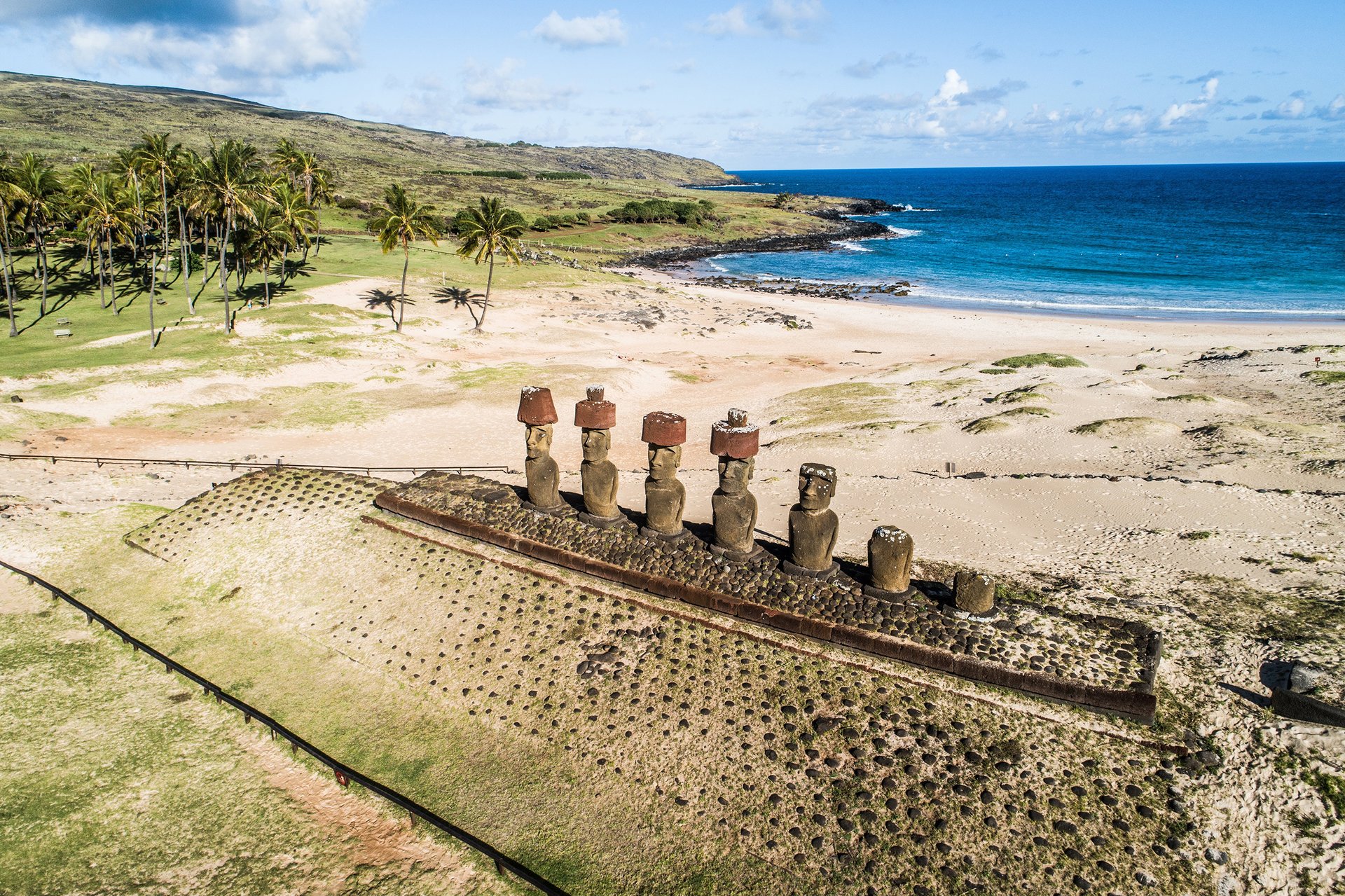
You have just been transported to Anakena, the northern part of the island. This is one of the few sandy beaches on the island. According to oral tradition, this is the location where Hotu Matu’a, the first Polynesian settler Ariki mau’, or Supreme Chief, landed in a canoe. Every year in July, the island communities come together for a ceremony to commemorate the arrival of Hotu Matu’a. Despite the island’s geographic isolation, the Rapa Nui people have been able to utilize natural resources on the island. This close relationship with the land has shaped the cultural life and traditions of the Rapa Nui people. This culture remains strong today. Traditions have been passed down through the generations through oral tradition.
Merahi Atam
(Merahi speaking spanish) My name is Merahi Atam and I'm from Rapa Nui. Specifically, the term Mana is related to... a concept wholly based on spirituality. I feel like the concept of Mana is directly linked to... the land where you first open your eyes and because of that, as a Rapa Nui, you feel directly connected with the space you live in.
Pau Hereveri
(Pau Hereveri speaking Spanish) My name is Pau Hereveri Teao. My job is to carve and plant anything. I'm Rapanui. I'm from here, from the center of the world.
Hotu Iti Araki
Hello, everybody. Hello! This is Hotu Iti Araki from Rapa Nui. And I’m going to welcome you to my island, I wanna welcome you to my home. Here, behind me, you can see the ocean, the Pacific Ocean. And this is our land that was left for us by our ancestors many, many years ago, hundreds of years ago. And I am a man who dedicates his life to preserve and also teach the Rapa Nui culture to the children, to the young, and to the old people all over the world, but, most important, to the young people and the children of my island, so they can carry the language as I do, as my father does too, and this is our legacy and how we preserve it to keep the memory of our ancestors alive and never forget from where we are.
Stop 2. Sacred Resting Places
Rapa Nui is famous for its ahu, ceremonial stone platforms around the island that were built to remember ancestors and act as sacred resting places for the Rapa Nui people. On top of the ahu usually rest moai, human-shaped stone figures carved from volcanic rock. Each moai on the island is unique and pays homage to a family member from one of the island clans. This particular ahu is known as Ahu Ature huki and has a moai that stands over 10 feet tall and weighs 30 tons. The tradition of moai carving commenced soon after the arrival of the island's first settlers. These figures remain as enduring tributes to the ancestors. Today, the moai continue to hold deep significance for the Rapa Nui people, who are the descendants of these ancestors, symbolizing a living heritage.
Stop 3. Living Faces
Located about 100 yards left of the single moai called Ahu Ature huki is another ahu known as Ahu Nau Nau. This ahu is much larger and has seven moai standing on the platform. You’ll notice that these moai are well preserved, and you can distinguish fine details in their faces. These moai are stylized with more angular facial features than the single moai you saw first. Every moai on the island is unique, influenced by changes in carving styles during the years that the Rapa Nui created these figures, as well as reflecting the appearance of the specific people they each represent.
Merahi Atam
(Merahi speaking Spanish) I think Mana as a concept is something we all have. And it's manifested in different ways. But, here in Rapa Nui, I feel that it's a term that's inside different things. Specifically, this concept is linked to the land, to the space that you live in. It's also a concept that we can give to certain material things. That's why a moai helps us to represent an ancestor because it's filled with Mana, with that energy, which was given to it by the person that is being represented (in the moai), or who in the end gave the moai a name Moai represent specific people. But I have also been learning that mana is also related to the level of experience that every person has.
Pau Hereveri
So, I make both, modern and traditional art. Well, and then, I go back to what's traditional Moai. It's sort of like a dream, you dream it and then you do it. It's sort of like that. The ancestors are spiritual. So... The stone is connected to the spiritual. Stone is a material And so are we therefore They can connect freely. It's a dream that never ends. Because... it keeps you healthy. If you don't work, you get sick. But if you're working, if you're carving and carving, you focus on what you're doing, you focus on your work. It's the best you can do because otherwise... everything falls apart. It's a very strong emotion. You feel present in the world. And I... You have keep carving to feel that. When you're carving, you're connected with the world.
Hotu Iti Araki
And this Hoko (traditional dance) is about the... when we put the eyes into the Moai’s face. It means that Moai is an sculpture, empty sculpture that, when we put the eyes on, then it gets alive again, but not alive alone. The spirit of this king that just died, because Moai was only for the kings. Not for everybody. No, just for the kings. So, the spirits of this king now enters into the Moai and when you put eyes into the Moai, it gets back to life, into the Moai. The real name of the Moai are not “Moai.” They have a real name, an ancient name, that is called“ariŋa ora o te tupuna.” Repeat with me, “Ariŋa ora o te tupuna.” One more, “Ariŋa ora o te tupuna.” “Ariŋa ora o te tupuna” means"the living face of the ancestor." And that’s what the Moai represents. The face of this king that just died and his spirit gets into the Moai and... and lives again, and guide again their people. To the people connected with mana, they can sense and they can connect with the king and it will be protecting them. That’s why the Moai are sitting all over the coast, looking into the island, because they was looking to their family, they was looking to their place, to their home, to protect it.
Stop 4. What is Mana?
Both ahu and moai are considered to have great spiritual power, or mana, because of their association with ancestors. They are governed by rules of respect known as tapu. These concepts are still an important part of Rapa Nui culture today and influence how people interact with these places and one another. As visitors, it is important that we also respect the sacredness of these places.
Hotu Iti Araki
What is this meaning for us as Rapa Nui, and how can we teach to the children to keep this knowledge going on and never forget what the Moai represents, that is our ancient kings, our ancient kings, and... that the Moai are sacred as culture, this is a sacred place, and we can not just go up into the Moai and hit the Moai or carve the Moai, no, no, no. You are offending our kings, our ancestors. That’s why we protect the Moais and we have distance. You can not go into or onto the ahu, but you can see it from a distance and understand, “Ah, that Moai is a grand grand grand grand grand grand father of Hotu.” So, that’s how we connected to the different places in the island, by the families. My family has an ahu in that place of Anakena, next to Hanga o Teo.
Stop 5. Importance of Family
Ahu on the island are located where important clan territory villages were. Most moai were placed with their backs to the sea and their eyes facing towards the villages and island interior, although there are a few cases in which the moai face the sea. In the past, families lived in stone houses of different shapes, one of the best known being hare paenga or hare vaka. These were arranged hierarchically around the ahu, with families of higher status living closer to the ahu. Today, as in the past, many people in Rapa Nui still have strong family relationships and live off the island’s resources through agriculture, fishing, stone carving, and raising animals.
Hotu Iti Araki
Mana is energy, mana is power. Mana is what you... how you can connect this and transmit it. Our ancestors used their mana to move the Moai They make the Moai like ten tons... huge stones, walking through all the island and setting up to the Ahu with their mana.
Stop 6. Protecting a Legacy
While no longer building ahu, Rapa Nui people maintain a deep respect for the land and the sea and uphold cultural ways of life like mana and tapu. Much of the island was designated a Historical Monument and National Park in 1935, with restoration efforts starting in the 1960s. In 1996, UNESCO listed the island as a World Heritage Site, and in 2017 the management of the National Park was taken over by the indigenous community, Ma’u Henua, which protects the island's cultural heritage today.
Hotu Iti Araki
The other part of my family, on the other side, then we know that we belong to those clans, and the land is ours, because the oral tradition told us where do we belong. That’s why we protect the Moai, we protect the culture, we protect the island and we are protectors of this ancient place, and, also, we want to keep teaching to the children the knowledge, so that when we die, when Hotu dies, then these children and all of the children that are he has taught will know this, will keep this knowledge, this wisdom, and will never forget what [it] means to be Rapa Nui. It’s an honor to be Rapa Nui.