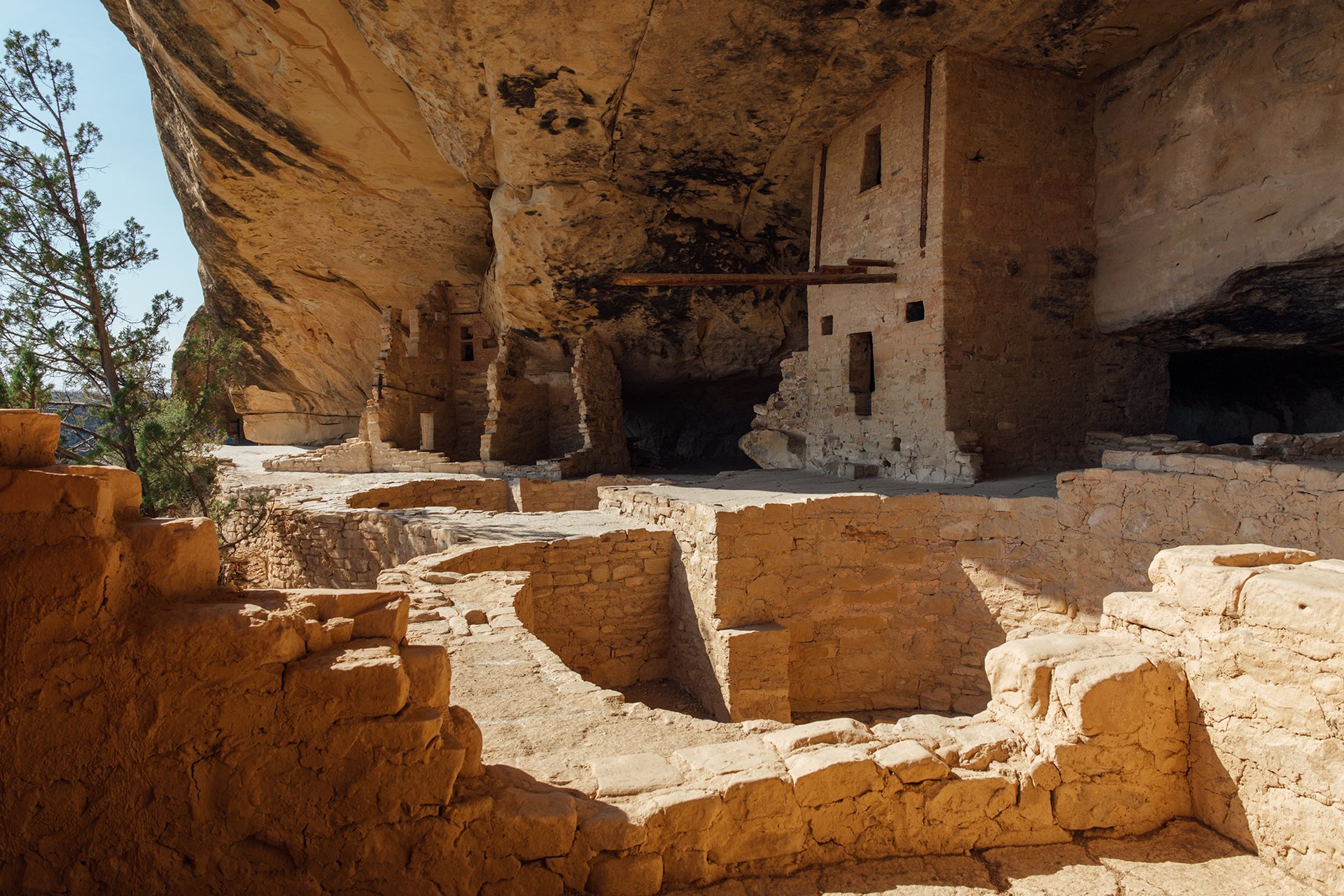
Balcony House Ancestral Home
Welcome to Balcony House at Mesa Verde National Park, Colorado. The knowledge, stories, and opinions included in this experience are solely from a Hopi perspective. Many tribal communities have long-standing ties to these sites, and Resonant does not intend to speak for them. Please approach the sites within this experience with an open and respectful mind as if you were visiting someone’s home. This experience wishes you to: elevate your knowledge about sustainability and climate change through the lens of Hopi; encourage intergenerational conversations within Hopi communities or your own community; learn how you can respectfully engage with cultural heritage sites; learn about the Hopi people to prevent stereotypes. If you are interested in learning more beyond this experience, many additional resources exist for those who are curious and respectful. Kwakwha’.
Stop 1. Footsteps of Our Ancestors
“Kukveni” Kyapsi, respect. For Hopi people going back home is a peaceful feeling of seeing the footprints of our Hisatsinom, our Hopi ancestors, and what they left for us. It is as if we are going back to visit our relatives and are reminded of their ingenuity and thoughtfulness of the future. We do not take any moment for granted and ask for permission to be there and let what is there speak to us. Hopi people feel special to be allowed to see what has been waiting patiently for us to study, feel the energy that still resides there and most of all to give thanks for thriving so we can survive today with what has been passed down. Just like any hospitable gesture we make offerings and thanks from the heart to ensure our paths that have crossed are respected. Sometimes it’s hard to leave without being emotional because you know you belong there and are accepted as you are, Hopi. Askwali, Tepinmana, Katsinwungwa, Hopi.
Stop 2. Spring Preparation
Eskweli Itam naatwanpit aaqw öki. Oovi sòosoy naanatim haalaykyakyang naatwànpit tumaltotangwu. The men of the family, maternal grandfather, father, unwed uncles, and brothers are responsible for preparing the fields, planting, maintaining the field during the growing season, caring for each individual plant, hoeing, and harvesting. Through this process, the boys are taught how caring for a living being requires prayer and nurturing in order to grow to full maturity to give fruit. When the men harvest the crops and bring it home to the women, the harvested crops become the responsibility of the women and girls in the family, maternal grandmother, mother, unwed aunties, daughters, and granddaughters. During the harvest, upon receiving the harvest goods from the men, the women and children are responsible for husking and saving the corn husks and corn leaves for use throughout the year. The girls are also taught about the various uses of all parts of the corn and bean plants, the leaves, husks, and cobs. The lessons learned from growing and harvesting crops begin from within one’s self. Having a good heart, great character traits, and prayer are the elements for success in all that we do: Growing crops, raising children, cultural practices, and life in general. Suwiigöysii, Ahsawungwa, Sichomongak sino.
Stop 3. Water & Rainfall
Iss uni! Yóooyangw öki. We do not run from the rain, we embrace it. It is what we ask for in our prayers and songs. It helps us grow and all living things grow. We are grateful for any moisture; it is a way our ancestors come to visit and bless us. It is ok to enjoy the rain and puddles, but do not waste water or take it for granted; it is very powerful. Honmana, Kalangwunga, Sipaulovi.
Stop 4. Food & Cooking
Momoyam haalaykakang Nöösiwqat Tumaltotangw. Blue and white corn are the main ingredients for most noova (meals) of the Hisatsinom and present-day Hopi people. The blue corn is used to make bread substitutes like Tangúviki (baked corn rolls), Wutaqa (gruel), Hurusuki (pudding/grits), pövölpiki (blue marbles), aatsmiviki (dumplings), and piiki (paper wafer). These breads were made from ground blue meal. Seasonally, fresh corn was utilized to make these breads. White corn was the main ingredient for nöqkwivi (meat stew), and páatupsuki (corn & bean soup). The white corn was made into hominy by boiling or pounding the white corn for the meat stews. It was also crushed and added to rabbit meat and beans. The main ingredient comes from the heart of the cook. A cook with a happy, kind, and generous heart brings the best flavors to the food prepared. Suwiigöysii, Ahsawungwa, Sichomongak sino.
Stop 5. Hopi Clans
Although it’s known today widely as Mesa Verde National Park, to Hopi this place is Tawtoykya, which translates to “a place for songs.” It is also known as Salapa, which means “Spruce Tree House.” Many, many people have called this place home. Clans that are known to have resided at Tawtoykya include Badger, Sand/Snake, Flute, Parrot, Katsinam, Water, Bear, and Mustard clans. In the days when Hopi lived in Tawktoyka, groups were constantly migrating. When a clan would want to reside here, they would have to ask the Lead clan for permission, demonstrating that their expertise in certain areas would be of great benefit to the community as a whole. In this way, everyone was sure to pull their weight and the community would grow stronger, more diverse, and more specialized. Today, there is far less frequent migration. There are currently 33 total living clans in Hopi. As it has always been, each clan has a duty that they provide to the community at large. For us at Hopi, our clan is an important part of our identity. The identities, relationships, and duties of clans remain strong forces in Hopi life.
Stop 6. Experiencing Hopi
Loloma. My name is Craig Andrews, Bear Clan from the Village of Mishongnovi, and I have the honor of serving as the Vice-Chairman of the Hopi Tribe. Our migration history is deeply tied to the four corners region, and our cultural and spiritual ties to the land stretch across multiple states. Hopi trace their origins to Hisatsinom, the Ancestral Puebloan people who lived in the southwestern United States for thousands of years. Hopi's migration story is an essential part of our history with knowledge that we traveled from various regions including places as far as the Great Basin and beyond before settling in present day northeastern Arizona where the Hopi reservation is located. Thank you for taking the time to experience Hopi. Kwakwha’.