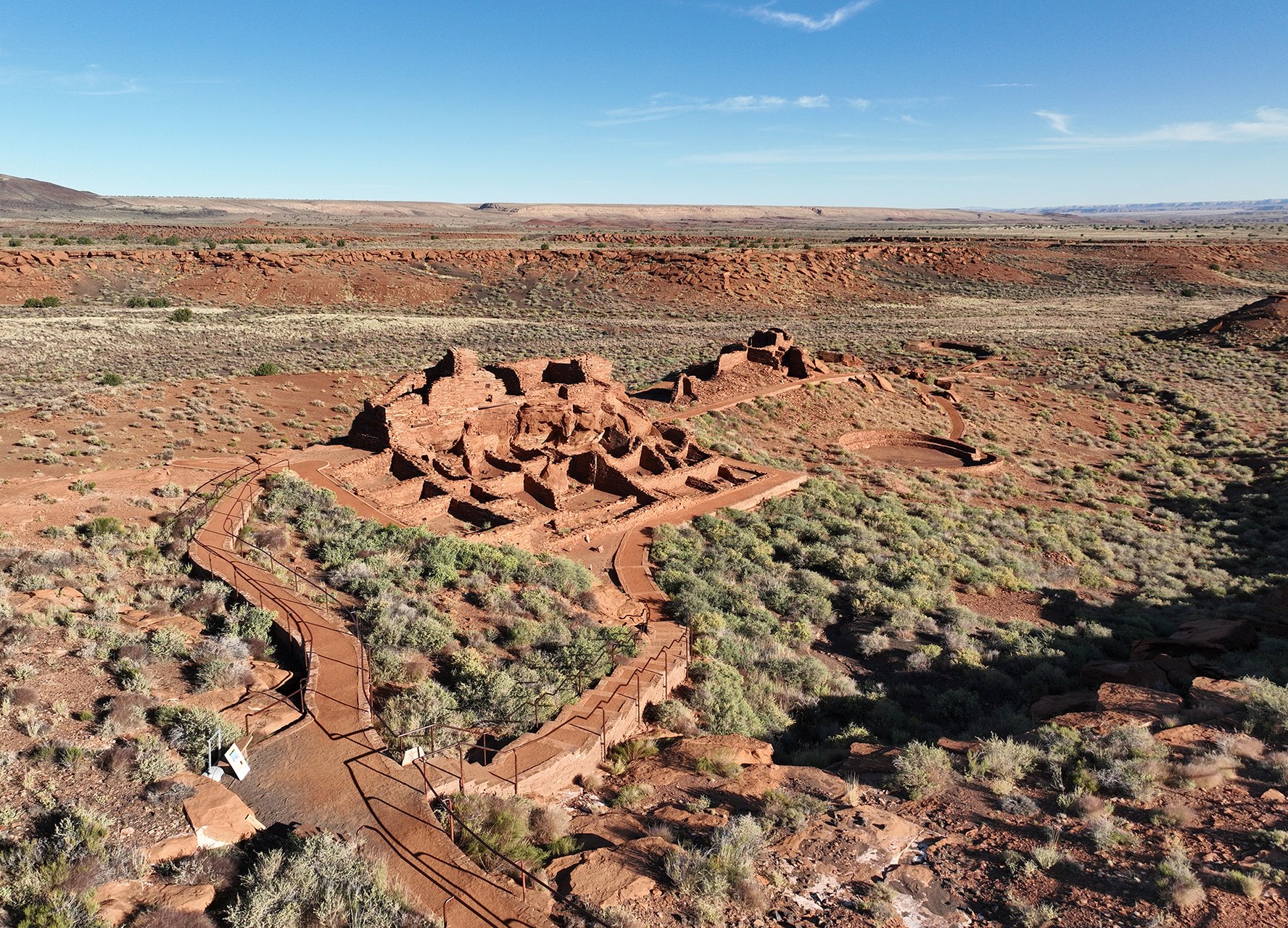
Wupatki Pueblo
Welcome to Wupatki National Monument, Arizona. The knowledge, stories, and opinions included in this experience are solely from a Hopi perspective. Many tribal communities have long-standing ties to these sites, and Resonant does not intend to speak for them. Please approach the sites within this experience with an open and respectful mind as if you were visiting someone’s home. This experience wishes you to: elevate your knowledge about sustainability and climate change through the lens of Hopi; encourage intergenerational conversations within Hopi communities or your own community; learn how you can respectfully engage with cultural heritage sites; learn about the Hopi people to prevent stereotypes. If you are interested in learning more beyond this experience, many additional resources exist for those who are curious and respectful. Kwakwha’.
Stop 1. The Land is Our Home
Askwali uma eeki. We have arrived at the Hopi ancestral village known as Nuva’ovi, or “Place of the Snow.” Our Hopi ancestors, the Hisatsinom, have inhabited these sites for over 13,000 years. By the early 1100s it stood as one of the largest and tallest in Northern Arizona. A more official name for the ancestral village is Wupatki – derived from the Hopi name Wupa-ki “Big House.” It was given this name in 1924 when it was established as a National Monument. Hopi is a word that translates to a philosophy of humility, a high standard of hard work. We live to aspire, to fulfill this philosophy and earn the spiritual name of Hopi’sinom. Our hard work and ingenuity skills are evident in these permanent homes made from the earth. We live by a respected belief that if you care for the earth, it will care and provide for you. Tepinmana, Katsinwungwa, Hotevelnaq sino.
Stop 2. Plants & Animals
Here at Wupatki, the Hisatsinom, ancestors, lived a beautiful life in balance with nature and animals. To survive in those times meant hard work for families and clan groups. Picking and harvesting the right plant materials throughout the seasons is a skill taught to us Hopi by our elders. Here in the late spring you can pick sivipsi, or sumac berries, and mix it with water for a rich vitamin C beverage that helps sustain the hard-working people. During that time,one may also spot möha, or a milkweed, nearby, a perennial that we Hopi eat as a spinach. Hopi men would hunt a taavoya, or a cottontail rabbit, to cook. Nothing was to be wasted when you take from nature. The skin of the rabbit was saved to make shoes and blankets for the cold seasons. The bones from big game like sowi’yngwa, or deer, are saved to make tools like a mootsi (an awl). These tools are important for manufacturing items like baskets, blankets, and jewelry. Over time, Hopi sinom has seen and experienced the decline of plants and animals important to us Increasing temperatures affect our harvest seasons and health of the wild game. It is important to remember and respect our native plants and animals so we can live longer into the future as Hopi. Ovi uma sutsep hom’oyiwta. Kyle Kootswatewa, Hokona, Mungapi Village, Hopivewat Learning Center.
Stop 3. Letting the Earth Rest
During the cold winter months, as the snow blankets the land, our Hopi ancestors would huddle close together in their adobe homes, sitting next to a warm fire, and listen to their clan uncles as they share their stories. Stories of clan migrations, traditions, ceremony, celestial knowledge. These were quiet times when the earth is resting and recharging for the repeat of another years cycle. It was a time to reflect on their crop harvest, and a time to plan for the spring thaw. Corn was and continues to be the staple crop so strong emphasis on lessons of planting, nurturing its growth, food preparations, and storing of their crop took special attention.
Stop 4. Changing Climates
For generations, the Hopi people have lived in harmony with the land, guided by ancestral knowledge that emphasizes respect and balance. Ancestors at Wupatki utilized this knowledge to adapt to changes in the environment. The eruption of the nearby Sunset Crater Volcano 900 years ago transformed the landscape. Those who lived in the Wupatki area found that the few inches of cinder and ash that blanketed the ground kept the soil moist and further supported their approach to dry farming. To conserve the little rainwater from summer storms, people built terraces and small check dams still seen on the Wupatki landscape. In the face of climate change, ancestral knowledge holds invaluable lessons. Hopi dry farming, for instance, demonstrates how to grow crops without irrigation by planting seeds deep to reach hidden moisture and using the natural contours of the land to conserve water. This practice not only sustains communities but works with nature rather than against it. The Hopi belief is that the earth is a living being—one to be nurtured, not exploited—and offers a perspective the world urgently needs. By walking lightly on the land and honoring the cycles of nature, traditional Hopi teachings provide a blueprint for addressing today’s environmental challenges. Paakwamana, Pipwungwa/Sahtowa, Hano/Tewa.
Stop 5. Continuing Connections
Loloma. My name is Craig Andrews, Bear Clan from the Village of Mishongnovi, and I have the honor of serving as the Vice-Chairman of the Hopi Tribe. Our migration history is deeply tied to the four corners region, and our cultural and spiritual ties to the land stretch across multiple states. Hopi trace their origins to Hisatsinom, the Ancestral Puebloan people who lived in the southwestern United States for thousands of years. Hopi's migration story is an essential part of our history with knowledge that we traveled from various regions including places as far as the Great Basin and beyond before settling in present day northeastern Arizona where the Hopi reservation is located. Thank you for taking the time to experience Hopi. Kwakwha’.