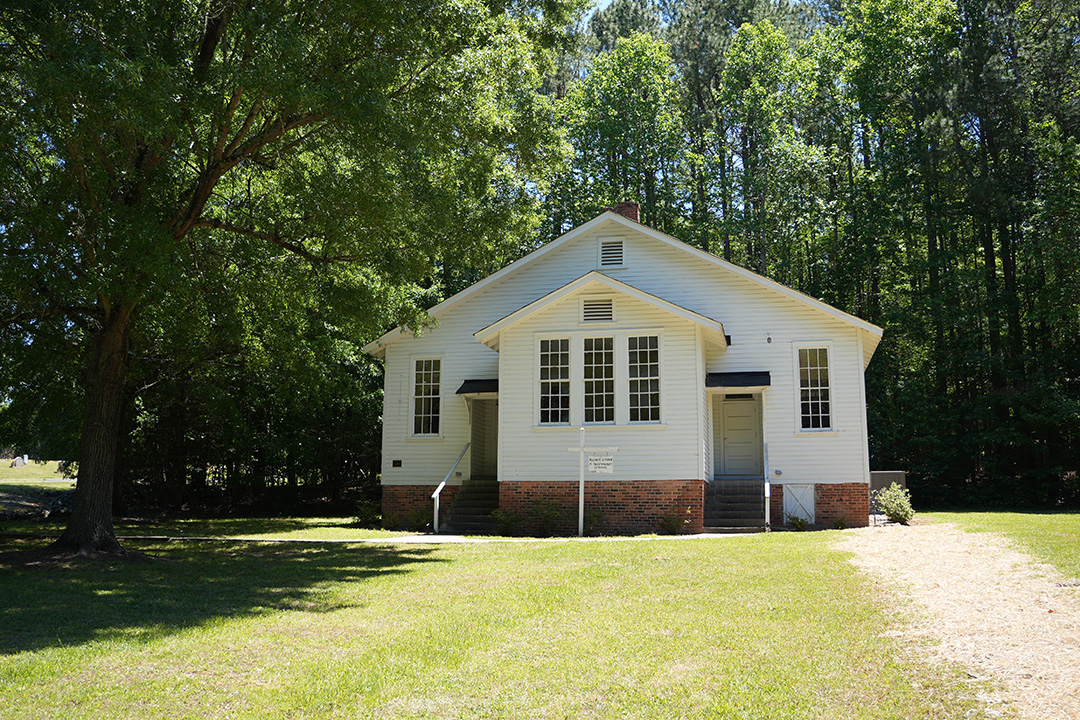
Welcome to the Historic Russell School
This small, white building is the Historic Russell School. Founded in 1926 in Durham County, North Carolina. The school is part of the expansive Rosenwald School network that once spread across the Southern United States. These schools were built in the early 1900s to provide education for Black children. In the era of Jim Crow, these schools are a testament to the sacrifice, determination, and commitment of the Black communities where they were built. Understanding these intentional and progressive principles can also serve as a model for how everyone can benefit from community efforts for education. Throughout this experience, you will hear from two Russell School alumnae, a professor of history and Black education, and the Chair of the Friends of the Russell Rosenwald School. Click the images at the bottom of your screen to meet these experts.
Stop 1. The Rosenwald School Network
Around 5,300 Rosenwald schools, teacher homes, and other buildings were once scattered across the Southern United States from Texas to Maryland. At its peak, North Carolina was home to 800 Rosenwald schools. However, only 125 are still standing today, and only one in Durham County—the Historic Russell School. The Rosenwald Schools were named after Julius Rosenwald, a Jewish-American philanthropist and former president of Sears, Roebuck and company. The schools were opened in collaboration with Booker T. Washington, an educator, reformer, and founder of the Tuskegee Institute for Black students. While Rosenwald provided partial funding and blueprints for these schools, with the help of Washington, he tapped into the existing desire and structure of the local Black communities. These communities did the majority of the work to raise significant amounts of money, acquire the land, and complete the labor for the schools.
Valinda Littlefield
When you're thinking about a Jim Crow system that's established to separate and to make things unequal. You still have an African American community who very much values education, very much values their kids enjoying citizenship to its fullest extent. And so they create. They're very creative in making sure they do some combating of what a Jim Crow system's intent and purpose is for. So education was always valued. If you go back and look at any state South Carolina, North Carolina, any state constitution during Reconstruction, one of the things that African Americans who now had a chance to serve in the legislature sense wanted was access to education. Everybody— it's called universal education. If you are here and it's public, you should have access to it. And so you see churches, you see people raising funding, starting schools in homes, churches, lodges—whatever they can start. Small schools. They're started in communities. Larger institutions are also started. So all of that's going on during that Reconstruction period. And one of the things that comes out of that is, you have schools already founded; African Americans want quality education. So when Rosenwald comes through, that is just for them icing on the cake. That's a vehicle or a venue for them to get nice schools, teachers who are in nice schools teaching. And so they're on board immediately; on board. And so that's why I argue that the foundation is already in the African American communities. And Rosenwald taps into that. And Booker T. Washington knows that better than anybody. And they tap into that vein that's already there.
Bessie Pearly
I live only a block down this road. so I walk every day to school. My brother, I have two brothers and one sister, and they were already in the school. So I came on the first day and I didn't like what was going on, so I missed my mommy. So I decided to go back home. So I asked my teacher Miss Lillie Rogers, could I use the bathroom? Our bathroom was on the outside where we called it a "John House". So she said okay, and she asked me, did I need one of the older kids to go with me? and I said no because I knew I was going home. So I went to the bathroom and I kept straight home. so the teacher missed me. I didn't come back. So she sent my brother and another boy to look for me, so they came to the house and they asked my mother had they seen me, and she said yes. She said the teacher sent her home, and they said no, she just kept coming when she left the school. So my mother made me get up and put my clothes back on and come back to school. So my teacher, Miss Lillie Rogers, sent me over in the corner for my discipline and I had to sit there until school was out. So after that day then I came back the next day. I started enjoying my school, 'cause We played, I met little friends, and we just had a ball.
Maedell Gattis
For me it was something. I expected it because this was the only school for elementary. So I looked forward to coming here. Coming to school allowed me to be more of a child, and to meet your community, friends and connect with people.
Phyllis Mack Horton
We are actually blessed to have a solid foundation in regards to the Historic Russell School. It has been in existence for 100 years. And we have made it our mission to keep it historically and aesthetically like it was for the 20th century. We have painted outside, exterior. We have also did an electrical upgrade. And there were no lights. So now we do have lights and fans within the school as well. There were at one point there were wooden steps that they had for the entryway to the school. And they are cinderblock now. And we don't know when and why it actually was converted from wood to cinderblock. So maybe sometime we might look at restoring it to wooden steps. But as far as the structure we are really blessed to not have had any of the huge restorative projects that some of the other schools have had in the South.
Stop 2. Importance of the Land
Property acquired for Rosenwald Schools had to meet several requirements, including providing two acres of land and access from a public road. Before cars and buses became more readily available, students would get to school on foot through the paths in the woods or by wagon on dirt roads. The surrounding woods provided multiple education opportunities, allowing classes to take place inside as well as outside. They would frequently go for walks in the woods to collect leaves for science classes and display them inside the school. The land also provided opportunities for agricultural lessons, as well as a large front yard for recess and play activities.
Valinda Littlefield
We often don't think about how much money African Americans put into getting a Rosenwald School built. Just if you take this one for an example, two acres you had to have, two to three could have more, but two to three was the, that was the average acre. Acreage for Rosenwald School that you absolutely had to have. So Mr. Harvey Wilson, he could not read, he could not write. He had no children. He donated the two acres of land that the school is on for a dollar to the county. That's the kind of resources that we often don't think about, the value that the community put into getting these schools built, and what they were willing to do to get it. This is 1927. You know, if he still had those two acres or his descendants still had these two acres, what could he do with it? Okay, so they're giving up generational wealth in order for the future generations to get access to an education.
Bessie Pearly
We played hide and go seek. We played hopscotch, and we played you put a board on a rock and one on the other end, and one on this end. And that was jumping. We played that; we played ball, and what else did we play? Hopscotch. I just said that, didn't it, because you're all on the ground and you jump. We played that, and I remember we had a little tree across the road, and we girls would go down there and we would get on that tree and make a horse out of it, but my grandmother cut that out. She came down the road one day; that was a dirt road, and she saw us down there doing that, and she came down there and she told us, I'm going to get a switch; y'all not going to play this. So we had a lot of little games we played.
Maedell Gattis
My favorite memory of being here was in spring of the year that we could go out and gather flowers and bring them back and put them in jars and put them in the window. And I always thought they were so pretty. And I enjoyed our strolls in the wintertime through the woods. I enjoyed that.
Stop 3. Architectural Layout
The design of the Russell School followed one of several Rosenwald School architectural plans. This school shows a typical two-room schoolhouse design, featuring grand windows on either side of the building. These tall windows were a characteristic feature of these schools, providing ample natural light to fill the rooms as there was no electricity. Other key features include the original chalkboards, which were provided secondhand from the white schools. You’ll also find a replica stove in the corner of each room. These stoves were the only heat source in the colder months and keeping them hot was one of the chores the male students were responsible for. Today, the Russell School has a display of framed photos showcasing other Rosenwald Schools once found in Durham County. These show both the variety and similarities of the architectural designs.
Valinda Littlefield
You have Rosenwald School layouts from one teacher to seven teacher schools. The seven teacher schools, the larger schools, come much later in the building period. But the earlier ones are like this one, the one teacher or two teacher school. And so you would have a school that would have partitions. This one has a partition, so you could have two classes. And the commonality is that you have the windows. You cannot miss a Rosenwald School if you know the design and look at the windows. And so this is before electricity when they're designed; the layout is designed. And this is therefore you need as much lighting coming into the school as possible for the students to be able to see what they're reading and writing. And so the layout, all the layouts, are very similar. But the commonality, windows.
Bessie Pearly
The only lights we had was the windows. We had the window lights and we had the desks were sitting kind of like this, you know, kind of corner like this so that we could have the light to read write and do other things, you know.
Maedell Gattis
Well when I was here this room was more or less like storage. but our class that was our classroom. From first grade to second grade and third grade you went to Little River.
Stop 4. Student Curriculum
While not in working condition today, the partition once sat on the rail that runs down the middle of the building and could be opened or closed to separate the two classrooms. The room on the left was for the lower grades and the higher grades were on the right. However, these arrangements likely changed over time. The Russell School students’ curriculum covered a basic education in reading, writing, and mathematics, as well as some science. In some Rosenwald Schools, students would also receive vocational and agricultural training by practicing the fundamentals of sewing, canning, and raising animals. Teachers were vital to the success of the Rosenwald Schools. Many of these teachers were from the Jeanes Foundation, a group of Black teachers that acted as supervisors and created curriculum. The foundation was created and funded by a Quaker woman named Anna T. Jeanes who worked with Booker T. Washington to establish the foundation to improve education opportunities for Black communities.
Valinda Littlefield
Ray Gavins wrote a paper entitled Sins of Omission. and it's peeling back the layers, looking at what people brought to any effort that was made. And so when you think about Jeanes teachers, they're 1908. They started in 1908; Rosenwald is 1912, 1913. So they're already in place. The funding comes from a white Quaker woman named Anna T. Jeanes. The first Jeanes teacher is Virginia Randolph, and she's in Henrico County, Virginia. She is a seasoned teacher. So Jeanes teachers are people who have, women mainly, women who have been teaching for quite some time. They are in the community. The community loves them. They work with teachers, and so they become Jeanes teachers. And she wanted rural supervision. That's what the funding was for, to hire rural supervision in Negro rural schools. She gave a million dollars. Yes. 1908. She came from a very—she came from a good sized family. She was a Quaker. They had money. She was the longest survivor of her siblings. None of them had children, and so the money would go from sibling to sibling. So she ended up with the money. And she wanted to do something for African Americans in the South. So that was her way of doing it. And so the funding hired Jeanes teachers, and as I said, Virginia Randolph was the first. So these women supervised these small rural schools. They were in essence the Black superintendents. And like the one in— I have a Jeanes teacher I looked at in South Carolina. She was in Aiken. She had 84 schools. So these could have been church schools, anything that was public she was over it. And so the Jeanes teachers understood the community. So when Rosenwald steps in to say, I will build Rosenwald schools, these are the people who are in the trenches, raising the funding, convincing the community members that this is a great idea as well, helping them and helping them establish Rosenwald schools and maintaining Rosenwald schools. So when you think about the building and the maintenance of Rosenwald schools, you cannot leave out Jeanes teachers because they're the ones— they're the foot soldiers along with the community.
Bessie Pearly
Oh she was kind. Miss Lillie Rogers. She was kind, but she was really strict. Oh she was strict. She would get a switch to punish you. She was really strict, but she was really kind. She was really nice and she would visit all the parents. You know, and like when it come a big snow, she would just come out here and stay with some of the parents until you know the roads got clear, because she lived in Walltown. And lots of days some of the parents would fix her lunch and bring it to her. And she loved that because she didn't cook, you know. But she was a wonderful teacher, but she was really strict. She was real strict. Well this classroom was like from first second grade. And that classroom was a little higher. I'd say like third, fourth and fifth grade. That was the difference. She didn't have all of us you know right together. The older kids were on that side, and smaller kids were on this side.
Maedell Gattis
At that time I guess the state was furnishing us some paper. And we would use the school paper, or if it was you could bring maybe like a composition book. You know, to write your home assignments in, but basically, well, we did graduate to when we had notebooks and had notebook paper. But the school furnished paper for us, too.
Phyllis Mack Horton
I love hearing the stories from the alum. One of our previous board members, and he's now deceased, Russell Mack, and he would talk about old newspapers, and he said that the old newspapers is what he read and he enjoyed reading them. And that would be their social studies curriculum. And I actually, after undergrad, taught science and social studies, so it was really funny for him to talk about his enjoyment of that, and some students said that they captured leaves so that would be part of science. So just listening to how they utilized their outside resources for curricula was fascinating.
Stop 5. Community Support
Each room in the schoolhouse had a door that led to the kitchen. While many students brought a packed lunch to school, others received food prepared in the kitchen. Support from the surrounding community was a huge part of the success of the Russell School. In addition to financial support, the community came together to provide support for students to receive clothing, medical treatment, and meals. The Russell School was, and still is, a center for the community in Durham County, celebrating its 100th anniversary in 2026. The School acts as an education and events center for the community, supported by Cain’s Chapel Missionary Baptist Church that owns the property and the Friends of the Russell Rosenwald School organization. One of the ongoing fundraising events to sustain the School is the “Buy-A-Chair” campaign, as seen by the folding chairs with names on the back that line the room.
Valinda Littlefield
Beyond finances, you're talking about lumber for providing lumber for providing land that we talked about, Mr. Wilson provided. You're also talking about a Church Cains, which provided funding, be it financial or labor, maintaining, preserving this school. Understanding the importance of the school and making sure that it survived, because we know most of them did not survive. So I think that's what the community understood best. They're still doing things with this school. So that's extremely important. It shows you that the memory is passed on from generation to generation, how important this school is.
Bessie Pearly
Some of the ladies in the community made little dresses. And you know what they made them out of, feed sacks. They made little feed sack dresses and for the little girls to wear to school. And they made lots of little things. And the women in the community would buy them, you know, the money. And they would, you know, donate it to the school.
Maedell Gattis
Nurses would come once a month. Yeah, and the one that I can remember mostly was her name was Ms. Pearl Henderson. And I think she was from the health department. And she gave me my first shot that I can remember, and it was for typhoid, and we had to have three shots. So the first time she came in, our teacher knew that she was coming, but the teacher didn't tell us because she was afraid that a lot of us would stay out of school. So when we saw Miss Pearl Henderson come in with her paraphernalia, we were thinking, well, what is all of this about, you know? Really, we had had lunch, had recess, and all of that, and here she comes with this stuff, and I'm thinking, what in the world is she going to do? Then our teacher told us why she was here. I said, oh my goodness, I can't run; what am I going to do? So that was the first shot that I can remember taking, and we had to have three of them.
Phyllis Mack Horton
For the alum it's really important that we still engage them. We still want them to be part of fireside chats where they can talk about their experiences. So that's really important for us, and we are blessed to have them, some still living. In regards to descendants and the general population of the community, as well as our church, I think that everyone knows what a legacy and gem it is, so they are very supportive. And also the community in general is supportive. If we publish different events then we might have people from towns, a couple of towns or cities away and just interested in the story of the school. So I think it's really important that people know more about its history, and we love having school tours. We have had pre COVID, we did have more in regards to homeschoolers, private schools, charter schools and public schools that they would come and make it part of their curriculum to visit us. So it has picked up recently and we love having the children.
Stop 6. Generational Impact
The use of these rooms has changed over the generations evolving from classrooms full of desks to pews for community events. Families viewed being able to attend the Russell School as a privilege, reflecting their strong education values. Many students and their siblings were the first generation in their families to receive a formal education. This opportunity was something that came together because of the work, donations, and sacrifices of those in the community around them. There was a collective “We versus Me” understanding as the community came together to make sure that future generations were able to benefit even if they did not specifically attend one of these schools. Even if Russell School students did not pursue further education beyond the Russell School, their children were often able to do so—giving each generation after more opportunities to establish successful careers.
Valinda Littlefield
Simple access to get an education builds the foundation for the next generation and the next generation. And you can see that in families when you look at— Okay, my great grandmother—I'll make it personal. My great grandmother had very little education. My grandmother maybe third fourth grade. My mother some high school education. Then my mother's children all graduated from high school. Some have college degrees. Some have Ph.D.s. Then the second the generation after that there's a Ph.D. Everybody has a college degree. The generation after that Masters and you know college degrees. So part of it is building that foundation where people know there's access, and they continue to push for access. I think that's the legacy.
Bessie Pearly
The future of my family was really good. Yeah, my oldest daughter went to school, and she worked hard and she have her PhD. And I have a granddaughter that really worked hard, and she has her doctorate. She's a nurse. She has her doctorate. And I have a great grandson and he got his master's degree, and my oldest son got his business, And I have a granddaughter have her own business, and I have another granddaughter is a nurse. And, but like I said they had to work hard, and they worked hard, and I'm so proud of them, because I know they needed education to get through, to make life better and everything. Education is really wonderful.
Maedell Gattis
When I look back from where I started and where I ended up. I mean you know I know this was the foundation here for what I'd done in life. I was able to support myself and then when my son was born to support him. I worked 35 years regular at Duke then I retired after 35 years. And then I went back and worked two days a week for a while. And I think if you put all that time together it equals about 62 years. I was at Duke Medical Center.
Phyllis Mack Horton
With the alum and the foundation of the school, and the teachings that they had here. I have watched some of the descendants go on and further their education and their professional careers, because I think that it's embodied in their spirit, the resiliency of their parents and forefathers, and they want to ensure that they keep the educational path going.
Stop 7. Continuing Legacy
The Russell School closed its doors as an active schoolhouse in 1945. Ten years later, Brown v. The Board of Education ruled segregated schools unconstitutional. Many Rosenwald schools were abandoned and fell apart. In 2002, the National Trust for Historic Preservation included the remaining schools in the list of Most Endangered Historic Places. Today, equitable education is still a struggle for many. Preserving sites like the Russell School allows us to continue learning from the past, and to find inspiration from the work these communities did to establish opportunities for education when it wasn’t readily accessible.
Valinda Littlefield
Communities come, it's representative of communities coming together to make sure that generations had access to education. Whether they had kids or not, they wanted to make sure that a generation after generation had access. What they're doing now, I think that legacy is extremely important because you're reaching this generation, you know, the Gen Z's or whatever they're called now. And I think that's extremely important because if you want the history to live, to continue living, then you have to have those younger people who are involved in making sure that the story is continually told.
Bessie Pearly
It meant a lot to me. I could leave the house every day. I didn't have to work all day. Because the biggest portion we did was work. We worked on the farm. And it was a pleasure, you know, to be with other kids every day. And we enjoyed it.
Maedell Gattis
I'm happy that, you know, that they're trying to keep it, and hopefully it will be, you know, a great place, and I believe it will be for people to see that, you know, the history of this school and what it is meant to the community.
Phyllis Mack Horton
I think the legacy of the Russell School will be in its preservation. I think that it is one of the most sound schools out of the 5,000 that were built here in the South, by maintaining the aesthetic preservation of the school. I think that that's really important because for me when I walk into the school I can feel the legacy of it. When I walk in, and so I think for anyone in the community that visits the school, that it's really important for them to understand what an important piece of the history it was. And for Julius Rosenwald and for Booker T. Washington to come together and have the forethought of trying to educate those black children during this Jim Crow era, so that they could have some type of formalized education. Many people have went above and beyond as far as alum and extended their educational opportunities and their professions. So it is really a foundation for our history, educational history, Jewish American history, black history, and the history of this country.