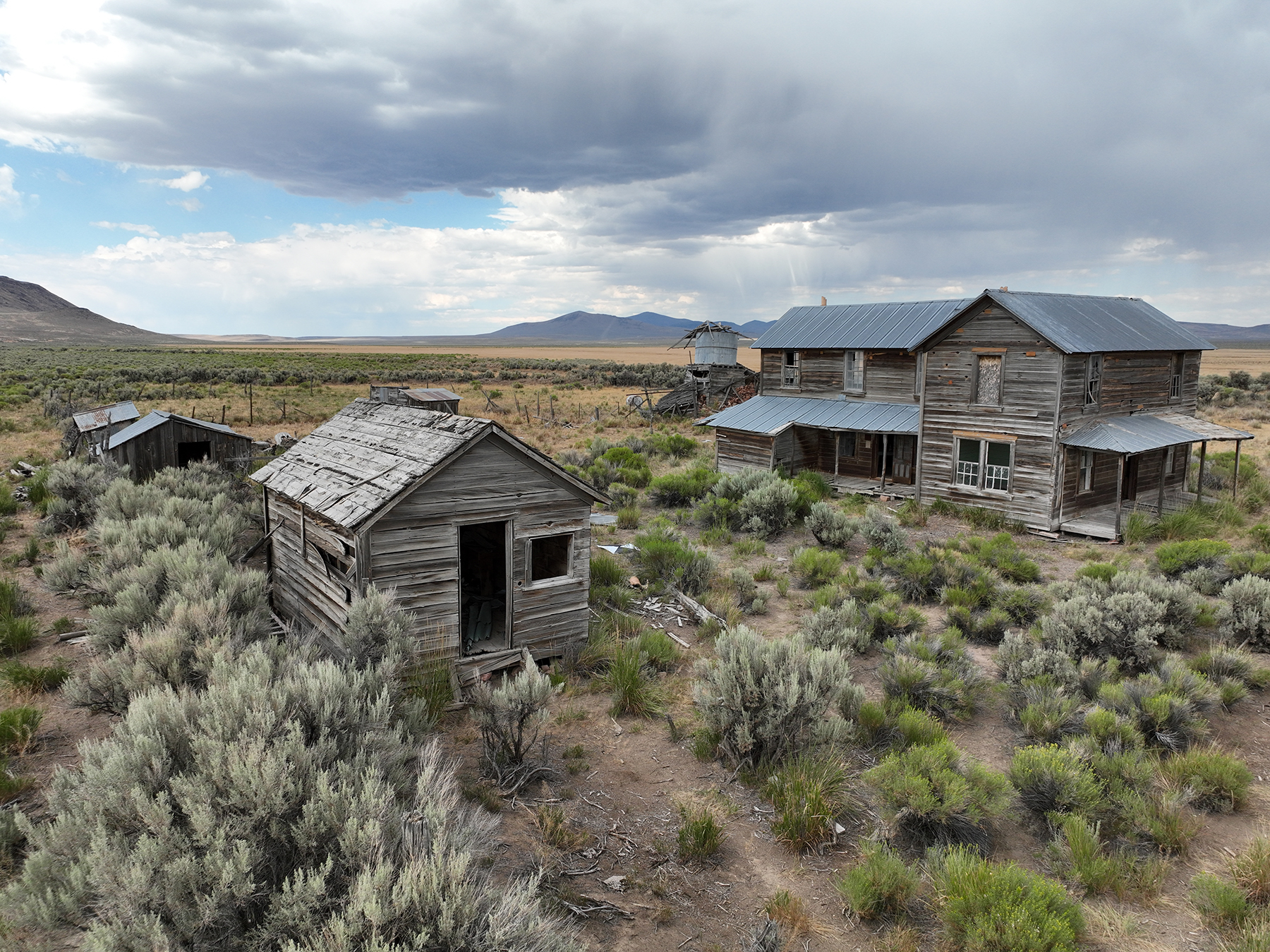
Welcome to Shirk Ranch
Welcome to Shirk Ranch. We’re in the western United States, in southern Oregon. This particular stretch is known as the Guano Valley. As you can see, we’re very far from town. This is the high desert. One of the nicknames for this part of the state is the “Oregon Outback,” and for good reason. The land out here is beautiful, rugged, and lonesome. In a place so unprotected from the elements there’s not much shade, or shelter from the wind—you might not expect to find traces of human settlement. This makes Shirk Ranch, whose first structures were built in 1881, all the more extraordinary. Today you’ll get a chance to explore this historic place. You’ll learn about the rancher David Shirk, his family, and a way of life that feels far removed from our world today. You’ll also hear about the surviving structures here, and the plant and animal life in this region.
Stop 1. A Vital Landscape
Shirk Ranch’s isolation is a key part of its identity. To give you a sense of just how remote this spot is, consider this: to get here from Lakeview, the county seat, you’d have to drive 56 miles east on the state highway, then twelve miles to the north on a dirt road. Out here, the summers are hot and the winters are cold. The climate is semi-arid—it rains less than ten inches a year—and the vegetation is primarily sagebrush and native grasses. In the old days, you’d have to have some real grit and backcountry skills to make it in a place like this. Nevertheless, people did—archaeology suggests human presence in the area more than 10,000 years ago. Many Northern Paiute communities continue to recognize this area of Oregon as part of their ancestral lands. In the second half of the 19th century, they defended this land, first from neighboring tribes, then, in a number of brutal battles, from white settlers and the US military. The place we now know as Shirk Ranch was homesteaded by the Hill family in the early 1880s. In 1883, it was purchased by David Shirk, a successful cattleman who selected the property for a horse-raising business. Many of the structures you’ll see today date back to Shirk’s time. So what was it about this place that appealed to David Shirk? He’d become familiar with the area during his years as a cattleman, when he drove huge herds from Texas to Oregon. As far back as 1876, he started successfully making claims on land in this valley. Its beauty was certainly appealing—he writes lovingly about the place in his memoir but on a practical level, it offered the perfect conditions for raising livestock. Though it may not seem like it, the area is actually abundant with water, with Guano Creek flowing into the valley from a canyon in the west. Also important to Shirk was the abundance of sagebrush, which grew several feet high. In winter, it grew above even the heaviest snow, and kept his livestock well fed. During an 1878 armed resistance of native tribes—the Northern Paiute, the Bannocks, the Yakima, and Umatilla among them. Shirk’s decision to remain on the ranch proved decisive. Shirk notes in his autobiography that neighboring properties vacated by settlers were often destroyed in the battle.
Stop 2. Who Were the Shirks?
Before we enter. It might be good to know a bit more about the sharks. David grew up on a farm in Indiana. At 22, he left home to travel the country, working in Missouri, Idaho and Colorado. Eventually, he wound up participating in the long cattle drives that secured his reputation. David married Frances Crowe in 1877. She was, according to David, an excellent horse rider, very skilled with the rifle, a superb cook and the love of his life. They had four children, two boys and two girls. He lived with his family here at Kirk Ranch for many years before settling in Berkeley, California. David sold the ranch in 1914 to Private interests, but his daughter Olive, eventually bought it back together with her husband. Olive worked the ranch until her husband's death in 1945. Sherk was very much a man of his era. He believed, as most white settlers of the time did, that in order to settle the West or bring it under their control, they would need to eliminate or at least forcibly remove indigenous populations. David Shirk was a talented and resourceful rancher with a knack for living off the land. But his successes undeniably rest on this history of violence and forced removal of indigenous people.
Stop 3. Making a Home
This is the two-story main house. The horizontal pieces are weatherboard, and there’s a metal roof that’s replaced the original wood shingles. Historians date this building back to David Shirk’s time, somewhere between 1883 to 1914. The original paint was white. This would have been the center of domestic life for the Shirks—both in David’s time and when Olive took over. The interior bears traces of several eras: there’s the original hardwood floors, but also carpet, vinyl flooring, and imitation brick likely from the 1980s. There are four bedrooms in total: two upstairs and two down. While much of the house is original, at some point the rear of the building was extended to accommodate a larger kitchen.
Stop 4. Life on the Ranch
According to his memoirs, David Shirk didn’t consider his ranch hand as second class citizens. They ate with him in the main house and upstairs in the large rectangular room, he installed a billiard table so they’d have something to do during the long winter evenings. Have a look around. And as you do, imagine the scene back in short time, perhaps on one of those winter evenings, you might hear the wind whistling through the cracks or some juniper logs crackling in the fireplace. You might hear laughter from upstairs, or smell something good on the stove.
Stop 5. An Abundant Ecosystem
If the human history of Shirk Ranch seems a little brutal, we can refresh our view by looking at the local flora and fauna. Two rare forms of buckwheat grow here—one is Crosby’s buckwheat, named after Virginia Crosby, the botanist who discovered it. There are also sagebrush and bunch grasses, and the awesomely named grimy ivesia, which is part of the rose family. Blue camas, white yampah, wild iris, and basin wildrye also grow here in the valley. And in May and June, wildflowers spring up in the nearby canyon and in the uplands. The animals are definitely here too. Mule deer, pronghorn antelope. Guano Creek has a variety of the chub fish, and provides a food and water source for migrating birds. Some even nest there. In the valley, you might also encounter coyote, badger, pygmy rabbit, weasel, and skunk, among other mammals, or fence lizards and western rattlesnakes. There’s even a local bat colony that makes use of Shirk Ranch, sleeping upside down in the empty structures.
Stop 6. Gravesite
There was something undeniably harsh about life in the old west. Whether seized by force or acquired through legal processes, land—especially land with access to water and food—was ruthlessly defended. Guns were plentiful, and disputes were frequently settled by violence. Outside the main ranch complex is this gravesite. Its headstone reads: Here lies Bill Vickers and J. Gruenke, Shot August 14, 1887. There have been conflicting accounts and much speculation about what exactly happened. One local oral history says that Vickers was a murderer who had escaped from jail and was on the run. He was joined by Gruenke, and both of them wound up on Shirk’s Ranch. Apparently they were killed at Shirk’s dinner table by a deputy named Dunning, perhaps with Shirk’s help. It doesn’t seem likely that we will ever know the full truth. Sometimes, people’s theories about what happened, when not backed by evidence, reveal more about their own minds than the actual events.
Stop 7. Layers of History
What is this feeling we have, looking at the remains of a once-thriving ranch? Learning its history certainly helps imbue it with life again. No doubt the stories and experiences of David Shirk, his family, and the many who worked the ranch still resonate in the structures that remain. We can imagine the lives they led, we can walk the paths that they walked. The layers of history are on dramatic display here. Every coat of paint, every change in the roofing or fencing, every ad-on and artifact offers a glimpse of the property’s many identities over the years. Visiting Shirk Ranch, we can’t help but reflect on the passage of time. What was once a successful ranch is now also home for bats and other animals. It reminds us that all things change. Thanks for visiting Shirk Ranch, and should you find yourself out this way sometime, stop by.