Sloan Canyon Petroglyph Site
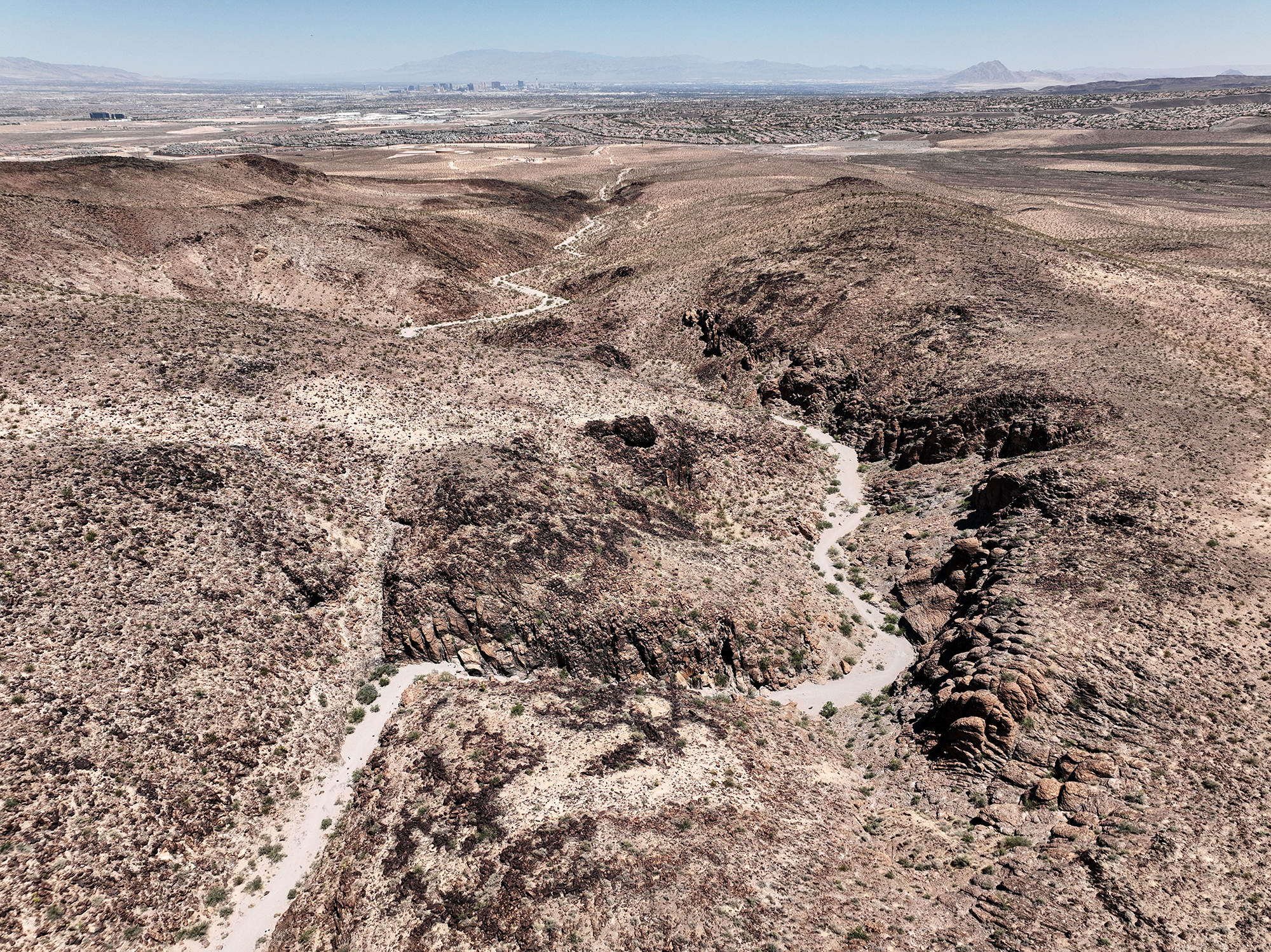
Welcome to Petroglyph Canyon, part of Sloan Canyon National Conservation Area, located just south of Las Vegas in southern Nevada. Since time immemorial, this place has served as an important passageway for Native people, plants, and wildlife in the Mojave Desert. Explore this history and the life that continues to thrive here through some of the hundreds of examples of rock writing in the canyon Along the way, you will hear from experts and the descendants of those who made their lasting mark on this place.
Stop 1. An Indigenous Highway
Leaving behind the city of Las Vegas to the north, we enter Petroglyph Canyon, part of the North McCullough Wilderness. For thousands of years, this has been a significant path for Native people traveling throughout the Mojave Desert region. As we enter Petroglyph Canyon, we cross over six dry waterfalls that each represent a different volcanic eruption that has shaped this landscape. As we enter, rock writing on the north side of the canyon shows what may be a burden basket, significant to the story of emergence for Southern Paiute, or Nuwuvi people. Its location between the canyon and the Las Vegas Valley provides insight into how this place is connected to the emergence and ongoing presence of Native people in this land.
Bridget Sandate
I see Sloan Canyon as a corridor or what I like to call an Indigenous highway. We know the landscape already. The landscape was set for us to be here. So when we left the mountain, we did come back. We would always come back. We were known to be visitors. We were known to travel with the seasons because the pine nuts, the pine nuts in Mount Charleston are ready at certain times. But while those are ready at one time, other things in the are ready to be harvested, to be preserved, and to just go find deer as well. A lot of us would follow the patterns of the deer because you don't want to stay in one area. When you stay in one area, you are sucking up all of the resources in that area. And you want to give those areas time to replenish to come back to. So visiting is not unknown to Chemehuevi. So constantly coming up here into the Vegas Valley was very well known. And I do believe Sloan Canyon was that corridor for us. It really connects the desert into the Vegas Valley into Mount Charleston. And you're protected. The canyon walls are protecting you in more ways than one. But not just protecting you, it's providing for you.
Chris Spotted Eagle
Everybody's got a different, you know, which story they like and there are different variations of our creation story depending on what tribe, you know, what tribe you're listening to or even what family. But the one I'm fond of is, so the earth in its infancy, of course, we have our creator who created all of us. And at the time, we were ants. We were servants of each other. We were servants of the land. And our creator told us that a big flood was going to come as the same flood tale has been told in a lot of cultures and in a lot of religions and a lot of different human groups around the world. There's a big flood coming and our creator told us, those of you that are serving me and are go up into Mount Charleston because the flood's coming and when the water subsides, I will gift you the greatest gift that I can give you. And those of us that listened at the time, we were ants. We listened and there were some of us that didn't and perished. And our creator, after the waters recited, he gifted us with two legs, two arms and made us human beings. When we came out of the mountain, we were human beings. And that's the story I like and that's the story I tell. And folklore being folklore, you know what I mean? So that's the one that kind of rings to me.
Annette Bennett
The dry waterfalls do give this feeling that you are going through a doorway of sorts. It is a path that you are traveling along and in order to get to the library, you have to climb a larger and larger dry waterfall. It's part of the experience really of getting to the site.
Stop 2. Guardians of the Canyon
The final dry waterfall marks the entrance to the canyon from the north and the beginning of the highest concentration of rock writing in the area. The Canyon, also known as the Library, is home to over 1700 individual examples of rock writing carved into the stone. In addition to writing, the canyon is home to a significant rock formation of a tortoise. On the east side of the canyon, the tortoise looks over the canyon, perhaps a guardian watching over those who move along the path. For many Southern Paiute people, the tortoise is an important animal and resource. Two tortoise formations were located above the canyon, but in 2021, one was destroyed by unknown causes. Please visit Petroglyph Canyon and other places like this with respect by staying on the trail, refraining from touching the site, and from this place, only taking pictures.
Bridget Sandate
Some of the petroglyphs in and around Sloan Canyon are very significant. I feel a lot of the singular circles that you find scattered all throughout the canyon up high and down low. It's been told to me that a lot of those circles symbolize the eyes. It's the canyon looking at you and making sure that you're respecting it because that's how you're supposed to treat these places and that's how you're supposed to act in these places with the utmost respect for them because they're watching you. They're watching us and they're making sure that we behave.
Chris Spotted Eagle
My grandfather is from Moapa, which is about 50 miles north of here. My grandmother is from here in Vegas, so I got kind of a foot in each pond. I really take pride in the fact that I'm kind of a son of both areas. I've lived in both communities, so my people in Moapa are of the Bighorn Sheep people, and then my people here in the Las Vegas band were the Turtle people. And even on my medallion I wear today, there's a turtle on there, and it has a lot of significance. That's kind of our resiliency. You know, a lot of people are like, well, you couldn't have picked a bear or a wolf or a horse or these things, but for us here in in this area, the turtle has the significance for us because it's lasted as long as we have, and it's done the best with the resources that this land has given us, you know. So those turtles, especially, you know, some folks that I've talked to in the Sloan Canyon have said that they're just natural formations. I kind of don't follow that point of view. I'm not saying that we made them, but somebody created them in a likeness that's close to one of our brothers and sisters. You know, it's heartbreaking. This is one of those images that's heartbreaking for me because I remember when the two images, the formations were there and now there's only one, and especially the one is gone now because of human touch, you know. That's really the heartbreaking kind of areas of the canyon that we need to do better with.
Annette Bennett
When you come into the canyon and you get up the final waterfall and you come around the corner, the tortoise is overlooking you. It is overlooking the canyon and it's facing roughly west, overlooking the petroglyphs, and it feels a little bit like you're being protected. I went up to that canyon several times, many times, in my first couple years here, and there were two. You come up and around and you're greeted by two tortoises. That first time I went up there and the other tortoise was missing, I did cry. It felt like a loss. It changed the entire feeling. Even to this day, five years later, I still sometimes look up there and I hope that the other one will just magically reappear because it still feels like a hole. These are irreplaceable and it's really important to enter these places with respect and knowing that it is so easy, even though these are rocks. We can often think of rocks as something that is solid. It doesn't disappear, but these things can disappear. When they do, it changes the entire feeling of a place. When you enter these places, enter them with respect and really a sense of reverence for what is there.
Stop 3. Connection to Nature
As we enter Petroglyph Canyon, views and sounds of Las Vegas quickly disappear. Even though it feels quiet, the desert is full of life. Many kinds of native plants and animals live in the canyon. You might see desert bighorn sheep, desert tortoises, many types of birds, and lizards such as the chuckwalla. While there is no definitive interpretation of the rock writing in Petroglyph Canyon, some of the imagery echoes the life that continues to thrive at Sloan Canyon. Those who carved the images into the stone understood the desert and the importance of respecting the balance of its ecosystem.
Bridget Sandate
While in Sloan Canyon, I've seen a ton of bighorn sheep. We saw a lot of different lizards, specifically the chukawalla. It's a grocery store. It's a hospital. There's so much medicine in and around it, and especially in Sloan Canyon. There's medicine, there's food, and then to see the petroglyphs reflect that as well by seeing the tortoise shells, seeing the kind of lizard -like petroglyphs, and then seeing the bighorn sheep as well because all three of those, the chukawalla, the tortoise, and the bighorn, were used as a food source. And so to have that food source around you constantly, you know where your food came from, you know how to gather it, you know how to prepare it all within the same area. So fresh is best. And yeah, just having it right there is incredible. And then to see that reflected in the petroglyphs as well just really solidifies what the area was used for. So to me, the desert is a grocery store. It's a hospital. It's a church. And that's why these places need to be treated with respect, and they need to be protected.
Chris Spotted Eagle
The bighorn, you know, that's such a significant animal and brother and sister to us, relative to us. And the fact that they're still in the area of Sloan Canyon is amazing. You know, I know the herd or the numbers aren't, you know, of course, what they used to be, but they're still there. And that, I think, that connection, again, the fact that we can talk about them and not in the was or were tense, but in the actual present day, I think is significant, especially for that. And the chuckwalla as well, you know, and just some of the plants and the animals that are Indigenous to the area as well. I think that keeps that relative connection for us, even in this modern day. And again, for all that visit there.
Stop 4. Life Cycles
Moving further into the corridor with the steep canyon on either side, it is easy to think of this place as a time capsule. But if you take a closer look and listen to the small sounds of desert life, the rock writing reflects a living landscape that is in constant fluctuation around life cycles, short and long. People from all stages of life likely would have passed through Sloan Canyon. Today, Sloan Canyon is also where the Nuwuvi Salt Singers come to honor those who have passed. For descendants of those who created the rock writing, visiting these places is an essential part of keeping the energy and cultural connection alive.
Bridget Sandate
Kind of going back to being humbled by it. I am really humbled because I'm grateful in the space that I'm in, but also knowing that their hands were there, their bodies were there, all throughout that connection is within me. A lot of the work that I do encircles around language revitalization and not having many speakers, I really have to put effort into language every single day, not having people to talk to. And because our traditions are oral traditions, I can't rely on books and other resources to keep that up. So when you go into these spaces to be able to see those things that connect with my language really helps that reinforcement of our language, to be able to look at the bighorn sheep petroglyphs and say, that's a nog, to be able to see the tortoise shells and say, that's aya looking at us. It really brings the language full circle because I believe language is the gateway or the doorway to culture. And it's almost, it's a gateway to our culture and to our spirituality. So in Sloan Canyon and seeing all those petroglyphs and being able to use language around them, that's what these places really crave. They crave hearing the people visit and they crave hearing the people talk. And a lot of our beliefs are when you go into these occupied spaces and you speak language or you sing song, sing songs, they come alive. So we always say these places are dormant or sleeping, but until Paiutes can actually come and occupy the space, then they come alive. So this is why these places need to be protected because we can't just go anywhere. We have to go to these certain places and occupy them.
Chris Spotted Eagle
They speak of these places, or even speak of us as the Indigenous, it's always a was or were. And when it's told through our voice, through our mouths, through our eyes, through our hearts, it's no longer was or were. Those sites, these sacred sites, they need us. Really, everything to us natives has a pulse. It has a being. It has energy. We need to be there to gather that energy, but not only that, but if we don't, you're getting what we have now. It's just getting more dormant and kind of darker. The light, for me, kind of seems like it's getting dimmer, but it's us as human beings. We need to get out there. We need to come with good hearts. We need to come with good, sound minds. We need to come from a good spirit, and we need to connect with these areas.
Stop 5. Waypoints
As we reach the end of the main corridor of rock writing, its abundance in this part of Sloan Canyon provides insight into its significance as a place that people have continuously passed through and visited. It is a corridor that connects the Las Vegas Valley with other regions, creating a route for trade and migration, connecting diverse Native communities with one another. It is part of the Salt Song Trail that traverses Nevada, Utah, Arizona, and California, and includes significant landmarks such as trading routes, gathering sites, sacred areas, and broader cultural landscapes. For ancestral people and their descendants, Nuwu sense of direction is key for understanding these ancestral sites and landscapes.
Bridget Sandate
I feel like a lot of the direction means something, especially with the anthropomorphic ones. Even though they're all etched onto the west side of the wall, they're still facing eastward. And so east is really significant to the Paiute people. It's how our singers sit whenever they are doing funeral services or the "Yagap". Also the way we bury, you know, when you wake up, you greet the east sun. So the east facing things really captured my eyes. And I feel there is some deeper meaning having so many concentrated on the west side looking east. There has to be something there.
Chris Spotted Eagle
Well, it's part of our salt song trail, and I don't know how familiar you are with the salt song ceremony, but it starts up here in our creation area, up in the Mount Charleston area, the Spring Mountains area, and goes down into the Sloan Canyon area and into California and the Barstow area, and goes out onto the coast, comes back in by the Salton Sea, 29 Palms area, and then kind of does a little zigzagging back and forth over the Colorado River, collects those songs. Right now, we currently sing about 115 to 120 songs throughout the ceremony. The ceremony itself is the funeral ceremony for when one of our people pass to the other side. There's about a dozen of us, myself, my son, my uncles, and my cousins, and some relatives up north. We now have a collective of about 12 to 15 singers, and we travel wherever we're called to perform the ceremony from dusk till dawn. Within that, we sing these songs, and Sloan Canyon being a part of those songs, because collectively, these songs were collected on this path, on this salt song trail, so they're incorporating a lot of different languages from tribes that are connected on that trail. They're not just songs in Paiute. They're in all different dialect through the tribes that are connected to the trail I'm talking about. Sloan Canyon is evidence of that, of a collective of our sister tribes, our neighboring tribes, our relatives that maybe Shoshone or Chemehuevi or Mojave are all these that are connected to this area. That's where we kind of collectively met and traded. It was one of the routes that my ancestors thought it was important enough to gather there, and that's why, as a salt singer, this area is very, very important.
Stop 6. Transitions through Time
Just as the desert life at Sloan Canyon changes with the seasons, the rock writing in Petroglyph Canyon reflects transitions that people have experienced here over time, such as imagery of a person riding a mule. European settlers arrived in the Mojave Desert later than in other areas of what became the United States, likely because of the seemingly challenging and remote environment. European settlers took advantage of existing trails and trade routes established by Native communities to move further into the Mojave region.
Bridget Sandate
So the Old Spanish Trail, from what I know, is an original indigenous highway. It's an original trade route that connected us through Nevada into California that eventually settlers coming into the west, mainly to mine for gold, ended up using it and unfortunately it doesn't have a good history behind it. It was used quite often as a Paiute slave trade and there's a lot of really bad things happened on that highway. So seeing Sloan Canyon and the occupancy that took place in that, I feel we eventually moved our own trade route into Sloan Canyon to avoid everything that was happening on the Old Spanish Trail.
Chris Spotted Eagle
The person riding what looks like a horse, you know, I mean, that's that's kind of you've got a kind of a little timetable right? Of now, okay, we have European contact now, you know and what our Ancestors saw kind of through their lens, of you know, but what was coming, you know, I think that that's kind of a you talk about that time capsule type. What some people might get from the canyon I can see where that that can come from when you have images like that, you know, and that's kind of a you know significant. You can kind of see some of the turning of the times when you get images like that.
Annette Bennett
When we talk about history, we look at things as prehistoric and historic, and that is very often a very delineated point, almost like there is a stop in the time and in human existence. There's a before and an after. But within Petroglyph Canyon, we have a few petroglyphs of Spaniards on mules in a mule train, which shows that middle period, that it was a transition period where it wasn't just no Europeans to Europeans. The Tribal Nations at the time continued to live. They continued to do a lot of the things that they had done for millennia beforehand, and these are probably some of my favorite petroglyphs because they remind us that with the arrival of Europeans, the Tribal Nations did not just disappear. They were still here, and they are still here today.
Stop 7. Learn More
Sloan Canyon is a landscape that remains significant for many Tribal Nations and descendant communities whose ancestors are part of this place. It is also a critical habitat essential for maintaining a healthy desert ecosystem. We encourage you to continue your respectful exploration of this place and support and learn more about the communities and organizations that work to carry on its legacy.