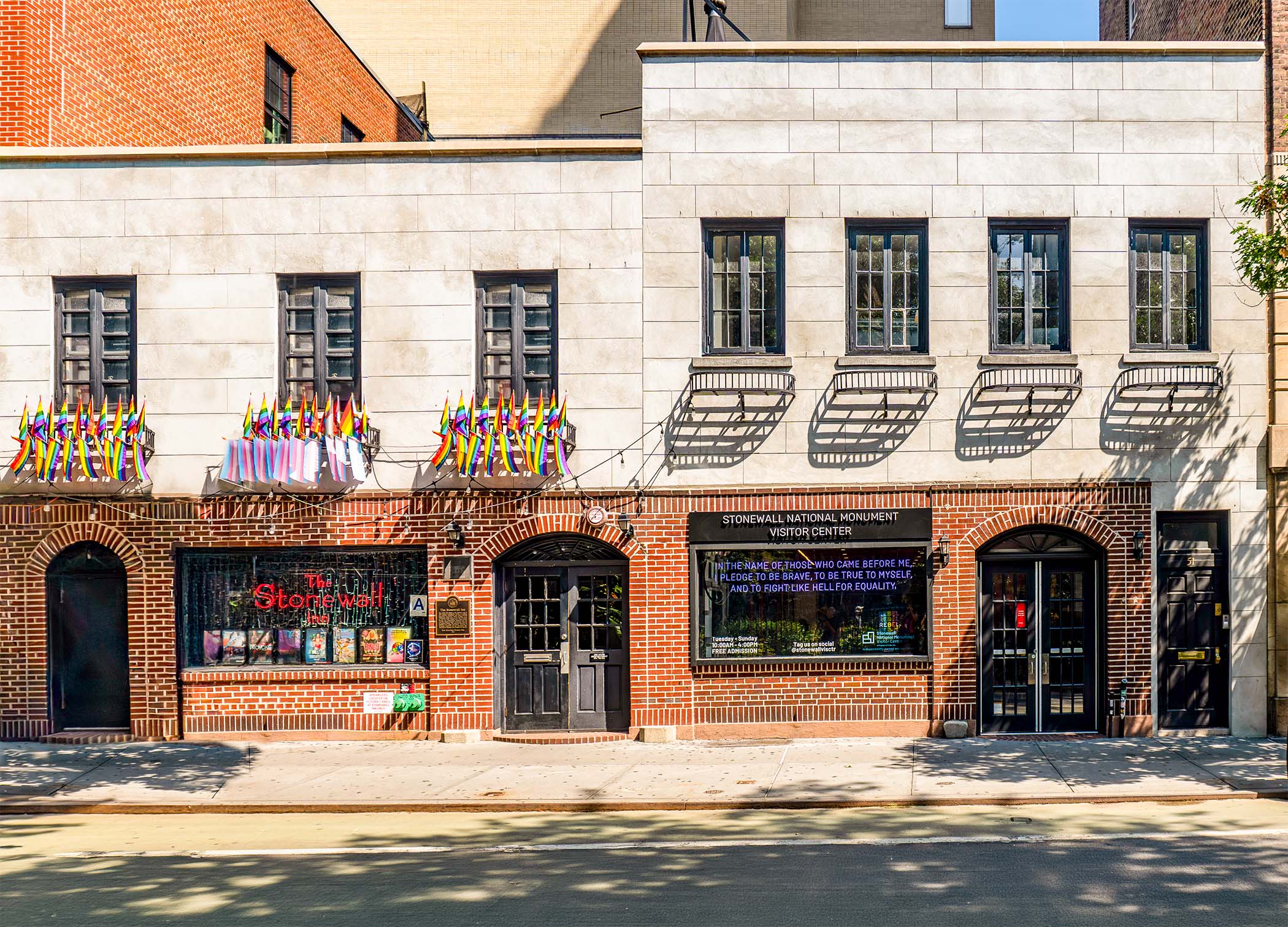
Stonewall National Monument
In the heart of Greenwich Village, Christopher Park and the Stonewall Inn mark one of the most important places in LGBTQ+ history. In June 1969, a police raid at the Stonewall Inn sparked several nights of resistance in the surrounding streets. The uprising brought together gay men, lesbians, transgender people, drag queens, street youth, and others who had long faced harassment, arrest, and exclusion. Stonewall did not begin the fight for LGBTQ+ rights, but it helped transform it. In the years that followed, new organizations formed, the first Pride marches took place, and Christopher Street became a symbol of visibility and liberation around the world. Today, Stonewall National Monument is the first and only U.S. national monument dedicated to LGBTQ+ history. This place invites us to explore a small city landscape where people gathered, resisted, and helped change the course of American history.
Stop 1. Christopher Park and the Village
You are now standing in Christopher Park, a small triangular park in Greenwich Village, directly across from the Stonewall Inn. This modest space sits at the center of a much larger story. For generations, Greenwich Village offered room for people who lived outside the expectations of mainstream American life: artists, writers, political radicals, gay men, lesbians, people who might be described today as transgender, gender nonconforming, or non-binary, and others searching for community. By the 1960s, Christopher Street had become one of the city’s important gathering places for LGBTQ people. Bars, clubs, street corners, and parks offered connection in a world where discrimination was built into daily life. In June 1969, this small area became the stage for a confrontation that changed history. What began as a police raid at the Stonewall Inn became a multi-night uprising and helped ignite a new era of LGBTQ activism.
Ken Lustbader
We're in the heart of the West Village in New York City. Standing in front of the Stonewall Inn at 51 and 53 Christopher Street. Um, the former Stonewall Inn was the site of the 1969 uprising that changed the course of, um, LGBT rights in New York City, and then eventually the country and the world.
Stop 2. The Stonewall Inn
In the early morning hours of June 28, 1969, police raided the Stonewall Inn. Raids on gay bars were common at the time. LGBTQ people could be arrested or publicly exposed simply for gathering in a place known to welcome them. Police harassment was part of a wider system of discrimination that limited where people could work, live, meet, and be open about who they were. The Stonewall Inn had opened as a gay bar in 1967. Like many bars serving LGBTQ patrons, it operated under difficult and often exploitative conditions. But it was also one of the few places in the Village where people could gather, dance, and find some measure of freedom. That night, the usual pattern broke. Instead of dispersing quietly, patrons and people gathered outside pushed back. The confrontation spread into Christopher Street and nearby streets, continuing over several nights.
Ken Lustbader
In 1993 there was the first attempt to have Stonewall made a National Historic Landmark. However, that had never been done before. And the response from the government was rather taciturn, saying LGBT history hasn't really been written. Maybe look at other sites other than a riot and come back to us. Well, a few years later colleagues came back in 1999 and were able to get Stonewall listed as a national monument. And that was the first national monument. It was done so with the cooperation of the State Historic Preservation Office and the National Park Service, due to the fact that Stonewall had such a huge influence. So even though at the time it was only 30 years after the period of significance, its influence was beyond that. So due to that, part they were able to get it on the National Register.
Kurt Kelly & Stacy Lentz
It's a living, breathing part of history, right? So it's not like a museum, but it teaches you and educates you about that, um, about, you know, the, the history and the importance, and it's still a focal point of activism. So what we've tried to do is keep it at a vehicle where it's still very active in the community. So not only is it a safe place, but it's also something that we're using that legacy and as a vehicle to go out and make global change. So this physical space and what Stonewall represents remains at the forefront of the gay rights movement, not just from 1969, but 50 years later in 2019.
Stop 3. Inside the Bar
Let’s step inside the present-day Stonewall Inn. The interior has changed over time, and the original Stonewall occupied two adjoining storefronts, not just the room we see today. But this space still helps us understand the setting of the uprising. In 1969, the Stonewall Inn was dark, crowded, and makeshift. The walls were painted black, the windows were covered, and patrons entered through a controlled front door. Inside were a coat check, two bars, a jukebox, and two dance floors. At a time when LGBTQ people faced police harassment simply for gathering, Stonewall offered one of the few places in the Village where people could dance together. The crowd included gay men, lesbians, drag queens, street youth, those who today would be considered transgender or nonbinary, and others who found community in and around Christopher Street. So while the room has changed, the essential meaning remains: this was a place where people came together, and where, in June 1969, another police raid became something much larger.
Ken Lustbader
Stonewall is the embodiment of gay rights in this country. In a sense it's a place that was a place of oppression and control. It was a mafia run bar that wasn't really that lovely inside. Where people went because they could go and socialize. It was one of the few avenues to sort of participate, meet people. So its meaning has changed over time. So today Stonewall is a place of celebration. It's a place that shows that resistance and activism can serve a purpose. Because it's where people fought back and protested against police oppression, mafia control. So it's very meaningful for people to understand that LGBT rights how they've shifted over time. And it's important to recognize it so people don't forget that there was a terrible time that people lived in 1969, Which is not that long ago, and that we need to recognize its history because it informs how we act today.
Stop 4. The Dance Floor and the Raid
On June 28, 1969, the raid began as part of a familiar pattern. Police entered the Stonewall Inn expecting another routine raid. Officers checked identification, questioned patrons, seized alcohol, and began making arrests. For many people inside, the danger was not only arrest. It was public exposure, humiliation, and the possibility of losing jobs, housing, or family support. But it did not unfold as expected. As police moved patrons outside, a crowd gathered on Christopher Street. People shouted, refused to leave, and began resisting. The officers retreated into the bar while the crowd outside grew larger and angrier. The uprising was not simply about one bar. It reflected years of surveillance, discrimination, entrapment, and exclusion. Stonewall shows how a single event can reveal deeper tensions in society, and how people pushed to the margins can turn public space into a place of protest.
Kurt Kelly & Stacy Lentz
So now if you're in Berlin, if you're in Sydney Australia, no matter where you are across the globe. Everything that actually started right here in this bar, that's why you have Pride. Because right after marking the riots was the first ever actually gay Pride march, which was from here, Stonewall, up to Central Park in 1970, called the Gay Liberation March. So that's why you have it. So that's a big part of it. So globally, when you celebrate Pride, you're celebrating it. Typically it's celebrated in June. It does happen all throughout the year, but a lot of the major cities have it in June. Always the last Sunday in June, because of the Stonewall riots and what happened in this very bar.
Stop 5. Streets of Resistance
From above, the streets around Christopher Park reveal an important part of the story. Unlike much of Manhattan, Greenwich Village does not follow the city’s strict grid. Its older streets bend, angle, and intersect in unexpected ways. During the uprising, this irregular street pattern mattered. People who knew the neighborhood could move quickly through side streets and around corners. Police trying to control the area found themselves outmaneuvered by crowds who understood the local terrain. Christopher Street, Grove Street, Waverly Place, and West 10th Street all became part of the unfolding resistance. Stonewall was not confined to a single building. It spread through the surrounding streets, turning the neighborhood itself into a site of protest. Today, the national monument protects Christopher Park, while the buildings of the original Stonewall Inn remain privately owned landmarks across the street.
Ken Lustbader
The activism that took place at Stonewall were in many parts by people who had the least to lose. They were people that were street kids. They were people that were of African American, Latino people of color and they knew the landscape here. They knew that they hung out across the street from Stonewall at Christopher Park. They knew that the streets dead ended or curved in certain areas, so they were much more crafty than the tactical unit and the police that were brought in in some ways from Staten Island, that only understood New York on a north south east west axis. Because of the village's curvy streets they really succeeded in fighting back over a number of days, which makes for a really compelling case. When the property was put on the National Register, our colleagues at New York State Historic Preservation Office used the Civil War battlefields as a point of criteria to make the nomination work. I think that just goes to the case that Stonewall really is going to be in the canons of American history, similar to how the Civil War changed this country for freedom and the same way that Stonewall changed it for American LGBT rights.
Stop 6. The First Pride March
One year after the uprising, on June 28, 1970, thousands of people joined the Christopher Street Liberation Day March. The march began near Sheridan Square and moved uptown toward Central Park. Today, it is remembered as the beginning of New York City’s Pride March. Earlier LGBTQ protests had often been small, carefully organized, and focused on respectability. Participants were sometimes expected to dress formally and present themselves in ways that would seem acceptable to the broader public. After Stonewall, many activists wanted something more visible and direct. They wanted to claim public space, speak openly, and demand equal rights without apology. The 1970 march showed how resistance could become organized civic action. It also helped create a tradition that would spread to cities around the world. Stonewall did not start LGBTQ activism, but it changed how the movement was seen, heard, and remembered.
Stop 7. The Mattachine Society
At 59 Christopher Street, just a few doors from the Stonewall Inn, the Mattasheen Society of New York once had offices on the second floor. The Mattasheen Society was one of the early gay rights organizations in the United States. Along with groups such as the Daughters of Bilitis, it challenged laws and social attitudes that treated gay and lesbian people as criminals, threats, or outsiders. In the years before Stonewall, these groups were often called “homo-file” organizations. Their activism could seem cautious compared with the liberation movements that followed, but their work required real courage. They organized meetings, published newsletters, challenged police harassment, and argued that gay and lesbian people deserved dignity and equal treatment under the law. This earlier activism is important because it reminds us that Stonewall was not the beginning of the movement. It was a turning point built on years of organizing, risk, and persistence.
Stop 8. Gay Liberation
Christopher Park is home to Gay Liberation, a sculpture by George Segal. The work shows two standing men and two seated women in quiet, everyday poses. They are not shown marching, shouting, or confronting police. Instead, the sculpture presents LGBTQ people as present, visible, and ordinary. For some, the sculpture became an important public recognition of LGBTQ life and love. For others, it did not fully represent the diversity, anger, danger, and complexity of the Stonewall uprising. That debate is part of the history of public memory. Monuments do not simply preserve the past. They also raise questions about whose stories are remembered, how they are represented, and what future generations are asked to understand. Stonewall National Monument asks us to look closely at a small city block and see a larger struggle for civil rights, visibility, and belonging. It is a place where people gathered, resisted, organized, and helped change what was possible.
Ken Lustbader
Clearly places matter. Our country is founded on visiting historic sites, whether it's Mount Vernon or Mount Rushmore, or places of family or graves. So people now come to Stonewall to celebrate. So it's a way for people to connect viscerally, knowing that this is where an uprising took place and getting a better understanding on how that happened, given the topography of New York and the streets that are in front of Stonewall, and having people understand that there were six days of people fighting back, which really makes a compelling statement, and understanding how LGBT history is really part of the American narrative of obtaining rights.