Totem Bight State Historical Park
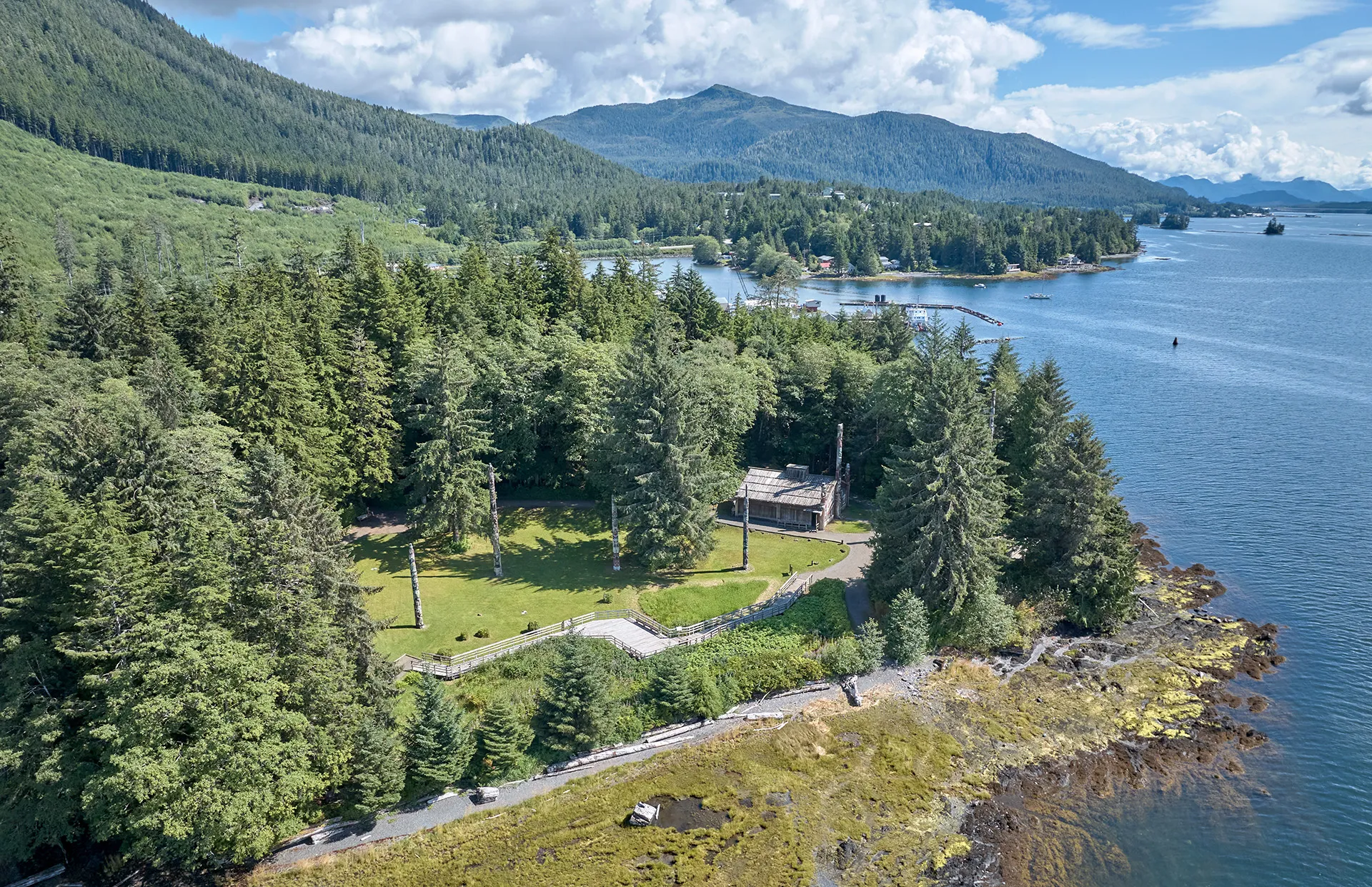
Welcome to the virtual experience of Totem Bight State Historical Park on the lands of the Saanya kwáan and Taant’a kwáan Tlingit in the coastal temperate rainforest of southeast Alaska. The park was created in the 1930s through the Great Depression-era program that hired Tlingit and Haida, men to restore totem poles from their ancestral villages for several regional “totem parks”. This park was strategically located along the water to be visible to those visiting by ship. Today, it also highlights people’s relationship with this diverse ecosystem. Totem Bight was a government project, but the poles you will see are deeply meaningful to the Tlingit and Haida people who created them and still claim their stories, names, and songs. In this experience, you will learn about the significance of this place from members of the different clans represented in the park, and witness the ongoing vitality of Tlingit and Haida culture in Southeast Alaska.
Stop 1. Place of Balance
As we enter the park, listen to the sounds of this place. Tlingit people have cultivated a relationship of balance and reciprocity with this landscape since time immemorial. Long before it became a park, this site was a fish camp where relatives gathered to catch and process fish for the coming winter. In recent centuries, neighboring communities of Haida and Tsimshian people have also settled in the region. When the park was being created in the 1930s and 40s, Indigenous communities in Alaska faced the loss of ancestral lands and pressure to abandon traditional cultural practices. Despite the circumstances, the landscape, totem poles, and clan house at Totem Bight State Historical Park show how people navigated these challenges and revived cultural practices in new ways. The Civilian Conservation Corps (CCC) project became a conduit for the cultural practices of carving and sharing the stories carried by the poles, both of which were at risk of being lost. As you explore, look for how Indigenous knowledge and concepts of balance have been maintained and passed down through this place.
Lee Wallace
The topic that we talk about at SHI (Sealaska Heritage Institute) is Indigenous knowledge. Those type of things that are passed down from generation to generation where you wouldn't get it any other place. And so for us to be able to share that Indigenous knowledge into Western ways, and saying here's what Western ways say, and here's what our Indigenous ways tell us, sometimes the same; sometimes they're better, but to be on equal ground, this is important.
Gloria Burns
Everything has reciprocity, and reciprocity is balance. And so I think that personally you can feel that through your whole body when it exists, and when it doesn't, you feel it through your whole spirit as well. And despite that this place came into being because of essentially the New Deal, and out of the space of loss, it has balance. It has a give and a take between it. I feel like you can walk those paths in all those spaces, and you can feel kind of where it reverberates in your spirit. And I think it's the space that they chose as well. That space has such a feeling to it. The land has such a feeling to it. When you walk down onto the beach right there in front, there's a trail there. You can feel — I feel as though I'm walking where ancestors have walked for millennia. Even though I know that those poles and those spaces weren't there, because that wasn't the place that they were traditionally supposed to be. And for me, I wonder if it isn't that those totem poles together make that space feel that way.
Stop 2. A Model Village
Look at the clan house and the totem poles you see across the landscape. The U.S. government created Totem Bight to be a "model village," loosely based on traditional villages, where visitors could learn about Southeast Alaska's Indigenous cultures. The park was created as part of President Franklin D. Roosevelt’s Civilian Conservation Corps New Deal program. This project hired Tlingit and Haida men to restore and recreate totem poles from former clan house communities impacted by the colonial era. The clan house before you embodies this vision. While traditional clan houses were home to a single Tlingit or Haida clan, this one reflects both Tlingit and Haida cultures in its design and construction. Similarly, different totem poles at the park are connected to Haida and Tlingit culture. At Totem Bight, and in this experience, you’ll encounter a variety of poles, including story poles, memorial poles, grave markers, and house poles like those on the clan house before you.
Lee Wallace
My connection with Totem Bight is very strong. My grandfather John Wallace took part in some of the totem poles out at Totem Bight. And also he had a connection; he was a head carver in the Hydaburg Totem Pole Project during the CCC days. And so other part is that the Forest Service had used him as a consultant on different projects. One being they consulted him on the construction of the Clan House. And also he had the opportunity to carve was it five totem poles out there at Totem Bight. So those are really strong for me because when I learned about the history of our family with the generation of Haida carvers that skewed my interest in wanting to pursue that when I was older.
Stop 3. Lineages Past, Present, and Future
As we enter the clan house through the circular door, notice the different levels. Like the totem poles, this clan house provides a window into the social organization of Tlingit and Haida communities.Typically, chiefs and their families would have lived on the upper level towards the back, while those with less status would have lived on the lower levels and closer to the door. Clan houses, like totem poles, are part of how clan lineages are understood. Large clans may have had more than one clan house. A house like this would have been home to multiple families, roughly 30-50 people. Tlingit and Haida are matrilineal societies where clan lineage is passed down through the mothers of each family. Important in maintaining balance, Tlingit and Haida clans are divided into two opposing groups called moieties: the Raven and the Eagle/Wolf. These sides are reciprocal, taking turns hosting events and ceremonies, ensuring all are supported. While people today no longer live in clan houses, these spaces are important for connecting younger generations with ancestral knowledge and lineage.
Lee Wallace
My father John, he was born in a clan house. He comes from a whole family of Haida carvers in his background. And so he was born in the clan and he probably built some clan houses. And so he was a consultant when they wanted to get to the part of constructing the longhouse at Totem Bight. And one thing he shared with them, being a woodworker and whatever kind of wood goes into the wet moist ground in Southeast Alaska and Northwest Coast, is you put a raw material in the ground. It's going to deteriorate quick. But one thing that they knew about indigenous knowledge is they charred the wood with fire, and they put that into the ground. And if you char it enough it's going to be a preservative, and it's going to have that red cedar, yellow cedar, last a lot longer than being untreated. And those were the days before all the petroleum products you could put on wood to make it preserve in a non harmful way, just simple wood burning, charring. So that's some of the knowledge he shared with the architects or the builders when they were building the clan house in here in Totem Bight.
Gloria Burns
I am the leader of a traditional Haida dance group. And part of that experience was that when Mary was the ranger, we would go and we would dance for the community once a month. I think we did that for 10, 12, maybe 15 years pre-COVID, and so it was what my family and my group did together. When you have like 32 dancers, kind of all trying to stick themselves onto the different layers, but when you're getting towards fall, like right now and it's getting dark, the whole place kind of gets spooky, without being spooky, and Green Bean Coffee always would donate like their coffee and then their homemade oatmeal cookies and their cookies, so it was just a time where our kids would load up on cookies and we'd do an hour-long performance, and it has great acoustics and a lot of times when people are recording and they would see these little orbs, these little lights all over, through all of our recordings, you know, so our ancestors are in the room and it was just the most fun, because for years locals would just be like, hey, what, what day is it? Are you guys dancing, and you had a whole group of us, family? It's just the most amazing experience, really.
Nathan Jackson
A lot of the polls that were put up in front was indicating what clan you're from. In the olden days you couldn't marry somebody from the same clan. You had to avoid breaking the clan system. Now I had made an error at one point not knowing. And pretty interesting, because this Native gal got off the fishing boat and she was a beaut. And where the potlatch was taking place in Klukwan 21 miles north of Haines. And I made an attempt to, since I saw her first, I was going to make a date. And as it turns out got up to Klukwan and the Ravens were on one side, the Eagles were on the other. And I noticed that she was on the Raven side and I started kicking myself. And I think I made a fool of myself as well.
Stop 4. Carving Totem Poles
The wooden building before you is the Restoration House, later built for carving and restoring totem poles. Historically, Tlingit and Haida communities relied on carving new poles rather than trying to preserve old ones.. To create a totem pole, a patron would commission a carver of the opposite moiety (Eagle/Wolf or Raven) to carve specific crests that the patron has the right to display. In the past, carvers would often make their own tools and use natural pigments found in the environment for paint colors. At Totem Bight, they were not able to produce enough paint with natural pigments, so they used house paints for the totem poles. When work on Totem Bight began in the 1930s, colonization had led to a significant decline in carving. While carving totem poles for the US government was controversial and strayed from typical social protocols, those involved saw opportunity in the shared goal of reviving carving practices. The lead carvers at Totem Bight included Haida carver John Wallace, and Tlingit carver Charles Brown. The carvers referenced totem poles that had been collected from former impacted clan communities from the colonial era no longer in use. Over the years, new generations of carvers have restored and recreated poles for the park, continuing the original vision of the project.
Lee Wallace
I had my first interest in carving. It was late, it was after I graduated from high school in 1970. And so really it wasn't until the early 80s when I started carving. From then I was looking at pictures in books, and really just trying to emulate what I seen. And later on in life it was a hobby of mine, but then really in the late 80s I wanted to pursue it as a career. Carving is for people who are pursuing it. I hear it over and over, it's a passion. It's something you just like, the excitement and the feel of taking a raw log and then start carving, and the images start coming out of a log, and I could only say it's a passion of mine. I could carve for hours like that, and I got reminded by my wife one time, she said it's about joy and pleasure, just to carve.
Gloria Burns
A totem Bight. It's sitting in this magical, beautiful place, like when you walk that land, you can feel the land like up into your bones, and then you can look at these totem poles and then you wonder, well, why these colors? Why this choice? But when you—when you think into it, because they had house paint. They didn't have the traditional paints. People were—had been forbidden from doing these things. You know, this important thing of telling a story and carrying on tradition, and having all this culture, and were reduced to house paint, and somehow got it done. I always think at Totem Bight and think this is a story of resilience. We can have it be a story of trauma and loss and all those things, but to think that all those hands that carved that space, all those people that were destitute in trying to feed their families—that that is really the significance of Totem Bite.
Nathan Jackson
The selection of the trees are probably from the mill. and so a lot of it is all piled up and you go through it and look at the end grain, look at what you're going to be using if it's got a lot of knots and stuff, if it's got rotten Red cedar is noted to rot from the center out. Most carvers end up just carving straight, but what I try to do is try to maintain the old look and in order to do that you have to have skill to be able to use the adze.
Stop 5. Pillars of Community: Story Poles
Totem poles record clan stories that are passed down through generations. The poles are living entities in Tlingit, Haida and Tsimshian culture. Story poles are visual aids that provide opportunities for those with authority and knowledge of clan lineages to share histories connected to important ancestors. The figures carved into the totem poles are crests that represent a house group to which each person belongs. These crests often reflect the natural environment, such as a killer whale, an octopus, beaver, bear, and raven. Each totem pole is a touchstone for a story that certain people have the authority to tell. While in this experience, you can hear abbreviated stories, much of the oral history connected to these poles is meant for those in Haida and Tlingit communities and cannot be easily interpreted.
Lee Wallace
The thousands of visitors that come to our lands. They have really no knowledge of what they're looking at. And so you could have really easily misconceptions of what they're looking at. Definitely the missionaries, when they first came, they had that great misconception of they were thinking that we were carving them and worshipping them. But in reality most of the poles were telling clan stories stories owned by the clans. And those clan stories, when I've looked at a lot of the Haida stories, I look at the clan stories, there's messages that you receive from the story. There's lessons to be learned from those stories. And so you really got to look at the history and look at the true meaning of the story.
Gloria Burns
In order to have totem poles you have to have trees that you can make totem poles with. And we are cultures in which we're telling our stories. So you have a storytelling pole, a mortuary, a memorial, a house post, and then one other, right? So you're telling all these different things through these massive pieces of wood that become totem poles. But we don't have a separate word for art. My mom loves to say, form follows function. Because we're weavers, I come from, generationally, I come from basket weavers. So every basket has a purpose. None of them were just meant to sit around. Clam basket, cockle basket, beach asparagus basket, berry basket. Like, everything was for functionality, but everything was beautiful at the same time. And it really is that the truth is so much of our spiritual beliefs are tied to our relationship with the land and relationship with our relatives who are from the ocean, are four-legged, are winged. And so that relationship, but it is not religion. And I think that is one of the issues that Western society really couldn't get around. They couldn't get around the idea in many places that these weren't false idols, that we weren't worshipping them in some way. Rather, they're telling our important stories and histories. And with a society that didn't have a written language, the ability to listen and the ability to repeat what you had heard in an accurate way that spanned generations was so important. And totem poles were an incredible way marker of what that looked like.
Stop 6. Remembering People and Events
Other types of poles at Totem Bight include memorial and grave marker poles. A memorial pole, such as the Halibut Pole that you see here, is raised when a clan leader dies. The pole is raised by the successor of the clan leader to transfer the status and titles to the new patron. Typically, these poles would be raised in front of the successor's house. Mortuary, or grave poles, mark the final resting place of high-ranking members of a clan. Typically, a person’s remains are placed within the pole in a box or compartment in the back. Two poles at the front entrance to the park are mortuary poles carved for Totem Bight. These include The Howkan Eagle Grave Marker pole, carved by John Wallace, and the Thunderbird & Whale pole carved by Nathan Jackson.
Lee Wallace
I'd like to talk about another totem pole. My grandfather John Wallace carved was the Howkan Eagle. That's currently at Totem Bight State Park. During the CCC days he was instructed by the Forest Service, Linn Forrest, to replicate the Howkan Eagle. I've got to say this: my grandfather John, he started his carving career. His first commission was when he was 12 years old to do a grave marker. Over in Kasaan he was carving during the CCC days in Hydaburg and the Ketchikan Park. He was in his late 80s. We had these vast years of carving experiences. Being a carver too, I've been instructed to replicate what was in the CCC days. As an artist sometimes you just can't really do that. You don't want to feel like you want to copy it. Although my grandfather was instructed to copy it, with his years of experience of carving, he wanted to do something different. So what he envisioned on the inside wing and the breast of the eagle, he envisioned a Chilkat robe. Your Chilkat robes also told stories, clan stories. The Forest Service, seeing his work, they were really kind of upset because they envisioned a copy, a replication of the original Howkan Eagle. I praise my grandfather for doing what he did to do what he was inspired to do. But sometimes you have that strife even in today's time.
Nathan Jackson
Thundering Whale pole. they're not very big pole. I think it was probably probably less than 10 feet. First of all, it's not a Tlingit pole, but it's a Tlingit story. And second of all, it's you know it was done by a Haida carver. And so just thinking about these things all the time. So it's kind of one of those things where you make a correction on your own. And that one in particular was that way with me.
Stop 7. Ceremonial Life
The totem poles that you see not only pass on clan histories but are central to ceremonial life, a critical part of how Tlingit and Haida culture is passed on today. Historically, when a totem pole is complete, the patron will organize a “cuee” a “potlatch” or pole raising ceremony. The patron who commissioned the pole will invite witnesses from the opposite moiety to the ceremony. Preparation for these ceremonies can take over a year. During ceremonies, clan leaders speak and display objects showing clan crests. The more ceremonies that a patron or clan hosts and totem poles they commission, the more honor comes to the individual or clan. Although different from the past, pole-raising ceremonies continue today.
Lee Wallace
Yeah once the project is complete. In the normal setting, in the right setting you do a totem pole raising, conducted by manpower, ropes and leverages, and it's all manpower and that's the most gratifying way to erect a totem pole. Once it's finished, I've been involved with a number of those. To do that you have to have somebody with the knowledge of how to do it, how many people you need to erect a totem a pole, having enough people there to pull on the ropes and people pushing from the back, and people in the back stabilizing the pole, but when you do it the traditional way there's community, and they're all participating and they're witnessing the event, And once the totem pole gets erected and you get it all secure by filling up the hole with rocks and dirt, and you're able to untie the ropes from the totem pole, That was a time where the clan was able to speak and tell you about the story of the totem pole.
Nathan Jackson
Now these ceremonies here, they're long lasting. I mean, sure. The one my first one I thought, oh man. They're really long speeches. And I said, well we got the pole and we're getting it up. And we all got a chance to see it. I don't think that I made I think my speech was just as short as I could possibly make it. But never mind how I felt at that point. It's up you know.
Stop 8. Passing Down Knowledge
The landscape at Totem Bight is an important touchstone for Tlingit and Haida culture. Though the US government's involvement in establishing the park changed social protocols around pole carving, it also created opportunities for younger generations to learn the craft — a tradition that continues today as lead carvers guide apprentices in their work. The ongoing carving of totem poles pass on the stories, knowledge, and ceremonial practices critical to Tlingit and Haida life. These poles are pillars of culture, so please visit Totem Bight and similar sites with respect. — Protecting them keeps this living heritage alive.
Lee Wallace
Where we come from, where we're going, that's really important for us. You know, in today's time, unfortunately in my time I wasn't raised around the language. That period of time where they were trying to squelch our culture, our art, our songs, our dances, you know those type of things, weren't really being done when I was a young child growing up because they want us to melt into the USA Western ways of life. But in today's time it's very important for us to continue our cultural, our language, our arts and our way of life. And actually this past summer my youngest granddaughter Johnsona, she was part of the carving project I did for the Kootéeyaa Trail. She's five years old and she helped carve and help paint. And she was there at the beginning when the log was delivered to the house. There was a blessing ceremony for the log and we start removing the bark. She was all part of removing the bark from the tree. And she was there to sweep up the carving chips and just being part of that. And so that was my goal for taking on the project, was to do it for my two youngest grandchildren, William and Johnsona. And that's what it's for, is we're doing things for our children, our grandchildren, our future. And so that was good, meaningful for us and the family.
Gloria Burns
Everything is connected to each other. And so you know it's really this concept for us. Haida says "yahguudangang," respect and that connection of everything. And so when you're looking at a space like Totem Bight and how things are connected, you can't have your ancestors without your babies. Like it's this continuum. And so when we're looking at a pole that is maybe the fourth, the third or the fourth recreation you know, redoing of almost the exact same design. It's almost trying to hold it still in time when that's not what our culture did. And so I think there is real power in having young people and elders and all those ages mixed in together amongst these pieces that essentially in a lot of ways as human beings, society is trying to hold permanent and still in one place, which is counterintuitive to community. So I think that when you have a community interplaying and whatnot, that is the way that you create that momentum and that change in there. Knowing that those two things are absolutely oppositely opposed, but our need to know our history so bad relies on them staying the same. It's just I love the state park in that it is almost, it's like all of our traditional values and all of Western society, and instead of going like this it's like going like this, And I don't know how it happens because it's not supposed to. There's this and there's this and they do not. And I think it's because of our philosophy here that kind of just has decided we're going to make this okay.
Nathan Jackson
At Creek Street here there was a fellow that was working doing art work. Nathan Jackson the last of the Tlingit carvers. I don't believe that I've had several people that have gone on and did work. Some have passed away, yes, but nonetheless you know I kind of feel it was an opportunity for me. And I think people seem to think that you know this is the end of the road type of deal. Well my son's still working and he's a better carver than his father. Now what does that mean? That means that there's improvement involved in his capabilities, but he's going to inherit all the tools that his father used to use.
Stop 9. Looking Forward
Gunalchéesh. Thank you for visiting Totem Bight State Historical Park. This place remains deeply meaningful for Tlinigit and Haida people who created the totem poles and carry on their living stories, names, and songs. We encourage you to visit this place and learn more about Tlingit and Haida culture. Tsu yei ikḵwasatéen — I'll see you again.