Story outline
-
Welcome to the Crossroads of Ukrainian History
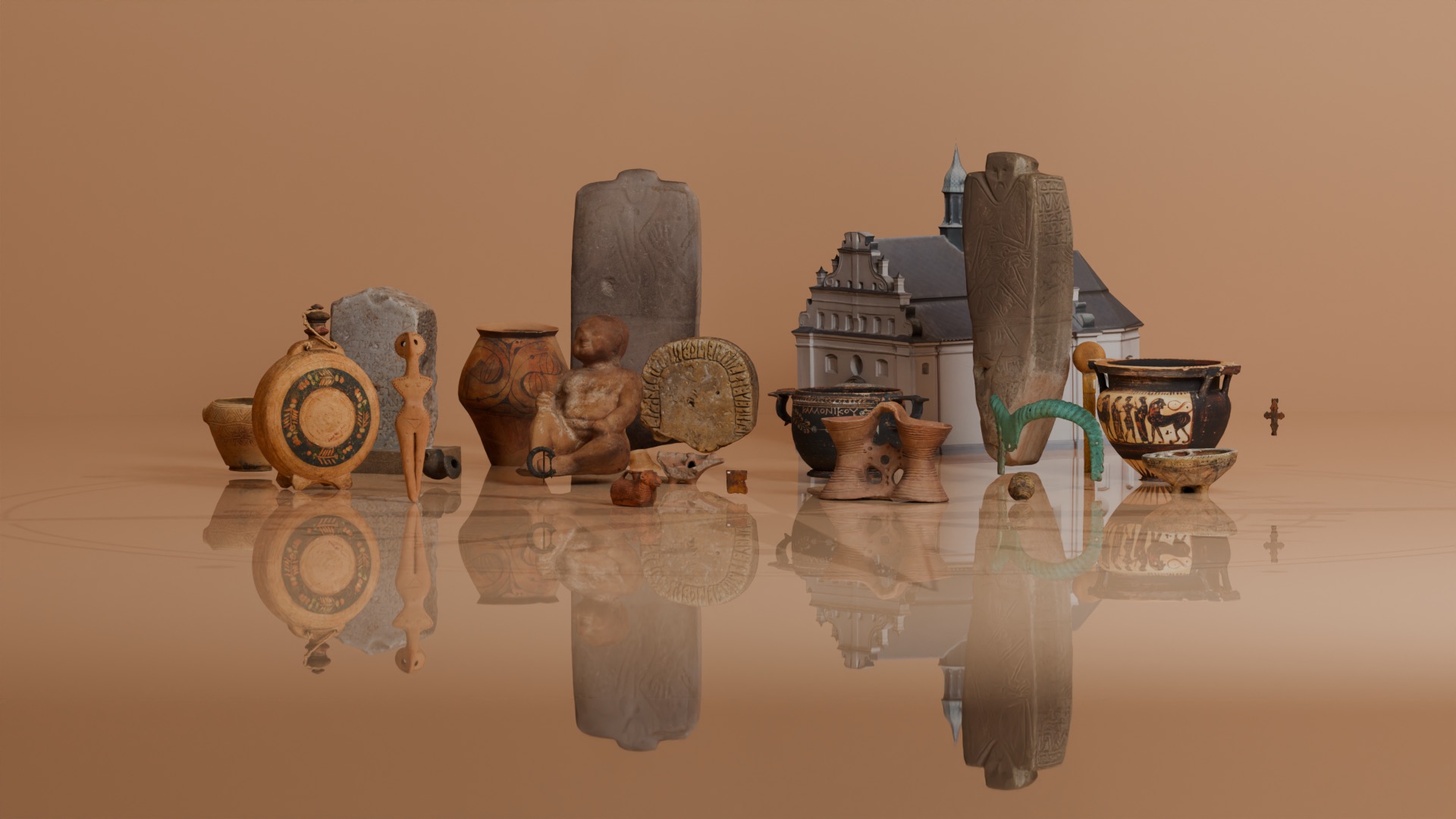
This virtual museum is divided into five rooms: North, South, East, West, and Center—each symbolizing the diverse cultural origins that have shaped Ukraine and contributed to its complex heritage and cultural identity. -
Stop 1. A Rich & Layered History
Ukraine’s vast landscape is a crossroad for civilizations, peoples, and ideas converging to form a unique cultural identity. Our journey traces its history from prehistoric settlements to the age of the Cossacks, all revealing how movement and exchange have defined the Ukrainian experience. -
Stop 2. Western Influences
In the West, the Cucuteni-Trypillian people of the Copper Age created ceramics adorned with intricate motifs, expressing one of the most sophisticated artistic traditions of their time. Their enormous “mega-sites” reveal early experiments in urban planning and communal life. -
Stop 3. Eastern Influences
In the East, the nomadic Yamna culture's burial mounds provide insight into the societal structure of the Early Bronze Age. These people laid the social and symbolic foundations for future civilizations to come. -
Stop 4. Southern Influences
In the South, Greek colonists introduced urban life, philosophy, and sophisticated art to Ukraine’s southern shores along the Black Sea. Their cities became centers for trade and cultural exchange, linking Ukraine to the ancient Mediterranean world. -
Stop 5. Northern Influences
In the North, the Viking-era Kyivan Rus’ united various cultures into a powerful medieval state defined by trade, law, and faith. This blend of Scandinavian, Slavic, and Christian traditions forged a multilayered identity that is still evident today. -
Stop 6. Ukrainian Center
In the Center of Ukraine, the Cossack social group emerged between the settled and nomadic worlds on the rapids of the Dnipro River. This social group established itself as a community of Ukrainian warriors and politicians that laid the foundations of future Ukrainian statehood. -
Stop 7. Lasting Traditions
Ukraine’s history is one of continual cultural influence, where ancient symbols, objects, and peoples echo through modern traditions. Each artifact and influence contributes to understanding Ukraine’s enduring identity and place in the world.
Voices
-

Vsevolod Ivakin
Head of the Department of Archaeology of Kyiv
Institute of Archaeology National Academy of Sciences of Ukraine
-
Anzhelika Kolesnychenko
Archaeologist and Museum Specialist
Institute of Archaeology of the National Academy of Sciences of Ukraine; The Cyprus Institute
Anzhelika Kolesnychenko is a research fellow at the Institute of Archaeology of the National Academy of Sciences of Ukraine. -
Svitlana Ivanova
Lead Research Fellow
National Academy of Sciences of Ukraine
Gallery
Partners




About the Project
The 3D artifacts featured in this virtual museum come from museums across Ukraine and were digitized through the Ukraine Heritage Dissemination Initiative (2023–2025), a collaboration between CyArk and Archaic that provided training, equipment, and hands-on technical support to Ukrainian museum professionals. Following training sessions held at Jagiellonian University in Kraków, project teams returned to Ukraine and traveled across the country to document collections at risk due to the ongoing war, capturing high-quality 3D data to support preservation, research, and public access.
We are deeply honored by the strength and dedication of the Ukrainian people and the museum professionals who continue to safeguard cultural heritage under extraordinary circumstances. We hope this experience helps illuminate Ukraine’s remarkable archaeological history and the many cultural traditions that have shaped it.
Related Links
Credits
This virtual museum was made possible with the generous support of Iron Mountain. We are deeply grateful to all participating Ukrainian institutions and partners whose collections, collaboration, and stewardship made this experience possible.
Content development, object selection, and 3D design were led by Simon Radchenko, Mariia Lobanova, Oksana Hrytsiuta, Dmytro Nykonenko, and Yurii Ezhel. We sincerely appreciate their creativity, professionalism, and time commitment throughout the development of this Tapestry experience.
Special thanks to Svitlana Ivanova, Vsevolod Ivakin, and Anzhelika Kolesnychenko for sharing their expertise through on-camera interviews, adding essential context and interpretation to the objects and stories presented here. Also, thank you to Dmytro Radchenko for composing the music used throughout the Tapestry experience. Additional support provided by the US State Department Ambassadors Fund for Cultural Preservaton and Jagiellonian University Krakow.