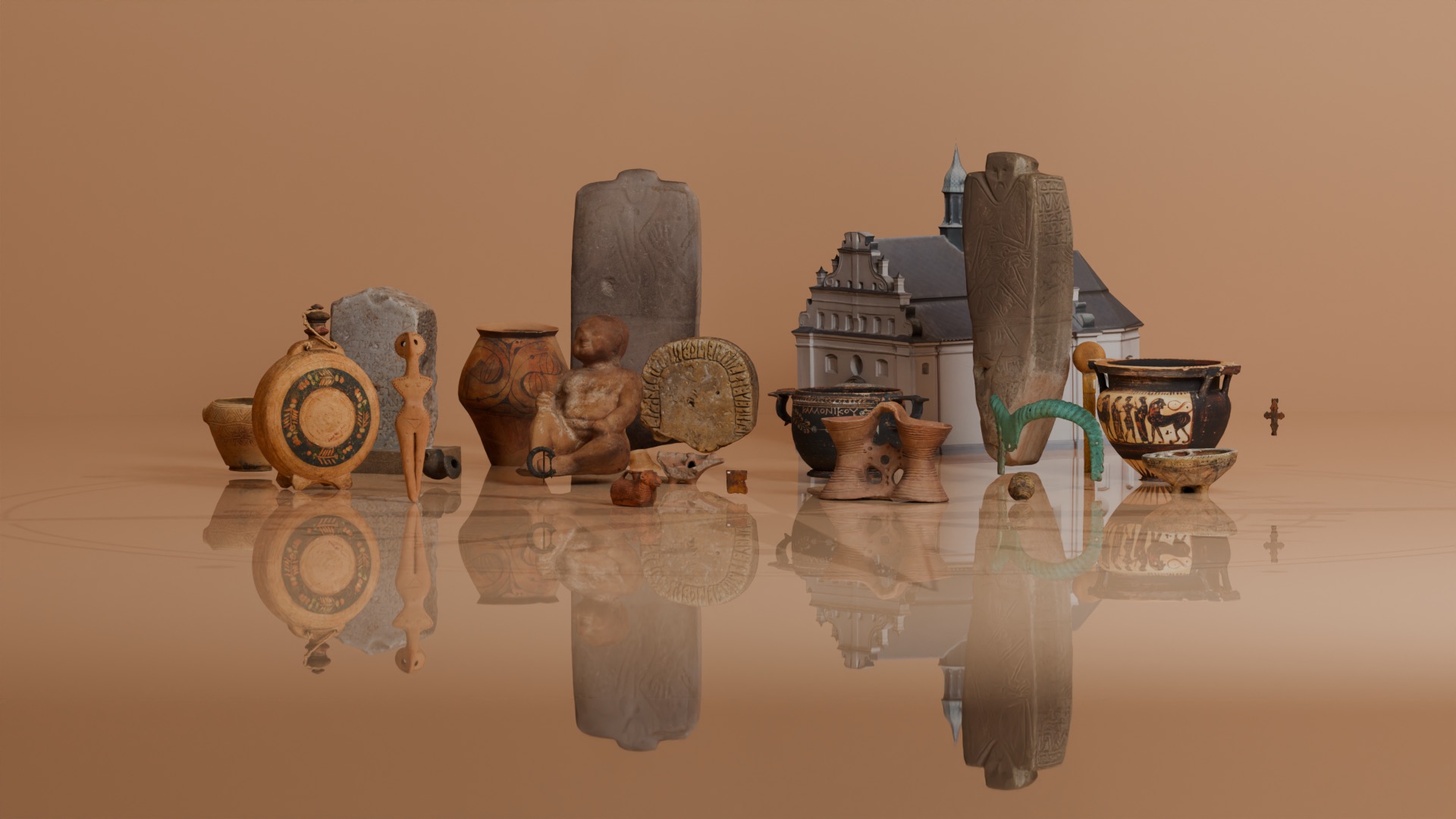
Welcome to the Crossroads of Ukrainian History
Welcome to the Virtual Museum of Ukraine. This exhibition is divided into five rooms, North, South, East, West and Center, each symbolizing the directions and origins of Ukrainian influences. We invite you to explore each room and the objects displayed to better understand the cultures and countries that have contributed to creating the layered heritage that shaped modern Ukraine and continues to inspire Ukrainian identity. You will also hear from three experts in different areas and cultures of Ukrainian archaeology. Thank you for being with us. Ahead of you lies your discovery of Ukraine.
Stop 1. A Rich & Layered History
Ukraine is more than just a territory on the map. It is one of the largest countries in Europe and has an ancient history with rich cultural heritage. For thousands of years, this land has been a true frontier, a space where cultures, peoples and ideas from different parts of the world converge. Each culture has left its own distinctive impact on both the land and the people of Ukraine. We invite you on a journey to explore Ukrainian history, to explore the mega-settlements of the Trypillians, the burial mounds of the Yamna, the ceramics of the Seafaring Greeks, artifacts from the Vikings and remnants of the legendary Cossacks. On this journey, we will travel through the different regions of Ukraine using various modes of transportation that our ancestors used – on sleds, by cart and by boat. It is because of these journeys, both real and symbolic, that the unique cultural landscape of modern Ukraine was formed.
Vsevolod Ivakin
Artefacts, as well as archaeological objects and cultural deposits, where they are located, are very important. They do not hang in the air, and the context is crucial. These are the main sources of information about the life of an ancient people that we have to reconstruct. Archaeologists are engaged in the fixation and study of these objects, artefacts, and cultural deposits. Artefacts go to the museums, based on the needs of the exhibition and the nature of the museum. Sometimes sites and cultural deposits are recorded and displayed in museum exhibitions as well.
Svitlana Ivanova
Artifacts are the most important source for learning the pre-written history of ancient Ukraine. Thanks to the artifacts found during excavations of settlements, or during excavations of burial monuments or hoards, it is possible to reconstruct the material and spiritual culture of the population that left these artifacts, their social order, trade links, migration or military campaigns. Of course, to the extent archaeology can provide.
Stop 2. Western Influences
We first arrive in the West, approximately 7000 years ago. Here sleds are the preferred mode of transportation, as the wheel has not been invented yet. The ceramics in this room were created by the people of Cucuteni-Trypillia culture. These early farmers were a phenomenon of the Copper Age and lived on territories across modern Ukraine, Moldova and Romania. They developed advanced technologies that allowed them to create impressive ceramic objects. These ceramics often featured intricate ornamentation, including celestial symbols, the sun, the moon and comets, as well as various animals and prehistoric people. The Trypillians were known for having large-scale settlements, also referred to as megasites. One of the largest, Maidanitske, covers an area the size of New York's Central Park. These megasites offer a unique opportunity to study how spaces for coexistence were formed in ancient times, as well as how social ties, conflicts and cultural exchange emerged.
Anzhelika Kolesnychenko
Actually, Trypilians built multi-story buildings. And after they burned them, these buildings left what is called ploshchadka in Ukrainian. It's a lens of burned clay, and then we excavate it. We can detect preserved imprints of different elements of construction, like, for example, beams.
Svitlana Ivanova
First of all, Trypillians are considered to be the first farmers in Ukraine. In is mainly because of them that agriculture appeared in Ukraine. The research of the last few years has shown that Trypillians used organic fertilizers. They knew the harness for animals. These were bulls; we have a clay figurine of a bull. Trypillians knew sleds. they had domestic horses — its bones were found on the Bilshivtsi settlement. Trypillians were also innovative in mining. They not only used metal, but also extracted it. The chemical analysis of some artifacts showed which mines the metal was mined from. The researchers who study metallurgy usually define Trypillian metallurgical province. They had their own technologies. We can say that the metallurgy of Trypillian culture laid the foundations for metallurgy of the next Bronze Age. Trypillians were also innovative in monumental architecture. We know this thanks to the megasites, but not only that. Their fortifications around megasites also show this. Besides, there are so-called megastructures inside the megasites. These are large buildings. For example, in the village of Nebelivka, there was a temple with an area of 1200 square meters. Archaeologists believe that part of these innovations came from Trypillians themselves, and the other part was adopted from the Balkan population that migrated to the territory of Trypillian culture.
Stop 3. Eastern Influences
We continue our journey forward into the Bronze Age, more than 4,000 years ago. Wheeled transport appears, and people here have become more mobile. So hop on an ox-pulled cart and make yourselves comfortable, because we have a long journey ahead of us across vast open spaces. The objects on display in this room represent one of the first great nomadic cultures in Europe, the Yamna. While there are many known Bronze Age cultures in Ukraine, the Yamna may be one of the most well-documented. These peoples left behind numerous burial mounds, providing us with the opportunity to learn about aspects of their burial rites, including insights into the culture's social structure. Other religious objects and special tools on display here also help us better understand it. In this culture, ideas about space, power, and community began to take shape, laying the foundation for some of the greatest civilizations to come.
Anzhelika Kolesnychenko
The specific element of their burials is the coverage with red ochre. They covered their deceased fully with red ochre. Maybe not always fully, but we found some traces of ochre here and there. And maybe this rite could tell us how they imagined their next life after death. Maybe this cult is connected with sin, for example. Maybe they believed that everyone should be clean before new life.
Svitlana Ivanova
We think that the Yamna culture representatives spoke Indo-European language. For the first time, the Motherland of Indo-Europeans, was searched for by Sir Gordon Child more than one hundred years ago. He came to the conclusion that it was located in the Black Sea steppe, between the rivers Dnipro and Don. This idea was developed by Maria Himbultas, who connected the first Indo-Europeans with the Yamna culture. In her view, the population of the Yamna culture was the first Indo-Europeans. This point of view was accepted by many archaeologists. But the problem is that without writing, it is impossible to 100% determine which language these other nations spoke. In 2025, the journal Nature published an article by Joseph Lazaridis and his team on the origin of the Indo-Europeans based on the paleogenetic data. For the Yamna culture, there is a special type of genetics. The oldest example of Yamna genes was found in the territory of Ukraine, in the settlement of Mykhailivka, in Kherson Oblast. This genetics was formed before the emergence of the Yamna culture, in 5700-5600 years ago. The Yamna culture was formed 5300 years ago. Therefore, at first there is a genetic that is typical to these people, and then these people form the Yamna culture. But the final conclusions can not be made only on the basis of paleogenetics, because we do not know the language of this population.
Stop 4. Southern Influences
Continuing to travel forward in time, we are transported to the world of another civilization that had a significant impact on European history and culture – Ancient Greece. As we follow this culture of skilled sailors, we master a new type of transport – the wooden trireme ship. Objects and art pieces shown here from the ancient colonists reveal how the cities they created became centers of culture, crafts, and contact between different peoples. More than just beautiful pieces of art, these artifacts and the Greek people who made them brought the ancient world with them to Ukrainian shores. Each artifact shares pieces of myths, philosophers, and gods of Greek culture. The Black Sea and its connected rivers formed part of a vast system of trade routes. Utilizing these bodies of water, the ancient Greeks gradually colonized the entire coast of the northern Black Sea region. Here, they built many colonial cities, including Pantikapion, Hersonesis, Tyrus, and Pontic Olbia.
Anzhelika Kolesnychenko
Greek colonists in the North Black Sea region brought everything that they used and they lived with, from Greece. Actually, they brought their traditions in democracy, in religion, and in different areas of their social life.
Stop 5. Northern Influences
Moving North in our journey, we arrive in the times of Kyivan Rus', a pivotal medieval state at the heart of Europe, dating from the late 9th to the mid-13th century. Here we board an ancient Viking sailing vessel of the time called the Lodja. The objects displayed here that were discovered in this region provide insight into the Viking culture that arrived here from Scandinavia, not as invaders, but as integral parts of a grand exchange. They named this land Gardariki, the land of cities, and became part of the sociocultural complex as a country run by power, laws, and faith. Here there was a multi-layered identity created by the blend of paganism and Christianity. It is a story of development, order, and the light of culture that shines through the centuries and still shapes Ukrainian perception and identity.
Vsevolod Ivakin
This is a difficult question. The core of this country was created in Ukraine, in my homeland. It was created in a very interesting geographical location, between the forest and the forest-steppe zone, at the crossroads between the Christian world of Western Europe, the Muslim East, the Byzantine South, and the pagan North. And, of course, this combination is very interesting, because it involved influences from all directions, from different cultures, and all this melted in the melting pot of the ancient Rus' state, and led to quite interesting results. For the Scandinavians, as we know, there was no distance. They engaged in long-distance trading, and even today the essence of the long-distance trade lies in these great transitions. That is, they reached the southern coast of the Caspian Sea in the east, they were in Spain, they were, as it seems, on Sicily. But in Ukraine, the southernmost point is, perhaps, the island of Berezal. This is the one known place they reached, on the west. This is what the iconic stone that is in the exhibition tells us. Another stone, since we are talking about stones, is from a bit later times. It describes how a person of Scandinavian origin, Rurikovich, measured the distance between the Crimean coast and the Taman peninsula, while the sea is frozen in the winter. It was probably important to him for trade reasons or something else. These are the southernmost locations of the Viking presence in Ukraine.
Anzhelika Kolesnychenko
The runic stone is an incredible artifact in Ukrainian archaeology. And, if I remember corectly, it is the unique artifact with runic inscriptions here. Runic stone was found in 1905 during the excavations of Professor von Stern. And this artifact is the best evidence of the history of Viking traveling from north to south. And usually, very often, they use river routes for traveling.
Stop 6. Ukrainian Center
We now move to the Dnipro, Ukraine's largest river. For your travels through the central region of Ukraine, we switch to a new boat, the Chaika, an agile ship that was popular with the Cossacks. Looking around the room, you can see objects that represent the period when the Cossacks appeared in Ukraine. The Cossacks were a social group that emerged between the settled and nomadic worlds in the famous Dnipro valley region of Zaporizhia. The Cossacks used their ships to rule the Dnipro River and the Black Sea, reaching the shores of Crimea, Constantinople, and the Caucasus, as well as Hadjibey, the place where modern Odessa would later appear. The Cossacks were not just warriors. They were travelers, scouts, fishermen, diplomats, and poets of the steppe. Although the term Cossack originates from Turkic languages, the phenomenon itself developed on Ukrainian soil. The Cossacks were active between the Ottoman Empire, the Crimean Khanate and the Polish-Lithuanian Commonwealth. This eventually culminated in the establishment of their statehood.
Vsevolod Ivakin
Cossack baroque, which is also called the Ukrainian baroque, and sometimes Mazepa baroque. This is precisely the presence of this fact that testifies to the presence of a social class in the Ukrainian society of the 17th and 18th centuries, which was not only a military and political elite, but also a recipient of artistic and visual constructs of the authentic Ukrainian cultural style. That is, the presence of historical and cultural monuments in Ukrainian architecture, music, iconography testifies to the development and cultivation of the Cossack baroque and emphasizes the cultural power and political power of the Cossack state. The Cossack heritage and the Kyivan Rus' legacy formed the foundations of contemporary Ukrainian culture. And this syncretism is preserved to this day. Same as we were between the East and the West, so we remain today. That's exactly why there are issues with electricity supply in Ukraine these days.
Anzhelika Kolesnychenko
Cossacks were big smokers, really, and I believe that smoking was a social practice that connected men and smoking served for interacting with men of the same rank, for example, and yes, they smoked too much, maybe. What's interesting is that for archaeologists, smoking is a very interesting topic of study because we can find a lot of pipes with different ornamentation, and through these pipes we can tell about the time, about chronology of their use, or about the event that happened in the place that they actually lost this pipe.
Svitlana Ivanova
There is such a stereotype, actively used by Russians, that Odessa is a Russian city and it has always been so. But this is not true. Even at the end of the 15th century, according to Polish chronicles, in the north of the Odesa region there were local Cossacks who lived by the Savran River, which flows into the Southern Buh. In the 16th and 17th centuries, Cossacks often appeared on this territory. They came here from the Zaporizhya Sich and plundered Tatar settlements and Turkish fortresses. At the beginning of the 16th century they even plundered Akkerman. When the Russian empress Catherine II disbanded the Zaporizhzhya Sich in 1775, some Cossacks fled to the territory of Turkey. And the Turkish authorities gave them the territory near Khadzhybei, that is, present day Odesa, near Adzhyder, that is present day Ovidiopol, and near the what is now Palanka. Some Cossacks even went to Dobrudzha and created the so-called Zadunaiska Sich. But the Russian side also used Cossacks. In 1790, the so-called Black Sea Cossack Army was created, led by the so-called Hetman Prince Potyomkin. He gave the Cossacks a place to live and to use the territory between the Dniester and the Southern Buh. Cossacks took part in the siege of Khadzhybei, and then partially stayed to build Odesa. There is indeed a Cossack cemetery near Odesa, the so-called Sotnikovo Cemetery. There are ancient Cossack settlements near Odesa, which have now become Ukrainian villages. These are Nerubaiske, Usatovo and others. And the first burial in this cemetery dates back to 1791. That is, before the foundation of Odesa, before the siege of Odesa, a young man named Ioan was already buried here, in this Cossack cemetery. There are many burials with Cossack symbols. At the beginning of the 21st century, 60% of the population of Odessa felt they are Ukrainians. That is, the fact that Odessa is a Russian city is a myth.
Stop 7. Lasting Traditions
Ukraine was formed gradually, absorbing the experience of different peoples and cultures. From the mysterious Trypillian symbols and pottery, and the architecture of Greek cities, to ox-drawn carriages and Cossack boats, each era has left a lasting mark that still influences Ukraine today. Ukraine is a place where ideas, traditions, and languages have intertwined for centuries, as each new culture leaves its mark. Moving through each room, we have traveled through many millennia together. Each object serves as a reminder of the exchanges and cultures that have shaped Ukraine's history. Thank you for joining us on this journey. As you leave, don't forget your luggage, the impressions, emotions, and new knowledge gathered here, each one allowing us to better understand Ukrainian history and the world around us.
Vsevolod Ivakin
The interesting part is an opportunity to reconstruct the life of a person who lived a thousand years ago. I'm captivated with a certain detectiveness and similarity to criminal investigations, because we have some traces of what happened, and we restore processes based on those traces. I think this is interesting. This exhibition, and we've talked a lot about this, reflects the syncretism and the multi-morphological nature of our culture. This is one of the main values. Our culture is not one-sided. We have many regions, they are different, and they are interesting, and they were interesting in the past. Our frontier position causes a lot of difficulties to us, but it also gives many interesting things to our history, both past and present.
Anzhelika Kolesnychenko
People, step by step, can feel and can learn our history from Bronze Age, or even earlier, till 18th century. And this exhibition showed them some extraordinary artefacts — like markers, like points in every very important topic of our history. So I hope that people enjoy this and they will try to feel our culture, because events that happened in the past actually construct our identity today. We use elements of democracy, Greek democracy today. And now, in a situation in Ukraine, it is quite important to remember these points, these terms of our history, of history of Ukraine, because our past builds our future.
Svitlana Ivanova
What I would like people to understand from our exhibition is that Ukrainian culture is relatively complex, because it combines Ukrainian folk traditions with the historical development of Ukraine. The culture was changing, it did not stand still. On the other hand, Ukrainian culture underwent the influence of neighboring nations and took something new into itself that was reprocessed and is not alien. Also, Ukrainian culture is not monolithic, since different regions have some differences. In my opinion, this is manifested in different types of embroidered ornamentation — different historical regions of Ukraine are different in ornamentation and in the color of embroidery. It is just one manifestation of such difference.