Story outline
-
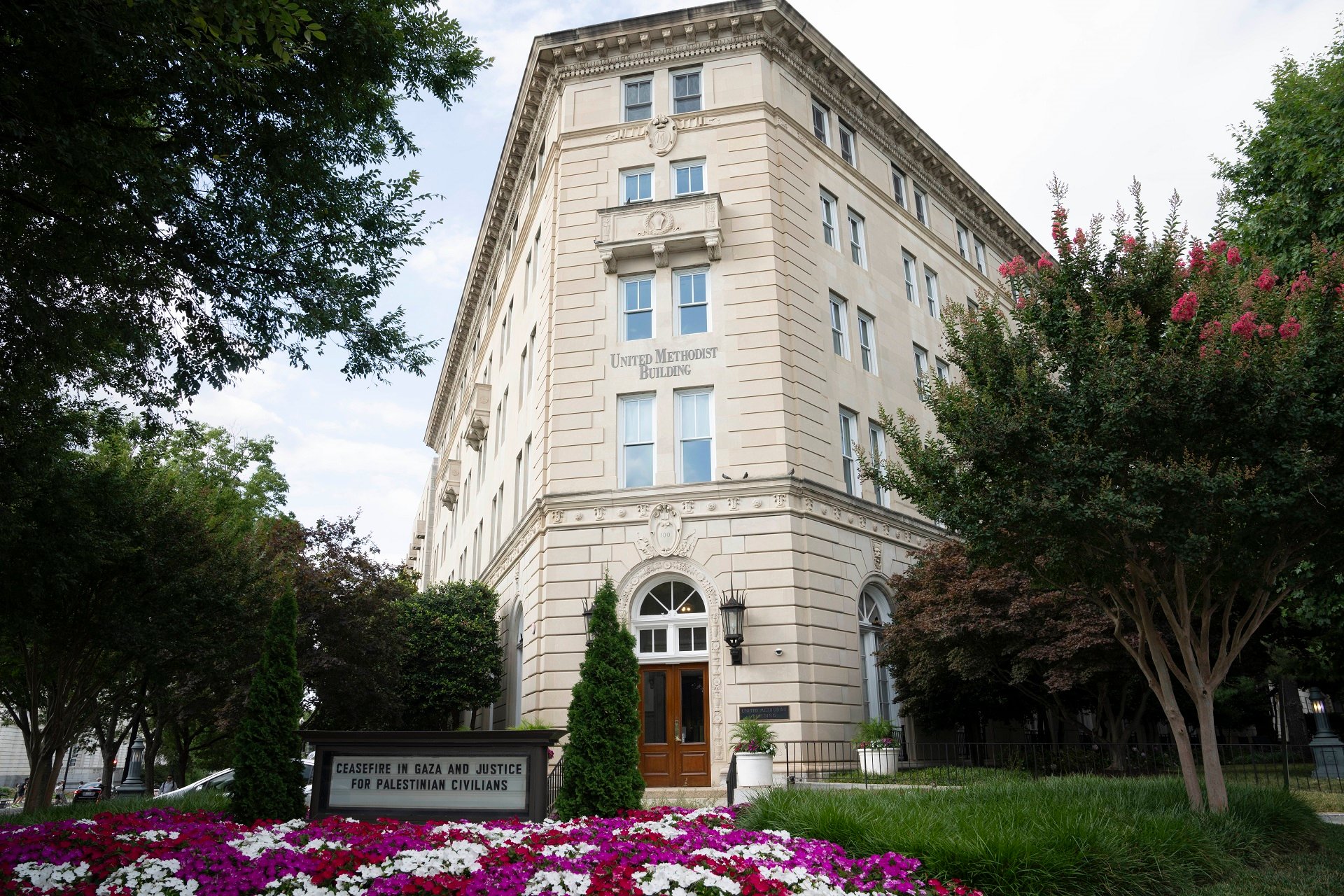
United Methodist Building
United Methodist historic presence on Capitol Hill -
Stop 1. Faith, Peace, & Justice
Constructed from 1917 to 1924, the building and its grounds have served as a witness to the intersection of faith, justice, and peace. Rooted in the Methodist tradition of social witness, today this work is carried out by the General Board of Church and Society. -
Stop 2. Local and Global Communities
The land that the building resides on is part of the ancestral home of many Indigenous communities. The front lawn offers opportunities for reflection about this history and advocacy work in the pursuit of peace and justice carries out through the building. -
Stop 3. Foundational Principles
This building was founded on social teachings of the Methodist tradition observed on the walls of the building’s green and white marble lobby and elevator entrance. The Temperance movement was central to the early establishment of the building which was originally home to the Board of Temperance, Prohibition, and Public Morals. -
Stop 4. Faith & Community
This chapel is named after Bishop Matthew Simpson and his wife Ellen Holmes Verner Simpson whose legacies connected to the temperance and anti-slavery movements that are carried on in the United Methodist Building today. The chapel has served as a place to come together during times of trial as well as celebration. -
Stop 5. Social Justice
The historic cafeteria became the first integrated carefteria on Captol Hill in 1947 and continues serve as a gathering space for people engaged in advocacy for social issues on Capitol Hill including racial justice and disability rights. -
Stop 6. Local and Global Advocacy
The wooden table in the third-floor conference room highlights the grassroots organizing and international impact of the work carried out in the building. The General Board of Church and Society has offices at the Church Center for the United Nations in New York City where advocacy is carried out on a global scale. -
Stop 7. Hope for the Future
The work carried out at the United Methodist Building builds on the foundations of its establishment to look towards the future in shaping a more just and peaceful world.
Voices
-
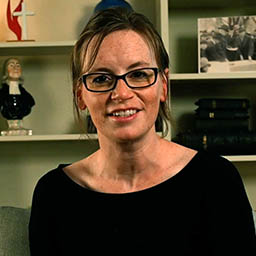
Dr. Ashley Boggan D.
General Secretary of Archives & History
-
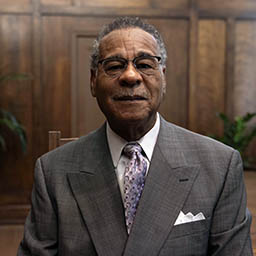
Congressman Emanuel Cleaver
Representative of Missouri's Fifth Congressional District
-
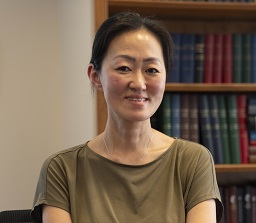
Aimee Hong
Senior Executive Director of Education and Engagement
-
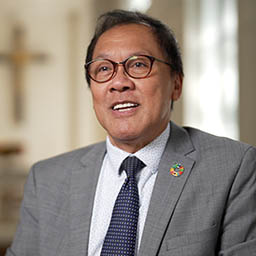
Rev. Dr. Liberato Bautista
Assistant General Secretary for UN & International Affairs
Gallery
Partners



About the Project
The United Methodist Building is home to the General Board of Church and Society which carries on the Wesleyan and Methodist traditions emphasizing social witness and faith-based action through social and political advocacy. This project was made possible through a collaboration between the General Board of Church and Society and the General Commission on Archives & History of the United Methodist Church.
Related Links
- The 1908 Social Creed (Opens in new tab)
- The General Board of Church & Society (Opens in new tab)
- The General Commission on Archives & History (Opens in new tab)
- Report on the Sand Creek Massacre (Opens in new tab)
- United Methodist Building History (Opens in new tab)
- United Methodist Building 100th Anniversary (Opens in new tab)
Credits
This project is a collaboration between the United Methodist General Board of Church and Society, the General Commission on Archives & History, and CyArk.