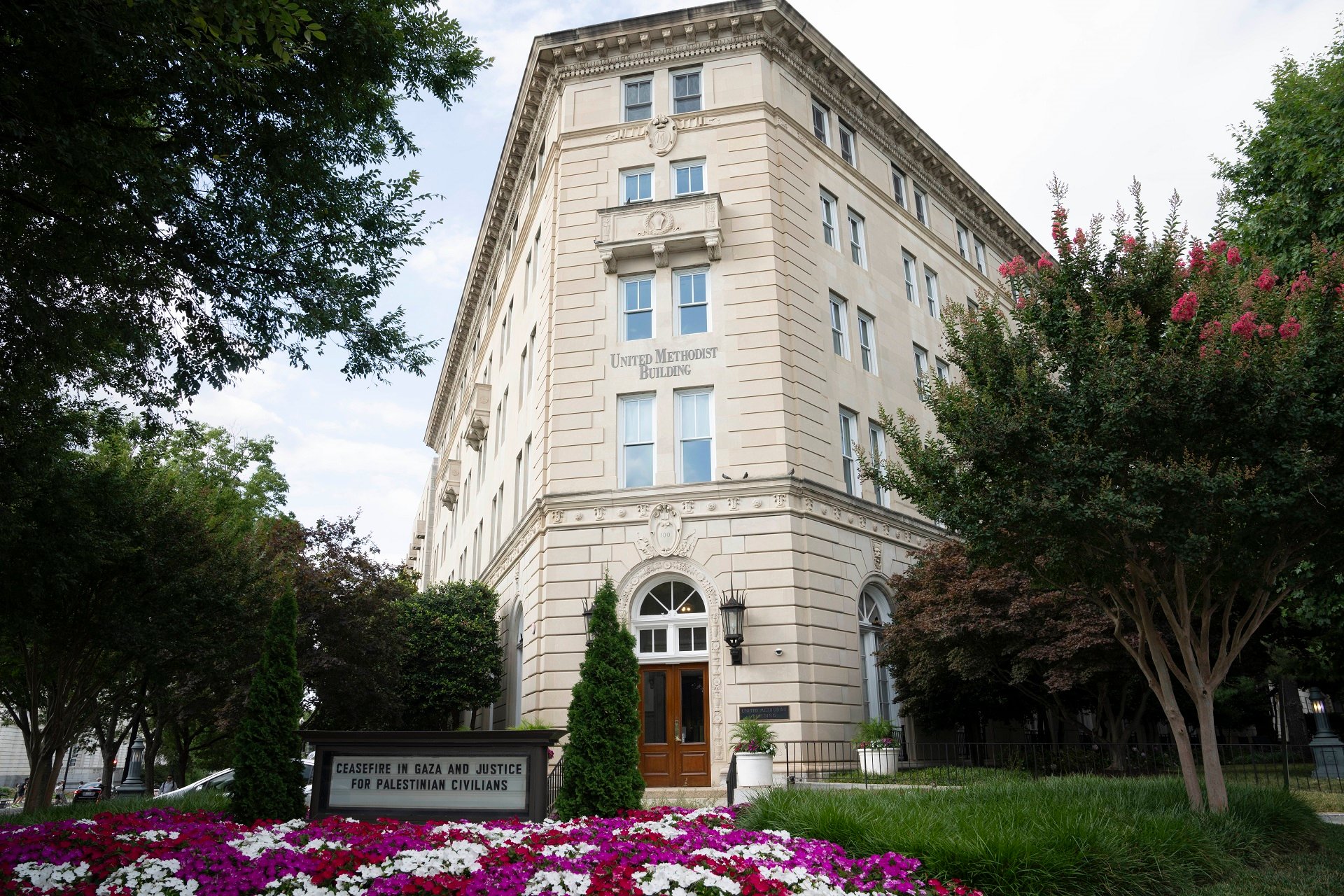
United Methodist Building
Welcome to the United Methodist Building, the only non-governmental building situated at the heart of Capitol Hill in Washington D.C. For over a century, the building has served as a foundation for the practice of faith, peace, and justice. Today the building is home to the United Methodist General Board of Church and Society which carries on the Wesleyan and Methodist traditions emphasizing social witness and faith-based action through social and political advocacy. In this experience, you will hear from United Methodist leaders including Dr. Ashley Boggan, Congressman Emanuel Cleaver, Rev. Dr. Liberato Bautista, and Aimee Hong about the significance of this United Methodist Historic Landmark and the contributions of the people who have utilized the building in advocating for social change.
Stop 1. Faith, Peace, & Justice
The five-story United Methodist Building sits across the street from the U.S. Capitol and U.S. Supreme Court. Constructed from 1917 to 1924, the building and its grounds have served as a witness to the intersection of faith, justice, and peace. Rooted in the Methodist tradition of social witness, today this work is carried out by the General Board of Church and Society through education and advocacy of the Social Principles and other social teachings of the church on peace and justice. Central to this work is the United Methodist practice of social witness, going beyond the individual to live out faith in social and political arenas for the benefit of all. Perhaps unlike any other location in the U.S., Capitol Hill provides a window to witness and engage with the most pressing social and political issues of our time. This space in front of the United Methodist Building has served as a gathering place for both remembrance and advocacy at the center of the General Board of Church and Society’s work.
Congressman Emanuel Cleaver
This neighborhood is a residential neighborhood for the most part. And, it's also important for them to know that, Frederick Douglass living around the corner, is also a statement, because on the night before, President Abraham Lincoln issued the, an executive order that we call the Emancipation Proclamation, slaves who had been freed lived in this neighborhood, lived in this neighborhood, and walked over to the Capitol. It had rained, and they, women were walking to the Capitol from this neighborhood with long dresses on it that were muddy from the from the rain going on in January. And men had on makeshift tuxedos because they wanted to be right there when the president of the United States read that executive order sentting most of the slaves free. And if you can think that, I mean, church saying “Where should we build our building that makes a socio political statement?” This is it. This is it, especially in the 1920s when, you know, we weren't that far away from slavery. We weren't that far away from doing damage to the Native Americans. So, you know, this is a this building is alive, and it speaks of what has happened in the history around Washington, D.C..
Aimee Hong
A sign that's located outside of our building has been important, and that it's become an advocacy tool for us. When there are issues that are happening, we're able to kind of message, our concerns using the sign. And so, for example, back when, in 2018, when children were being separated from their parents at the border, the sign took a Bible verse, but kind of tweaked it a little bit. So the Bible verse was from Matthew 25:35 where it says, for I was hungry and you gave me food. I was thirsty and you gave me drink. I was a stranger and you welcomed me. It was changed to say “I was a stranger and you ripped my child from me. Wait a second.” End quote. And it actually got a lot of attention from people that were just walking across, you know, walking by. It also caught the attention of some of our senators. I think Senator Cory Booker took a picture of it and shared it on his social media, as well. And there are people that walk by really kind of wondering, oh, wow, here's a church that's actually speaking out on what's happening. And so and since then we've been using that the sign, as you know, our messaging, for a lot of different issues. It's very powerful.
Rev. Dr. Liberato Bautista
The United Methodist Building has doors. It is next door to the Supreme Court. It is next door to Congress. It is therefore a door to the powers that, whose decision making are of consequence to small nations, to the big nations. It is a window to the world. People come to Washington, DC to speak of their pain as much as their joy. This building provides the windows in which you can peak through and see demonstrations happening in front of the Supreme Court and in front of Congress.
Stop 2. Local and Global Communities
The land on which this building resides today is the ancestral homeland of the Nacotchtank (Anacostan), Piscataway Conoy, Pamunkey, and Manahoac people. These communities and neighboring tribes stewarded the land for generations and continue to carry on their connections to this place today. From the front circle of the United Methodist Building, and looking down Maryland Avenue, a quiet lawn offers neighbors and residents a place of quiet to rest and reflect. A white pine serves as a “Tree of Peace,” and is dedicated to former General Secretary Thom White Wolf Fassett, a member of the Iroquois Confederacy. The peace pole connects the United Methodist Building with cities and diverse communities around the world as well as serves as a reminder to those walking the halls of power on Capitol Hill. Constructed in 1931, the 110 Maryland Ave. building extends beyond the lawn. It provides apartments for people who live and work on Capitol Hill as well as offices for ecumenical and interfaith partners; The building's green roof and other updates to the building reflect the organization’s ecological stewardship.
Congressman Emanuel Cleaver
I'm from Kansas City, Missouri, so I'm a great distance from the churches and and the people that I served. And for me personally, it is a place that I can have ongoing communications with a bishop. The bishop lives in the building. We can see what's going on in the in the country. For example, as we're filming today, a crowd is gathering in front of the Supreme Court. And, of course we are, as I said earlier, right next door to the Supreme Court. Now, it's a bad deal because, my apartment faces the Supreme Court, and, I don't think people have been warned that I'm asleep at five and six in the morning when they begin to gather. But, they have ignored me over the years, and I resent that. But, you know, they're more committed to to their cause, than my sleep. But they will start gathering on days when that's going to, when there’s [an] expected a decision by the Supreme Court. And it there's just something sacred about being here when some of the most significant decisions of our nation are being dealt with at the Supreme Court.
Aimee Hong
So I think it's really important to know that the work of justice can't be done alone. That we can't be working siloed from everyone else. And I think this building is a big testament to that. I know from in the 100 and the 110 building, there are like 40 different nonprofit groups, I think, that exist in this building and the building next door. And some of them, it's like the UCC they're a public policy and advocacy office; the PCUSA, Justice Ministries office; ISNA, Islamic Society of North America; and Shoulder to Shoulder Campaign are just some that exist within these two buildings. And, you know, oftentimes we work on a lot of these justice issues together.
Rev. Dr. Liberato Bautista
The peace pole planted on the United Methodist building grounds is one of many other peace poles erected in many places around the world, in capitals of countries as much as in small localities, in provinces, as much as in barrios, as well as in commercial capitals. They are a necessary reminder of the seeking of peace and the pursuing of justice, essential to the witness to God's desire and intention. Biblical injunction, if you will. It is a reminder to leaders as much as policy makers, that the search for peace and the pursuit of justice are central to the Christian witness, and I am glad that I was a part of the erection of this pole on Capitol Hill.
Stop 3. Foundational Principles
This building was founded on the social teachings of the Methodist tradition, observed on the walls of the building's green and white marble lobby and elevator entrance. In 1917, the Reverend Dr. Clarence True Wilson broke ground on the building as a place to protest, witness, and advocate on Capitol Hill. Reverend Wilson's wife, Maude Akin Wilson was also instrumental in directing the work and finances of the building's construction. Methodist women played a prominent role in gathering funds through their advocacy in the temperance movement to purchase the land where this building sits today. Those who led efforts in the temperance movement with prominent leaders such as Francis Willard, sought to change society for the better through the prohibition of alcohol. The building began as the home of the Board of Temperance, Prohibition and Public Morals. The principles, creeds and verses shared in the rotunda space reflect foundational principles of Methodism. The lobby is a visual reminder for tenants and visitors alike of the faithful call to respond to the pressing social issues affecting communities.
Dr. Ashley Boggan D.
The first time I came to the United Methodist Building, I was an intern at another denominational agency. I had read about the building and seen photos of its exterior, but stepping inside for the first time was powerful. If you've ever stepped into the interior of one of the grand European cathedrals, it's that same type of moment. You were overwhelmed by the beauty, and you can almost feel the history rushing at you. When you first see the 1908 Social Creed engraved in marble, You can hear the words being spoken by those who wrote it, calling for basic rights for workers. There are few sacred spaces such as this on American soil. It is a space with a true active Holy Spirit.
Congressman Emanuel Cleaver
My joy in coming into this building, is that there is a statement that we make as Methodists that can be seen if you drive up and down Maryland [Ave.], where we make statements from time to time. In many instances that irritates members of Congress, and in some instances, it creates joy. But it is not to be ignored. The church must not be ignored.
Rev. Dr. Liberato Bautista
My work is mostly based in New York, but each time I come to this building, it's as if the 100 years legacy of this public witness on the Hill is speaking to me. I owe it to the people that have come in and gotten out of this building for the courage, bold witness, that is, to the powers that be, that God's intent for justice and peace be made manifest in our human relations and in the relations of nations around the world.
Stop 4. Faith & Community
This chapel was originally built after a donation of Ida and Sarah Elizabeth Simpson, the daughters of Bishop Matthew Simpson and his wife Ellen Holmes Verner Simpson. The Simpsons were involved in the temperance and anti-slavery movements. Matthew Simpson regrettably also defended and profited from illegal acts of war against American Indian communities including the Arapaho, Cherokee, and Cheyenne. This complicated legacy provides insight into the early to late 19th century history between Methodism and marginalized communities. The chapel has served as a place for those who work in the building and the broader community on Capitol Hill to come together during times of trial as well as celebration. In 1983, when Dr. Martin Luther King Jr’s birthday was signed as a federal holiday at the Capitol Building, Coretta Scott King and 100 others came to the chapel and had a two-hour service celebrating Dr. King’s life. Historically and today, the chapel serves as a spiritual home on Capitol Hill for local and visiting communities.
Aimee Hong
So we've had special services like, during Lent or Ash Wednesday service, like big Christian holiday markers, we would have services. And it's always been, you know, nice that we can, you know, I know this building is not a church per se, but it's still a good kind of reminder that, you know, we are a community of believers. And so that helps to kind of ground us in the work that we do. And I’ve always found it to be good for the soul.
Stop 5. Social Justice
This large white vaulted room has served as a gathering space for people engaged in advocacy for social issues including racial justice and disability rights. Historically, this room served as a cafeteria which remained a segregated space until 1947. Thanks to the efforts of civil rights activist Bayard Rustin and a committee of citizens including the Rev. James Cannon, this space became the first integrated cafeteria on Capitol Hill. Although this room is no longer strictly a cafeteria, it remains an ecumenical gathering space where people advocate for policies that address social injustice in the U.S. and beyond. Through advocacy work within the walls of this room and building, Church and Society contributed to efforts in the passage of the Americans with Disabilities Act (ADA) and prominent social movements including the 1963 March on Washington, the 1968 Poor People’s March, and years of protest against the Vietnam War.
Dr. Ashley Boggan D.
From here, those within the Methodist tradition have called for health care reform, workers rights, equal pay, reproductive rights, civil rights, and women's rights. They have brought a Wesleyan and Methodist lens to the often secular conversations. By doing this, they have demonstrated how Methodist connected our social and personal holiness, how we live out our relationship with God through active love and relationship with others. For us, United Methodist, we cannot love God without loving neighbor. At the United Methodist Building, our love is often put into law or used to even break down law. It is here that our love helps shape the institutions that shape then our very fabric of our society. It is here that our love, our theology, our witness, transforms from the pulpit and into petition.
Congressman Emanuel Cleaver
During the days right after the historic decision of the Supreme Court on desegregation, that bishops have addressed those issues even in the 1940s and the 1950s. the Supreme Court in 1954, the Supreme Court made a decision. And the decision did not go unnoticed, as it related to the desegregation of schools. There were discussions in this building, prophetic discussions. People who talked about the the, the, the theologically wrong direction that the nation had been traveling, trying to separate people on the basis of skin color, right here in this building, meetings of been held in times when the things that the church stood for were not universal, you know, particularly on the issue of race. And so, whenever you look at the the history of the United States and then measure what was going on at the same time in this Methodist building, I think it really conveys where we stand. I mean, I think John Lewis used to say, you know, “Don't be on the wrong side of history.” Actually, Martin Luther King said at first, but, and I think when you look at Supreme Court decisions, when you look at legislatively, legislative action in the Congress, and then and then juxtapose that with who was speaking in the United Methodist Church, we were on the right side of history.
Aimee Hong
The Methodist building, unfortunately, it is also a building of its time. And so from the earlier days when there was actually a cafeteria here, it was a segregated cafeteria for the employees, staffers on the Hill, senators and House members, and Methodist, tourists and visitors alike. But it was a segregated cafeteria. It was only in 1947 that the agency began the process of changing the cafeteria so that it was no longer a segregated space. And 1947, it was when the cafeteria became the only integrated cafeteria in all of Capitol Hill, which is pretty, you know, great. Now, today, it's still the conference. The cafeteria is now the conference room. And the conference room still functions as a place where people are gathering for different things like seminar programs, like, trainings and workshops. It's also a place where people come to have meetings before they go meet with their senators and House representatives. It's a place where others can get together and connect. It's also a place where a lot of people of faith gather to kind of connect with others, because I think oftentimes people feel very much alone in the work of justice. And so it still functions as a gathering place. Often time, people gather and break food, you know, break bread together, eat food together, which is similar to what the cafeteria was like. Where people gather, sit together, eat, and share ideas, which is pretty much kind of the same today.
Stop 6. Local and Global Advocacy
The wooden table in the third-floor conference room highlights the grassroots organizing and international impact of the work carried out by the General Board for Church and Society in the United Methodist Building. Here, Church and Society hosts strategy meetings with coalitions and partners and throughout the building, educational seminars, that provide resources for people to gain skills in advocacy work. At this table and within many of the conference rooms in this building, people of diverse faith backgrounds have worked together to explore pressing issues, connect with impacted communities, and engage with national and international leaders. In addition, the General Board of Church and Society has offices at the Church Center for the United Nations in New York City and holds a non-governmental, consultative status with the United Nations allowing for participation in key UN conferences. Inspired, educated, and organized, people leave these spaces to go out into the world and engage with local and global leaders both on Capitol Hill and on an international scale through the United Nations.
Dr. Ashley Boggan D.
The United Methodist Church is a unique mainline Protestant denomination in that its majority of membership exists outside of the United States. Therefore, the work done at the United Methodist Building and through the General Board of Church and Society is worldwide in nature. The stances taken here on women's rights and human rights, on climate change and voters access are meant to extend beyond the borders of this country and push other countries towards a more equitable understanding of the law. In this way, the General Board of Church and Society works with the United Nations to enforce certain universal social standards.
Aimee Hong
Within education, we work on seminars, workshops and trainings, resource development, and curriculum development. Basically the idea is that educating is integral to advocacy, and that is at the helm of what we do here at Church & Society. And so a lot of the educating through seminars, you know, groups come here, they tell me what they would like to study, and we design a educational program, on that topic and prepare them to how to take it home to continue the work and also how to be an advocate on these issues as they talk with members of Congress. There's also resources and curriculum that's also developed on similar issues, so that churches can use it on the local level, as well.
Rev. Dr. Liberato Bautista
There have been many instances where I’ve worked with colleagues and other ecumenical and social movement colleagues here at the United Methodist Building, but one that strikes me the most is my work with colleagues working on the seminars on national and international affairs. What the United Methodist Building represents is a a voice at the seat of economic, political, military power. And the seminars on national and international affairs brings to me a specific character of ministry, which is ministry to that which is speaks to the local as much as the international. The United States being a superpower and the United Methodist Building being located at the heart of that power on Capitol Hill, strikes deeply into the very character of the social witness which is required of us as followers of Christ: to speak truth to power, to humble the powerful that they may know exactly what the Lord requires, which is justice, and a piece of compassion and and kindness. Those are our gospel imperatives that you don't see at the seat of power. And it needs, the powerful needs reminding by a public space like the United Methodist Building and and faith based actors, who, who bring to that table, waring tables, a construction of another table, a table of peace. And I think this building has afforded spaces for not just the conjuring of what makes for peace, but the crafting of actual work that brings food on the table. That's peace, that brings decent job. That's makes for peace. That that assures your civil and political rights are defended and respected. That makes for peace. So this building is a witness to the making of the things that make for peace.
Stop 7. Hope for the Future
In the century since this building was established, it has stood witness to transformational moments in history. From the March on Washington to the Americans with Disabilities Act, leaders have convened here to advocate for peace and justice for communities around the world. As you leave the United Methodist Building towards the US Supreme Court and US Capitol, reflect on the change that you would like to see in the world.
Dr. Ashley Boggan D.
I hope that more people discover this treasure. It truly is a remarkable anomaly on the Washington, D.C. mall. It is the only non-governmental building to hold deed on this secular and somewhat sacred ground. Its story shines forth Methodist witness here on Capitol Hill. Its story tells of ecumenical work, often at its best, and its story tells of who we can truly be when we live out God's love for and to all. I hope it continues through its front lawn church sign to challenge Passerbys to a Wesleyan Social Holiness, and I hope that it continues to embody the Wesleyan ideal that we might not all think alike, but may we not live alike.
Congressman Emanuel Cleaver
The future of America is always bright. I know that we live in moments of darkness, even, even today. But if you look at science, you will learn that there's always at least a speck of light in darkness. That, there's no such thing on Earth as pure darkness, because darkness cannot defeat light. And we are the light for this community. And, we have been told that we should be the light of the world. And I think we are still doing that today, and I don't foresee a moment in the future when that's not going to be, one of the greatest needs of this nation. And we all are a light, and the light shall not be extinguished.
Aimee Hong
My hope is that it continues to be a beacon of hope, and a faithful presence on Capitol Hill. That we continue to, you know, work in implementing the social principles, that we are able to continue to advocate for these issues that impact communities here in the US and also abroad. And that we continue to the work that God has called us to do.
Rev. Dr. Liberato Bautista
Speaking of hope for the future, the Magnificat of Mary provides key points that I want to emphasize, that the hungry were filled. It speaks of a different hope from hunger into being filled. That's hope. The Magnificat of Mary speaks of the powerful being brought down. Well, that speaks to the sovereignty of God, that even while earthly lords and princes hold the levers of power, it will yet come to pass that God's justice and peace, God's liberation for God's people, will happen. That’s a hopeful statement. We are an Easter and resurrected people, and we know that God's justice and peace will one day reign.