Bernard Zakheim Murals
Welcome to the Bernard Zakheim Murals virtual experience. Through this experience, you will explore murals created by the Polish-born artist Bernard Zakheim. The University of California San Francisco (UCSF), commissioned the murals in 1936 with the intention of creating an educational space that would highlight the history of medicine. In this experience, you will explore works of art previously displayed in Cole Hall and virtually visit the murals in their original location in Toland Hall. You will be guided by nine narrators representing diverse disciplines at UCSF and descendants of those depicted in the murals.
Stop 1. Introducing Toland Hall
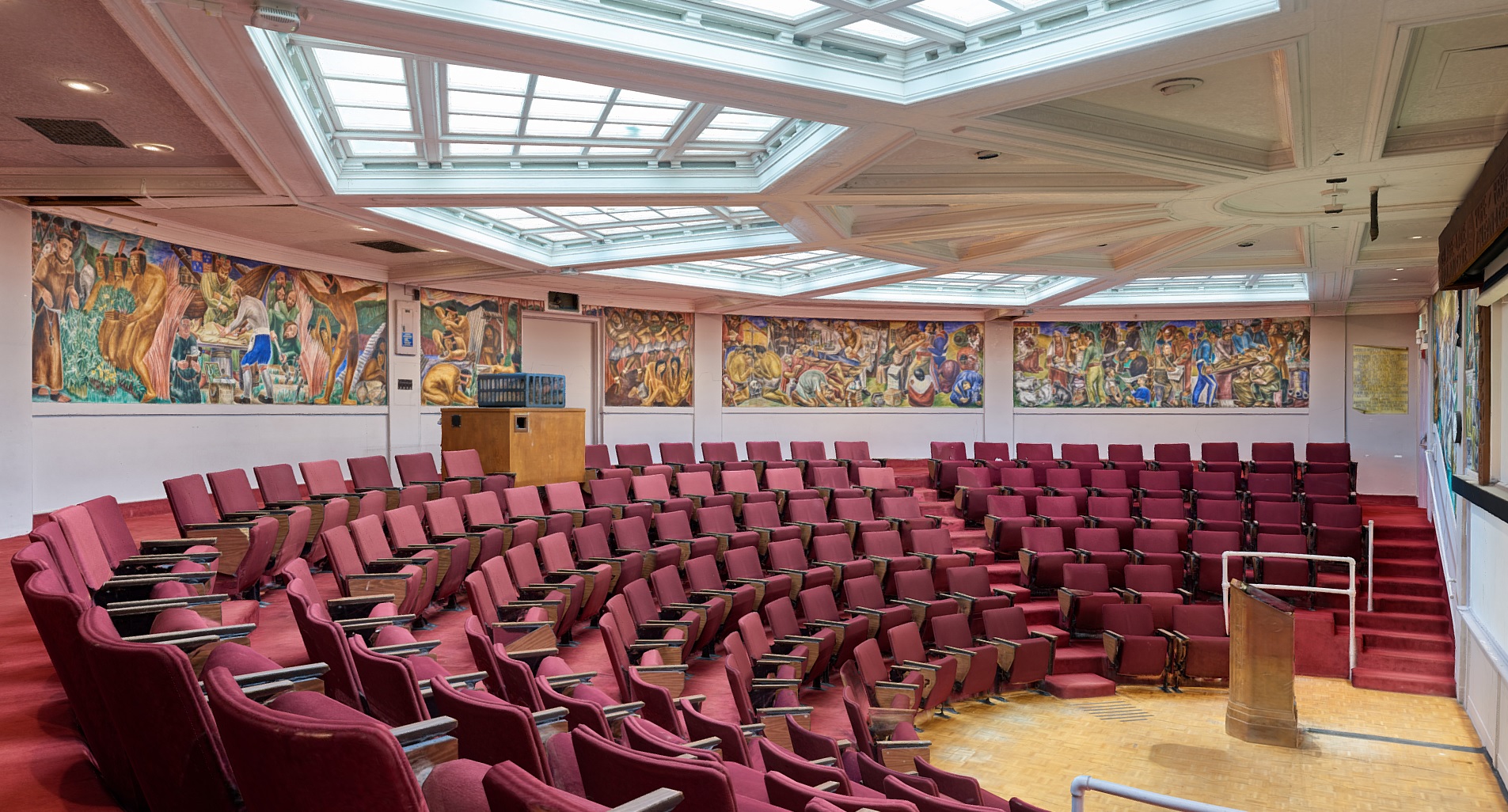
[Aaron Jackson] Welcome to the digital version of Toland Hall, where a remarkable ten panel set of fresco style murals depict the "History of Medicine in California." This presentation is the result of painstaking efforts to digitally capture, preserve, and share the New Deal era murals that once adorned the walls of Toland Hall at UC San Francisco. Toland Hall was a large lecture amphitheater located in UC Hall Building, the first teaching hospital on UCSF's fledgling Parnassus Heights campus at the foot of Mount Sutro. Designed by Lewis Parson Hobart, the architect for San Francisco's Grace Cathedral and several buildings of the California Academy of Sciences, Toland Hall was constructed in 1917 and featured a radiating sunburst design in the ceiling, a curved back wall, measuring a little over 100 feet in circumference, and skylights intended to provide natural lighting. But by the 1930s, the skylights provided little illumination and the prevailing natural fog let little sunshine in, spurring some of the faculty to refer to it as a dark and dreary cave. In 1936, Dr. Chauncey Depew Leake, an American pharmacologist, medical historian, and professor in UCSF's Department of Pharmacology, managed to combine the University and Federal Art Project funds to commission local artist Bernard Zakheim and his assistant Phyllis Wrightson, to undertake an ambitious murals project in Toland Hall. Leake hoped the murals would brighten the room and make it appear larger while simultaneously highlighting the rich history of medicine in California. Leake and Zakheim shared a common interest in representing medical science through art. Leake because he appreciated the artistic exploration involved in medical practice, and Zakheim in representing medical science. because he believed medical science appealed to the higher ideals of humanity. The two had already collaborated on a pair of ten foot square murals in Cole Hall, also located on UCSF's Parnassus Heights campus, but the Toland Hall project was significantly larger and more complex in its simultaneous architectural, educational, and artistic goals. Zakheim began by creating seven pilasters at the junctions of the ceiling sunburst design and the curved wall at the back of the room, producing six panels along the back wall or creating the visual effect of a raised ceiling. Painting life-size figures in the compressed vertical space along the back wall further added to this effect. Once the panels were laid out, Zakheim and Wrightson, with generous input from UCSF faculty, researched and designed the scenes and sketched them directly onto the plastered panel walls. These sketches were necessary because fresco painting is time sensitive. It involves using watercolor paints on wet marble plaster, requiring the completion of a section before the plaster dried. Zakheim began the process in the exact center of the curved wall, with the figure of the Native American man facing the sunrise. From there, moving outwards, he portrayed the history of medicine in Northern California to the left and Southern California to the right. On the straight wall at the front of the auditorium, Zakheim broke with the geographical and chronological narrative to emphasize the struggles, accomplishments, and possibilities of the University of California's School of Medicine, culminating with the artist's appeal to the future potential of medical science painted in a panel directly above the hall's exit. Thus, upon entering the hall, students were presented the history of medicine in California and upon leaving, they were invited to contemplate their contribution to its future. Zakheim hoped the stories in the murals and their meanings would be self-explanatory, but as with any work of art, the frescoes are subject to individual interpretation and have thus developed a history of their own. The murals have evoked a range of responses from viewers since their completion in 1938. Professor Leake and many of his colleagues at UCSF appreciated the work for its artistry, the way the scenes challenged students to consider the philosophical and social ideals of the medical profession, and how the frescoes achieve the desired architectural effect of making the auditorium appear brighter and bigger. But not everyone was so pleased. In 1948 shortly after Professor Leake left San Francisco to take a position out of state, some of the UCSF faculty began complaining that students were distracted by the murals. These faculty managed to convince the school to have the murals covered with wallpaper and paint. The artwork remained covered until 1962 when Chauncey Leake returned to UCSF and managed to mount a successful effort to have the frescoes uncovered once again. Over the years new controversies regarding the murals have emerged. This exhibit does not seek to settle such controversies, rather, it seeks to provide information that will allow observers to decide for themselves. With that, we invite you to explore the digital recreation of UCSF's Toland Hall and its historic works of art.
Stop 2. Bernard Zakheim
[Kathleen Hennessy] The artist who created the UCSF frescos, Bernhard Zakheim, was born in Warsaw, Poland, on April 4th, 1896, the youngest of ten children. Though his parents intended him to become a Jewish Orthodox rabbi, Zakheim took to visual arts as a child and displayed enough talent to win scholarships to receive a formal art education. Unfortunately, this training was cut short by the First World War. Zakheim enlisted in the Polish Army and spent a year fighting Germany on the Eastern Front and nearly another year as a prisoner of war. His horrific experiences in the trenches and the P.O.W. camp informed his art, inspiring him to portray human suffering and the fight for justice. After the war, Bernard and his wife, Eda, immigrated to the United States and settled in San Francisco, where he resumed his artistic education. Zakheim studied at the School of Fine Arts, today known as the San Francisco Art Institute, where he met the famous Mexican muralist, Diego Rivera, who convinced Zakheim to assist Rivera with frescos at the Palacio Nacional and the Ministry of Education in Mexico City. After an artistic sabbatical in Paris, Zakheim returned to San Francisco in 1932 to pursue a livelihood as a professional artist. Bernard Zakheim's art career began with a fresco at San Francisco Jewish Community Center in 1932, followed by a collaborative effort for the Public Works of Art Project at Coit Tower, the largest federal art project in Northern California. He painted the library scene in a reference to his colleague Diego Rivera. He included Karl Marx's Das Kapital, causing a stir in the press. In 1934 while working on frescoes at the Alemany Health Center in San Francisco, Zakheim met Dr. Isabella Perry, the first woman pathologist on the staff of the University of California who introduced him to Dr. Chauncey Depew Leake, professor of pharmacology, who hoped to humanize the study of medical science at the university. Marsha Zakheim, the artist's daughter, described the meeting this way: "in Dr. Leake Zakheim found a man of vision similar to his own belief in the validity of historical perspective in medicine. And conversely, Dr. Leake's lifelong efforts to humanize medicine at UCSF found in Zakheim a gifted artist willing to portray in monumental form the spirit of healing and research for future good." After completing the murals at UCSF, Zakheim painted two more public art murals at Texas post offices before government support for such projects ended during the Second World War. By then divorced from his first wife, Zakheim married Phyllis Wrightson, his assistant at the UCSF frescoes, and moved to a farm in Sebastopol, California. When the university wallpapered over the Toland murals in 1948, Zakheim found that no one had a job for a controversial painter. Though he received his final fresco commission in 1961, he continued producing art from his Sebastopol farm until his death in 1985.
Stop 3. Doctors of the Gold Rush Period
[Aaron Jackson] This panel depicts the chaotic state of medical practice during the Gold Rush. Only about half of those who practiced medicine in California at the time had ever set foot in a medical school. Medical treatments consisted primarily of herbal remedies and patent medicine, better known as snake oil, surgeons worked without anesthesia and classically trained physicians competed with quacks for patients. Out of this chaos, the foundations of modern medical practice and training were established. The promise of gold sparked an unprecedented migration to California. The population of San Francisco alone exploded from 2500 in 1848 to more than 30,000 by 1849. Some 1500 practicing physicians came to California at this time. Most hoped to strike it rich in the gold fields located along the Sierra Nevada mountains. Most failed. One such failed miner was Dr. Hugh H. Toland, the namesake of Toland Hall, who arrived in 1852. Frustrated in mining, Dr. Toland established a medical practice in San Francisco and found his fortune selling medicines to patients through the mail. His business was so lucrative that by 1864 he was able to establish the Toland Medical College, California's first viable medical school, and the precursor to UCSF.
Stop 4. European Colonization of California
[Aaron Jackson] California was a frontier of European exploration and colonization in the 18th and early 19th centuries. The Spanish, Mexicans, and Americans each attempted to civilize what was to them an untapped wilderness. Medical practice under such circumstances was a largely ad hoc affair, with those exploring and colonizing California and making do with what was on hand. This panel's three scenes, divided by the strands of redwood trees, portray the suffering that resulted from the colonization of California, with Zakheim offering a striking critique of civilization as a disease itself. In the first scene, we see Trapper Thomas Peg Leg Smith, a man who represents the small group of American explorers whose efforts were critical in scouting and establishing migrant trails throughout the West. Such efforts were seldom welcomed by indigenous peoples, as Smith's tale demonstrates. After being shot in the leg, and the wound becoming infected, Smith claimed to have amputated the limb himself. The artist depicted Smith performing this operation on a rock upon which is carved an inscription that translates to, quote, "of medicine, poetry and insanity, we all have a little," end quote. The central scene features Dr. Don Pablo Soler, a surgeon attached to the Monterey Presidio between 1791 and 1800. Here we see Dr. Soler tending a native man who had been gored by a bull such that his entrails protruded from his abdomen. That patient survived the ordeal more than a century before the discovery of antibiotics is a testament to Dr. Soler's skill and bolstered his reputation as a humanitarian. Finally, we see the Anza Expedition of 1775, which resulted in the establishment of the Presidio in San Francisco. Juan Bautista de Anza, a Spanish expedition area leader and military officer, is depicted supervising a scene in which anguished indigenous people are beset by soldiers offering alcohol and priests offering holy water. This was Zakheim's way of criticizing European colonization through militarism and religious conversion, thus noting that civilization itself could be a disease.
Stop 5. Early European Contact
[Alejandra Rincón] Depicting the earliest European contacts in California, this panel follows the artist's penchant for triptych, or three part presentations. Here, the parts are divided by California's coastal grasses. In the first scene, we see are likely fictional exchange of medicinal knowledge between indigenous peoples' and Spanish missionary Junipero Serra, a Roman Catholic priest of the Franciscan Order who was responsible for establishing the first mission in California in 1769. Disease was a scourge for the early settlers who had to learn to live off the local environment, so gaining knowledge of local medicines was vital for their survival. The central scene features English explorer Sir Francis Drake, presiding over the autopsy of his brother Joseph's corpse. Drake's expedition was commissioned by Queen Elizabeth of England to raid Spanish settlements and shipping in the Pacific, and in that it was successful, but their voyage was also fraught with disease and death, which the ship's chaplain attributed to divine retribution for the crew's sins. To prove that deaths were natural in origin, Drake ordered the ship's surgeon to conduct an examination of Joseph Drake's body, allegedly resulting in the first documented autopsy performed in California. Finally, the panel concludes with a depiction of indigenous ceremonial health rituals and demonstrating that notions of health and medicine in California pre-date European contact. Here, a young man emerges from a sweat lodge to greet the rising sun before plunging into a cold river
Stop 6. Indigenous Medicine
[Alejandra Rincón] Located roughly in the center of the curved wall at the back of the auditorium, this panel, divided by an exit door, marks the chronological beginning of the story told in the Toland Hall fresco-style murals. It portrays the healthcare practices of indigenous peoples of California prior to the European contact. From this section, the story of the history of medicine in California diverges geographically as well, with the panels to the left covering the story of Northern California and the panels to the right covering Southern California. The scene to the left of the door shows a warrior sucking on a wound to promote healing while a medicine man prepares a tincture of mud, blood, and herbs. Below these figures, an herbalist gathers roots and bulbs to use in snake bite remedies. To the right of the door is a childbirth scene. The woman giving birth bites down on a stick for the pain and pulls on ropes to assist the delivery as midwives apply pressure to her abdomen. Outside the birthing chamber, four feather-skirted ceremonial dancers hold therapeutic herbs and perform a ritual to ensure an auspicious birth. The depictions of indigenous peoples in California in these frescoes are based largely on descriptions from Henry Harris' 1932 book titled "California's Medical Story," which in turn draws from descriptions by American cultural anthropologist Alfred Louis Kroeber. While Kroeber's descriptions of indigenous peoples were relatively accurate in relating observations, such observations tended to be superficial and often lacked the type of deep contextual understanding that marks the work of anthropologists today.
Stop 7. Medicine in Spanish and Mexican California
[Erik Wieland] In the first panel covering the medical history of Southern California, the artist returns to his favorite triptych format, though the divisions here are less clearly defined than in previous panels. Each scene focuses on the ravages of disease and efforts to address the same in the early years of European colonization in California. The first scene shows a Spanish soldier standing guard over several indigenous people gathered around a Christian shrine, the cross of which sits atop a death's head, signifying the terrible death and suffering of indigenous peoples, both directly through the violence of colonial soldiers and indirectly through the introduction of European diseases represented here by the flies and pox marks on at least one of the Native Americans. Prayer, which was ironically enforced through the ever-present threat of violence, was often the only remedy the Spanish and Mexican missions allowed for indigenous converts. The central scene portrays California's first hospital established in San Diego in 1769 to treat scurvy victims of the Portola Expedition. Don Pedro Prat, a graduate of the University of Barcelona and California's first physician, is shown treating the leg of a friar, while several more patients wait for his attentions. The final scene depicts the first documented case of vaccination in California in 1828 as American trapper James Ohio Pattie administers a smallpox inoculation to Don Jose Maria de Echeandia, the second Mexican governor of California.
Stop 8. Pioneer Doctors of Southern California
[Cheryl Cox] Continuing the story of medicine in Southern California, divided by the palm tree in the center, this panel depicts the efforts of pioneering doctors and scientists in establishing scientific medical traditions across its two scenes. The first scene portrays two pioneering doctors of Southern California. John Marsh, a Spanish-speaking minister who traveled to California via the Santa Fe Trail in 1836 was granted permission to practice medicine by Mexican officials after presenting his Harvard diploma. Dr. Marsh is shown measuring the pulse of a sick child while taking stock of his payment of cow hides and livestock. To the right of Dr. Marsh we see Dr. Richard Den mounted atop a black horse as he rode into Los Angeles in 1844, being greeted by two boys holding a banner reading "El Caballero Ricardo" in his honor. Dr. Den's patients so admired his healing abilities that they attached a proverb to him: "After God, Dr. Richard." The second scene begins with an image of a seated Dr. Cephas Bard, Ventura County's first American physician, recording lore about local medicinal herbs. To the right of Dr. Bard soldiers carry a stretcher with a malaria victim who is being tended by Biddy Mason and Dr. John S. Griffin, two of Los Angeles's pioneering healers. Mason learned the medicinal arts while enslaved, inheriting oral and practical traditions that allowed her to tend to her community as her enslavers migrated to California to establish a Mormon colony in 1851. With California a free state, Mason was able to successfully petition for emancipation in 1856, after which she continued practicing the healing arts in Los Angeles. Griffin, who held a medical degree from the University of Pennsylvania, came to California as part of the Kearny Expedition and decided to set up a practice in Los Angeles, quickly earning a reputation as one of the state's premier physicians. To Griffin's right, Dr. Joseph Widney appeals to Dr. Griffin to help establish the Los Angeles County Medical Association and Board of Health. Widney, a member of the first graduating class of Toland Medical College in San Francisco in 1866, went on to help establish the University of Southern California.
Stop 9. San Francisco’s Medical History
[Dr. Andre Campbell] Located on the far right end of Toland Hall's front wall, this panel attempts to portray the early struggles of modern medicine in San Francisco including questions of medical professionalization, the influence of racism on public health efforts, and the need for medical institutions that could overcome these obstacles. Whether the artist's intentions are clear is up to the interpretation of the observer, but if the reaction of many students, faculty, and visitors are a guide, Zakheim's artistic expressions in this panel are not as self-evident as he perhaps hoped they would be. In the upper right corner of the scene, we see a group of physicians gathering around the body of James King of William, recounting the infamous Sponge Case of 1856 in which Dr. Beverly Cole accused Dr. Hugh H. Toland of medical malpractice in the treatment of King. Cole and Toland became professional rivals after this incident for many years, but both would eventually work together to lay the foundations of University of California's Medical School. Toland established the first medical school in San Francisco, which was incorporated into the University of California system. Doctor Cole convinced Mayor Adolph Sutro, a German-born Jew who made a fortune at the Comstock Lode, to donate land for the site of the new institution, land that today makes up is site of the UCSF oldest and largest campus at Parnassus Heights. The central scene addresses the 1900 outbreak of bubonic plague in San Francisco. The first victims were found in Chinatown, a circumstance that allows elected officials like Governor Henry Gage to scapegoat Chinatown's residents by appealing to contemporary racist notions of disease transmission. Governor Gage is shown here grasping his lapels while ignoring the medical advice of public health officials like Wilfredd Kellogg, San Francisco's bacteriologist. Officials' initial refusal to take a professional medical approach to address the epidemic caused the disease to linger longer and claim more lives than it should have. As a result, it took until 1904 to contain the first outbreak of plague in the city. To make the point clear, Dr. Kellogg has shown, gesturing to a lecture quoting the introductory lecture at Toland Medical College, which reads: "The greatest enemy of rational medicine is popular ignorance. From the source comes the obstruction of education, the failure to appreciate merit, and the success of folly and imposture... our schools and hospitals must raise us from this mire." The left side of this panel pays homage from top to bottom, the scholarly works of contemporary physicians, the inventions of medical quacks, and medical efforts to control the plague outbreak despite the ignorance of elected officials. The physician repairing a brick wall in the effort to keep the rats out is the artist's portrait of Dr. Chauncey Depew Leake, head of the Department of Pharmacology at the time the murals were painted and a primary UCSF official responsible for making the murals possible.
Stop 10. University of California Medical School
[Dr. Renee Chapman Navarro] Located on the far left end of the auditorium's front wall, this panel is dedicated to notable early figures in the history of the University of California's Medical School. Artistically arranged to contrast the panel on San Francisco's medical history at the opposite end of the wall, the indoor setting in this panel intentionally reflects the architectural features of Toland Hall itself, giving the impression of adding more space to the room and inviting those in the auditorium to consider the figures in this scene as colleagues in the continuing story of California's medical history. To bring this point home, and in contrast to San Francisco panels warning against obstructions to science, the scroll in the center of this panel calls the students sitting in Toland Hall to action: "The mercy of medicine and surgery has been applied and disseminated. Remember that our school built by the hearts and brains of many great men is greater than any or all of us here today. Join yourselves to its greatness. Add the stature of your personalities to these living buildings." Among the notable figures in this panel is Dr. Lucy Wanzer, seated on the far left, the first woman graduate of the UC Medical School, having earned her diploma in 1876. Seated in the background is an anonymous public health nursing student, which Zakheim modeled after his assistant Phyllis Wrightson. The inclusion of the public health nurse referenced UCSF's efforts under the Social Security Act of 1935, which became law while Zakheim painted the murals. The central collection of lab coated figures includes the bespectacled Dr. Langley Porter, a distinguished pediatrician, Dean of the Medical School when the murals were painted, and the namesake of the Langley Porter Psychiatric Institute. Other figures include Dr. Herbert C. Moffitt, who helped establish UCSF standards of medical excellence and whose name graces Moffitt Hospital. Dr. Frank Lynch, professor of obstetrics and gynecology, who was an avid supporter of the mural project. Dr. Wallace Terry, who established the Department of Surgery. Dr. Jacques Loeb, whose interest in medicine was matched by his interest in philosophy and ethics. And Dr. Saxton Pope, a surgeon, professor and outdoorsman who is perhaps best known for the friendship he established with Ishi, the last of the Yahi people, who taught Pope how to hunt with a bow.
Stop 11. Hooper Foundation
[Erik Wieland] Located just to the left of the hall's projection screen, the Hooper panel depicts the application and dissemination of medical research developed at UCSF through the G.W. Hooper Research Foundation, established in 1913. George Williams Hooper was a wealthy lumber tycoon and directed the establishment of a philanthropic institution in his will. After his passing in 1911, his wife, Sophronia Hooper, approached the University of California's Medical Department about making a $1 million bequest to establish a public health research center. Thus, the Hooper Foundation became one of the earliest medical research foundations in the United States and the first to be associated with a university. Arranged in a circular pattern that reflects the final panel located on the opposite side of the projection screen, this panel portrays the early work and successes of the Hooper Foundation. On the left we see a scientist testing shellfish from the bay behind him to determine seasonal toxicity. Below him, charts, lab animals, and a jaundiced victim of Weil's disease, a condition attributed to poor sanitation, referenced the foundation's public health research efforts. In the lower right corner, George E. Coleman maps the functions of the auditory nerves and temporal bone, work that later proved instrumental in the development of the cochlear implant. And finally, we see Dr. Carl Friedrich Meyer holding up a document about his research on botulism, an often fatal form of food poisoning that ravaged the canning industry until Meyer convinced the National Canners Association to fund research at the Hooper Foundation that led to the development of safe industrial canning processes with the added benefit of improving the safety of home canning techniques as well. The George Williams Hooper Foundation and the Carl Friedrich Meyer Laboratories continue the foundation's mission of medical research for public benefit to this day.
Stop 12. Future of Science
[Kathleen Hennessy] Above the door and to the right of the screen, the final panel in Toland Hall symbolized the machinery of science and its possible applications. Zakheim built upon the circular motif of the Hooper panel to create a spiral pattern by implying the motion of the giant wheel at the center. The muscular figure to the left represents human energy, turning and powering the process of scientific advancement into the future. The wheels motion is possibly due to its bearings, upon which are inscribed the names of scientists and philosophers who led the foundations of scientific knowledge: Galileo, Newton, Lavoisier, Einstein, Roentgen, Pasteur, Hegel, and Darwin. The products of this machinery can be both a benefit and a detriment to humanity, as represented by the airplanes at the top of the panel. While aircraft allows humans to fly, they also make possible horrors like aerial bombardment, causing suffering as depicted by the victim at the bottom of the panel. To this end, Zakheim challenged the students leaving Toland Hall to contemplate the consequences of their work and seek compassion with the figure of the mother and child, begging the question: "Who shall decide what the purpose is, good or bad, Humanity may apply its knowledge?"
Stop 13. Cole Hall: Ancient Medicine
[Lisa Cisneros] Before he painted the fresco style murals in Toland Hall, Bernard Zakheim worked on two murals for Cole Hall to decorate the spaces on both sides of the blackboard. For the ten by ten-foot panels, he conceived two images juxtaposing the turbulent brutality of ancient medicine against the orderly calm of modern scientific-based healing. This panel, titled "Ancient Medicine," comprises of deliberately swirling, chaotic motions that emphasize the anguish and suffering of humanity across the centuries before the advent of medical science. Zakheim criticized the barbarity and apparent irrationality of specific types of ancient medicine. Religious ceremony and ritual are particular targets of this panel, which portrays both being employed to diagnose the divine causes of disease and suffering, and to treat the afflicted through the expulsion of evil spirits. The artist also criticizes the unhygienic brutality of early surgery, as this is the case of the scenes of trepanning and the English operating theater. Finally, Zakheim's criticisms of ancient or superstitious medicine take aim at the practice of alchemy, with quacks mixing dangerous and sometimes deadly compounds to sell as aphrodisiacs and healing potions. Zakheim did not limit his criticisms to the relatively anonymous, ancient figures and practices. He used the opportunity presented in painting the mural to offer a critique of contemporary figures as well. These included Benito Mussolini, the fascist dictator of Italy who seized power in 1925; the American newspaper magnate William Randolph Hearst, who had lambasted Zakheim in his papers for his decision to paint a copy of Karl Marx's Das Kapital in the library scene in a mural inside San Francisco's Coit Tower; and Mr. Gilmore, the janitor whose job it was to lock up the lecture hall at night, and who insisted on Zakheim leaving on time even though the plaster was still wet and the artist was willing to continue working.
Stop 14. Cole Hall: Modern Medicine
[Won Ha] Bernard Zakheim painted the two panels in Cole Hall in deliberate contrast. His work in the panel, "Ancient Medicine," was full of chaotic swirls depicting superstitious and irrational methods. The scenes in the panel, "Modern Medicine," on the other hand, portray an image of the orderly, calm and rational nature of modern medical science, which Zakheim believed to be the hope for the future of humanity. In place of criticisms, Zakheim presents commendable examples of modern medicine and medical practitioners. Instead of the ambiguity and irrationality of ritual interpretations of disease, here we see a team of physicians reviewing X-rays of a patient's body to seek out physical signs of ailment, and instead of the ministrations of priests consulting the heavens for answers, formal education empowers people to seek preventative health measures. The brutal, painful and unhygienic butchery of ancient surgery gives way to the regimentation of the modern aseptic operating room, where specialists ensure the patient is spared pain and suffering through the application of anesthesia. The theme of this panel is a triumph of modern scientific practices over the dangerous and ineffective quackery of earlier times. As in the previous panel, Zakheim used the opportunity to commemorate and celebrate contemporary figures, including several members of UCSF's faculty, researchers, and student body. He also included portraits of his own children and those of UCSF's Dr. Chauncey Depew Leake, who commissioned Zakheim to produce these murals
Stop 15. Explore the History of Medicine
Thank you for exploring the Bernard Zakheim Murals virtual experience. We hope you gain new insight about the diverse histories of medicine and its interpretation through art and encourage you to continue your exploration of how the history of medicine continues to shape our world today. Please visit the UCSF archives and special collections website to learn more about these murals and UCSF history.