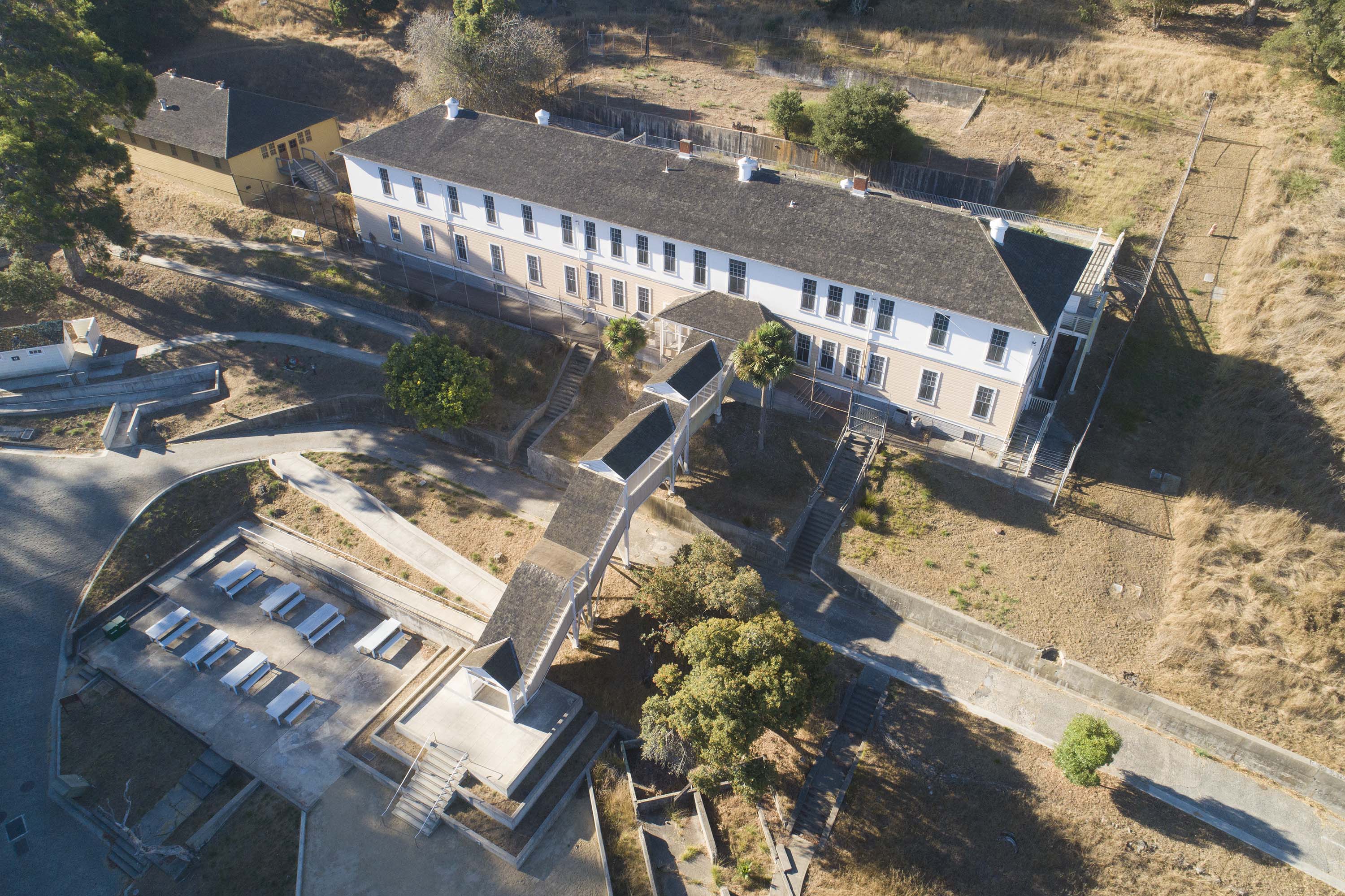
North Garrison at Fort McDowell
Welcome to Angel Island Immigration Station located in the San Francisco Bay area, a historical crossroads for many diverse communities. During this visit, you will learn about the experiences of Japanese Americans whom the US government detained on the island during WWII, continuing a legacy of discriminatory policies targeted at Asian Americans. Along the way, you will hear from researcher Hannah Schoenberger and Angel Island State Park interpreter Casey Dexter-Lee about the experiences of people detained on the island and how this place has changed over time.
Stop 1. Japanese Americans on the Island
The small white wooden pier before you marks the entrance to the immigration station utilized from 1910 to 1940 for the detention and processing of immigrants. During WWII, the US government reused pre-existing buildings for the war effort. The detainment of Japanese American internees on Angel Island during this time was part of discriminatory policies that eventually led to the signing of Executive Order 9066 and the US government's forced removal and confinement of over 120,000 Japanese Americans. Over the course of the war, about 600 Japanese American internees who lived in the territory of Hawai'i and 100 from California, Oregon and Washington were temporarily detained here while awaiting transfer to Department of Justice camps across the mainland US. The US military also used the immigration station to detain Prisoners of War from Japan and Germany, as well as people of German and Italian descent living in the US deemed a threat.
Hannah Schoenberger
My name is Hannah Schoenberger, and in this experience, I'm going to be sharing some firsthand accounts of men who were detained on Angel Island during World War II. Many of them later shared their experiences, allowing us to gain a better understanding of their time here and how it affected their lives afterwards.
Casey Dexter-Lee
Welcome to Angel Island State Park. My name is Casey, and I'm an interpreter with California State Parks. We're at the historic immigration station, which operated from 1910 to 1940. This facility was used to detain immigrants arriving from all over the world, about 80 different countries. The majority of the people detained here were coming from Asia. After the administration building burned down, this site was turned over to the U.S. Army, which had a fort here called Fort McDowell. This became the North Garrison of Fort McDowell. During World War Two this facility held people. The people held here were prisoners of war or P.O.W.s, as well as people with Japanese ancestry identified as 'enemy aliens' by the U.S. government. People came and went here from a dock that is no longer on the island, and there have been many different buildings at this site as well, and uses for those buildings. Over the years, the changes were made to adapt to what was needed for these spaces.
Stop 2. Under Military Control
Located on a hill overlooking the two story barracks building, the wooden guard tower is evidence of the site's transition to an Army- controlled WWII detention center in 1941. At the time, Japanese immigrants to the US including those detained at Angel Island could not become naturalized citizens because of the Naturalization Act of 1790, which stated that citizenship was limited to free white men of good moral standing. When WWII started the US government labeled them “enemy aliens” along with non-citizen immigrants from Italy and Germany. After Japan attacked Pearl Harbor on December 7th, 1941, the FBI and local law enforcement began arresting people they considered to be the highest risk, some of whom were eventually detained on Angel Island. Religious and community leaders, journalists, photographers, and even martial artists were arrested because of their perceived ties to Japan. No acts of espionage or sabotage were committed by Japanese-Americans, whether born here or in Japan, before or during WWII.
Hannah Schoenberger
Otokichi Muin Ozaki was born in Kochi Prefecture, Japan. He was a journalist, a school teacher, a community leader, a flower grower, and a poet in Hilo, Hawaii. Ozaki did volunteer work for the Japanese government to help new immigrants adjust to life in Hawaii. He also taught Japanese at a language school. This, coupled with his proficiency in Morse code, made him a suspicious person to the FBI during World War Two. The FBI did note that no evidence is found that he is engaged in espionage, is a potential saboteur, or is disseminating subversive propaganda, except possibly by teaching school children under his direction the Japanese culture and loyalty to ancestral country. While the FBI says they had no evidence against him, Ozaki was interned for the remainder of the war because of the assumption that by teaching Japanese language, he was loyal to Japan. Ozaki said: When we reported to the Angel Island immigration station in San Francisco, soldiers ordered us to remove our clothing, searched our belongings, and took them all away. A week later, when we were about to be transferred in, our belongings returned to us three watches were found to be missing.
Casey Dexter-Lee
In 1941, the U.S. Army took control of the former immigration station site. The people that were held here stayed in a barracks and there was a mess hall and recreation area. There were additional facilities for feeding American soldiers, as well as barracks for troops that were stationed here at Fort McDowell. There were a few changes that had to be made in the transition from an immigration station to a P.O.W. detention facility, and a place that would come to hold people identified as 'enemy aliens' by the government. There were fences added around the barracks building. There were two guard towers added, but there was already a fence around the entire site that was about eight feet tall, and there was already enclosed recreation areas. These additional measures were changes that were made to further restrict people's movements within the site.
Stop 3. Language of Confinement
Just below the guard tower stands the two-floor barracks building where Japanese American internees were detained. The language used to describe WWII confinement of Japanese Americans reflects the complexity of people's citizenship status and euphemistic terms commonly used at the time. The term ‘internment’ refers to the legally permissible, the morally questionable, detention of ‘enemy aliens’ in times of war. During WWII, the federal government arrested nearly 8,000 individuals across the US and its territories based on these proclamations, including internees detained at Angel Island. This barracks building would be one of many detention centers where they were sent during the course of the war. While detained in the barracks on Angel Island, Japanese American internees discovered a legacy of Asian immigrant experiences carved into the walls.
Hannah Schoenberger
Yasutaro Soga and Kumaji Furuya were both prominent members of the Japanese Hawaiian community in Honolulu, Hawai'i. They were both arrested shortly after the attacks on Pearl Harbor in 1941, and were detained on Sand Island in the Honolulu harbor before being transferred to Angel Island. They both later wrote about their experiences in detention here, using the pen name Suikei Furuya, Kumaji Furuya wrote: Although the physical examination was quite severe, the officers noncommissioned officers and guards were nice to us. Angel Island turned out to be better than I expected. Behind the building was a small field on a hill. Bushes grew around the field and I happened to find apricot flowers blooming among the green leaves. Birds were singing and it felt as if spring were here. I heard the voices of children walking along a road in the middle of the woods beyond. It was the first time I had heard children's voices since being taken from my home just three months earlier, but it felt as if I had not heard this sound for years.
Casey Dexter-Lee
The main building where people were held at this site is the barracks. The first floor had just over 300 beds and unfortunately a healthy capacity of 70 to 80 people. There were also rooms on the first floor used as offices, supply rooms and a room designated for, quote unquote, “unruly prisoners.” The second floor held just over 400 beds. Some of the larger rooms were divided in half to create smaller spaces. Additionally, there was a separate room for prisoners of war that were officers. They were held separately from enlisted men, and there were, doctors offices and an infirmary on the second floor as well. Those healthy capacities are determined at the time by public health standards. So these facilities were extremely overcrowded.
Stop 4. Life in Confinement
Inside room 211 on the second floor of the barracks, bunk beds three levels high illustrate the close quarters where detainees lived. Japanese American internees would have stayed in rooms like this awaiting transfer to another detention center. Others deemed ‘enemy aliens’ along with German and Japanese Prisoners of War, would also have been detained in this building over the course of the war, but likely held separately. While this room is quiet today, imagine this place filled with dozens of men going about their daily lives in confinement. POWs and Japanese American internees carried on traditions of previous immigrant detainees and left inscriptions on the walls.
Hannah Schoenberger
Yasutaro Soga was the editor of a Japanese language newspaper in Hawai'i. He wrote the following about the detention barracks: Living quarters for all 49 of us, were two rooms, about 36ft by 70ft, on the second floor of an old building that had once been the Immigration Bureau office, because there were about 90 internees from California already housed there space was very tight. The beds were tri level bunks with barely enough walking space in the aisles. There were about ten windows and one ventilator, but with 140 occupants air circulation was poor. That night I had difficulty breathing and had a headache. The place reminded me of the Honolulu immigration office soon after my arrest. Using the pen name Suikei Furuya, Kumaji Furuya wrote: Even though I enjoyed the area's scenery with nothing much to do, I became bored. I was walking aimlessly around a big hall when I noticed the walls were covered with graffiti. I was surprised to see that the marks had been engraved, most likely with knives. There were many kinds of graffiti, and I assumed they had been made by Chinese immigrants long ago.
Casey Dexter-Lee
Prior to 1940, the writing we see on the barracks walls is left behind by immigrants detained here. They wrote and carved on the walls, but that was painted over by the immigration officials. On the top layer paint from World War Two is where we see inscriptions mainly from prisoners of war from Germany and Japan. People with Japanese ancestry that were held here, that were solely held for that ancestry, were not considered prisoners of war. The writing you'll find from the World War II era is typically around windows and window frames, sometimes hidden in corners, obviously done with a little bit of discretion to hide it. The words that they left typically were messages to would be rescuers. How many people were in the group, where they had been and where they thought they were going next.
Stop 5. POW Mess Hall
Next to the detention barracks is a small mess hall that was constructed during WWII and built on top of a preexisting recreational space. Records show that Prisoners of War ate at this mess hall, although Japanese American internees may have also utilized the building while detained on the island. Today, visitors to Angel Island can step inside and learn more about the WWII experiences of Japanese American internees who were detained at Angel Island, and the historical events that brought them here.
Hannah Schoenberger
Isoo Kato was an immigrant from Hiroshima Prefecture, Japan. He became a coffee farmer in Kona, Hawai'i, and was a member of the local Japanese school board and hospital board. He was arrested and detained in Hawai'i before being transferred to the mainland. He later wrote: Here at the center are about 14 or 15 Germans and 23 Italians along with us. It is different here from Hawai'i in that we are enjoying more privileges. We are free to bathe and use the toilet at any time. All accommodations are comfortable so it's a good feeling. The dining room is new and the food preparation is sanitary and tasty. The cook in the kitchen helpers were all military men and they treat us kindly. During dinner the German and Italians are together with us. We are all enemies and comrades alike.
Casey Dexter-Lee
The mess hall provided seating for 200 people to eat meals at one time. There are also remnants of what is left behind in the kitchen, like stoves and dishwashers that were used to cook and prepare meals. There was also a wooden path outside the mess hall to sinks where prisoners of war would rinse their trays before they would head to the dishwasher.
Stop 6. Mass Evacuation & Confinement
The inside of this building is similar to mess halls, built in ten Army-style camps where the US government confined Japanese Americans following the signing of executive Order 9066. In March of 1942 when the first Japanese American internees from Hawai'i came to Angel Island, the US government began the forced exclusion and confinement of over 120,000 Japanese Americans. Unlike Angel Island, two-thirds of those confined in the ten camps administered by the War Relocation Authority, or WRA, were US citizens. While sometimes thought of as internees, this group is more accurately referred to as being incarcerated. None of those sent to Angel Island came here as a direct result of executive order in 9066, but many had family and friends who were confined in the WRA camps, where some were later reunited.
Hannah Schoenberger
My ancestors were immigrants from Japan who arrived on the West Coast in the early 20th century. While they didn't pass through Angel Island themselves, their history is deeply connected to that of the people who both immigrated through here and the people who were detained here during World War II. My great grandmother was a picture bride, like many of the women detained here in the 1910s and 20s. My great grandfather was detained by the FBI after Pearl Harbor and sent to an internment camp, separated from his family in North Dakota. He later joined his family at Manzanar, but their separation had a deep impact on their family for decades to come.
Stop 7. Japanese Americans in the Military
The counter separating the kitchen from the dining area is where military personnel would have served those detained on the island their food. For Japanese Americans, there was a fine line in the eyes of the Federal Government as who was seen as a military threat and who was seen as fit to serve. During WWII, Japanese American US soldiers spent time on Angel Island in other areas while training and serving as linguists for the Military Intelligence Service. More than 33,000 Japanese Americans served in the US during the war despite the questioning of their loyalties and mass evacuation and confinement. Records show that 210 of those who served were sons of Hawaiian internees detained on Angel Island. Seven of those were sons killed in action.
Casey Dexter-Lee
During World War II, soldiers stationed here had many different jobs, everything from KP or kitchen patrol duties to serving overseas. Fort McDowell shipped soldiers to the Pacific campaigns, and most of the folks leaving here were replacement troops traveling to areas where other soldiers had already been injured, or had become ill, or had died in battle. They replaced those soldiers to refill the ranks. At the end of World War II, soldiers came through here to be discharged and sent home.
Stop 8. Separation & Uncertainty
This mess hall would have served Japanese American internees for a relatively short time before they were sent to other detention facilities. After Angel Island internees were moved along several different routes that typically ended at the Santa Fe Internment Center in New Mexico. Some families of the internees who were arrested in Hawai'i made the difficult decision to leave their homes in Hawai'i to join their loved ones at WRA camps in places like Jerome, Arkansas, and Gila River, Arizona or the Department of Justice's Crystal City Family internment camp in Texas. Families of West Coast internees were forced to live in WRA camps after Executive Order 9066. While some internees would be reunited with their families at these camps, others would have to wait until the end of WWII. Those who requested repatriation to Japan were sent to the Tule Lake Segregation Center. Many changed their minds due to family objections or after learning of the dire conditions in the country.
Hannah Schoenberger
Throughout this experience, I've shared quotes from some of the men who were detained on Angel Island during World War II. For all of these men, Angel Island was not the first nor the last place they would be interned. During World War II. Otokichi Muin Ozaki left Angel Island and was transferred first to Fort Sill, Oklahoma, then Camp Livingston, Louisiana, then Santa Fe, New Mexico. His family elected to leave Hawaii and join him at the Jerome concentration camp in Arkansas. He returned to Hawai'i after the war and continued his work as a poet and journalist. After Angel Island, businessman and poet Kumaji Furuya was interned at camp McCoy, Wisconsin, Camp Forest, Tennessee, Camp Livingston, Louisiana, Fort Missoula, Montana, and finally Santa Fe, New Mexico. He returned to Hawaii in November 1945, where he returned to his work as a businessman and continued his literary pursuits. After Angel Island journalist Yasutaro Soga was sent to the Lordsburg camp in New Mexico and later the Santa Fe Camp, he returned to Hawai'i in November 1945 and continued his work as a journalist, working for the Hawai'i Times. Coffee farmer Isoo Kato left Angel Island to be transferred to the Fort Sam Houston Internment Camp in Texas. He later was sent to the Lordsburg Camp in New Mexico and finally the Santa Fe Camp, also in New Mexico. He returned to Hawai'i in November 1945.
Casey Dexter-Lee
After World War II, the former immigration site went unused for many years. In the 1970s, a park ranger going through the building out of curiosity was one of the staff that noticed writing on the walls here. That writing was the poetry left behind by immigrants detained between 1910 and 1940. That led to a movement from the community to save this building from destruction. The path this site might have taken was to become camping and picnicking areas, but instead the buildings were preserved to make sure that this story was never forgotten. Remodeling to the facility was done in the 1980s, 90s, and early 2000 to bring it to the condition it's in today.
Stop 9. Remembering Injustice
The WWII history of the Angel Island Immigration Station is one of many layers of Japanese American experiences at the site. Since WWII, grassroot community efforts led to the US government's acknowledgment of past wrongs committed against Japanese Americans during the war. With the Civil Liberties Act of 1988, the government issued an official apology and reparations to survivors. Most of those who were detained on Angel Island were no longer living. Today, the immigration station stands as a testament to the resilience of Japanese American immigrant communities.