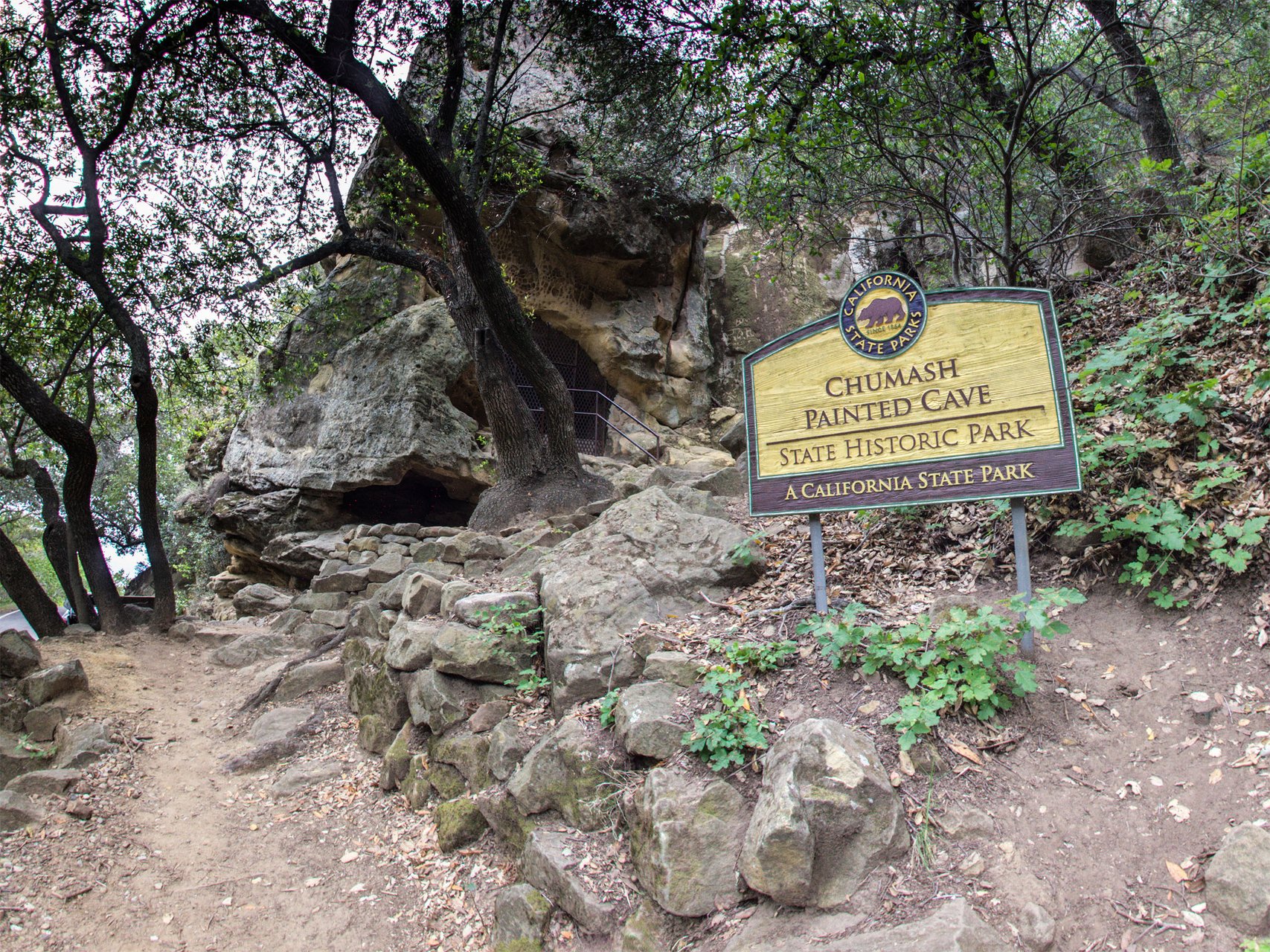
Welcome to Chumash Painted Cave
[Music] Welcome to Chumash Painted Cave State Historic Park. named after the Chumash people who painted this cave and who have lived in this area for over 13 000 years since time immemorial. On this visit you will learn about people's unique relationships with this place in the past and its significance for Chumash people today. Along the way you will hear from Ernestine Ignacio de Soto whose family has been deeply connected to this place for generations.
Stop 1. History of Chumash Painted Cave
Chumash painted cave lies within the territory of the Barbareño Chumash, whose ancestral lands spread from the coast foothills and to the southern slopes of the Santa Ynez Mountains, making them one of the largest and most influential cultures in California. Likely use during the summer and fall. Chumash Painted Cave was located off of a major trail linking the main historic period Chumash settlement, Syukhtun. Modern Santa Barbara with other villages throughout the area. When the Spanish, Mexican and later American settlers came to the area, they used the same trail later called San Marcos Pass as a stagecoach road and was later paved into the highway we see today, but now connects Painted Cave Road to the main highway.
Ernestine Ygnacio de Soto
My name is Ernestine Ygnacio-De Soto, and I am connected by way of the fact that that painted cave across the creek there runs right into our Indian orchard known as the Alacon, and where we've been, for gosh, years. And it means a lot to my people up there. Back in the day, I can't say exactly when. And so it has a special meaning for us and I believe hopefully all Chumash.
Stop 2. Visiting with Respect
Thank you for your help to preserve this very special place by leaving your name, a comment, or even a picture in the log book located at the site. Some visitors over the years, unfortunately, carved their initials into the soft sandstone and moss, creating long term damage to the site and inspiring others to do the same. Sadly, this damage creates visible pollution surrounding the cave. Please help protect this special place by using the logbook, taking only pictures and leaving only footprints.
Ernestine Ygnacio de Soto
I hope you're going in there with a good heart. Don't go in there with all your treats and goodies and or whatever, and burning incense or sage or whatever, and go in there with an actual idea of why you were there, what you expect to get out of there, and what you would think you're going to learn and what you think you learned. And be respectful when you go there. That's what you should do and get and then report back to me.
Stop 3. History of the Park
In the late 1960s, the land containing Chumash painted cave was part of the private property of Robert Hyde. Recognizing the fragile condition of the cave, Robert began to work with Campbell Grant from the Santa Barbara Museum of Natural History to transfer the land to the state for nearly ten years. Grant exchanged letters with governmental officials and nonprofit organizations advocating for the preservation of this important cultural site. Grant wrote in California, With its phenomenal and aimless growth, the vestiges of our past, particularly those of our Indian heritage, are being swiftly engulfed by the bulldozer and subdivision or the brainless activities of the Sunday vandal with his paint spray can and rifle. At this time, no singular major rock art site is protected by the state of California. Such protection should come soon or it will be too late. In 1976, Grant's continuous work paid off, and the Chumash Painted Cave State Historic Park opened to the public, adding interpretive signs a formal path and railing.
Stop 4. Unique Geology
All along the outside of the cave, you will notice many holes that appear to have been drilled in this type of erosion is called tafoni weathering and can occur under various conditions, such as salt weathering, wetting and drying or freezing and thawing cycles at Painted Cave. This erosion may occur when wind and water loosens larger grains of sand, eroding it away and continuing to make the hole larger. This same erosion process is what created the cave in the first place. Just inside the iron gate are examples of tafoni weathering. Also found along the outside wall due to the softness of the sandstone wind erosion easily sculpts the stone. However, this type of erosion has contributed to the degradation of the cave painting itself. Looking towards the back of the cave, a clear gap can be seen between the two sides of the painted ceiling. Exposure to wind and water from the cave opening represents the greatest threat in the preservation of paintings.
Stop 5. Rock Art & Pigments
A unique quality of rock art is that we are immediately connected to the artist. We are privy to a single moment in time where a finger or brushstroke left its mark. In some instances, the artist left behind their fingerprint. Two ways in which rock art is made is either by finger or brushes into Chumash painted cave. The thick lines may indicate the use of fingers along the east wall. The painting continues, revealing the remains of black and white striped figures. Inside the cave, you will see three colors used black, red and white. These pigments were made by grinding down charcoal ocher and diatomaceous clay to keep them permanent on the wall. The pigments require a binder agent such as animal fat, certain types of sap or grease. Saliva would also work, or sometimes even blood was used. Therefore, the binders are just as important as the pigment themselves.
Ernestine Ygnacio de Soto
To introduce to people who've never been here before or know anything about it. To me, it's like taking you on a mini short tour through the Sistine Chapel, if you will. It's out of the way and it's loved and revered. I'm talking from the past by the Chumash, you know, the Indigenous people here that have been here for like over 13,000 years. They are the Indigenous people to this area, which, you know, cover from the San Luis Obispo down to Malibu and from what is New Cuyama even, I think a spill over some in Bakersfield and to the islands out here. And it doesn't mean we didn't travel. We didn't just stay in one place. When we had our village life, not to say it was perfect, it was not, but it was working for us. We had a specific job, a specific place, a specific title, and we it ran like a fine machine. But in the whole you had your village, you had your women who had their job. Not to say, I'm sick of hearing, you know, the ERA business. We had, we knew we didn't, we weren't forced. We knew we had to take care of the children. We had to take care the plants, the meals. You realize what it is to do acorn flour. It would take me all day long. Now, I utilize your appliances and John’s. And we, our men would go out and do all the hunting and they'd take the you know, the pubescent and never say, boys, you know, out there to learn because they have to carry it on. And the point is, we were taking care of the children and teaching them the little ones. And we were hunters gathering and making the foods. And when they brought things home, like the acorns and all that, we had granaries so that nobody in the village like myself, I couldn't go out and do that. But I would never go hungry. Do we do that today? I don't think so. And we all raised our children as a village.
Stop 6. What do the paintings represent?
What do these symbols mean? Not everyone might have known what these symbols meant in the Chumash world when they were created. Knowledge like this was often restricted to specific Chumash individuals connecting with the spiritual world. Today, much of that information has been lost due to the effects of colonization.
Ernestine Ygnacio de Soto
Well, the Painted Cave is known in Barbareño, according to my great-great-grandmother, as the ‘alaxulux’en. It's overwhelmingly beautiful and connects me with my people. And I myself have my wondering about what it all means, what they're trying to say or what they're just journaling, if you will. Each tribe or person or whoever is coming through says there's so much in there that people have different ideas [of] what it means. And I for myself, can't really say, you know. I’d have to be some kind of mind reader, but it pretty much depicts the animals and what transpired and what's coming through and maybe what it is in the future. So, and the colors are absolutely, you know before the wear and tear, magnificent like someone was saying about the reefs in the coral reefs and their brilliance that is fading. So that's what it means to me and why it's important that I hope everybody else can see that.
Stop 7. Possible Meanings
A more recent interpretation suggests that members of the ‘antap Society, a group of religious specialists that consisted of high ranking members of a tribe, depicted celestial bodies such as the sun, moon and stars as supernatural beings. These paintings were meant to maintain balance in supernatural forces around them while preserving the Chumash people with their past. In 1677, the area around Painted Cave experienced a totally clips and two of the brightest stars in the sky. Mars and the Red Supergiant and Antares created a triangle with the sun, argued to have been documented here. The black circle is said to represent the total eclipse. The star with legs would have represented Mars as a wandering star while Antares is on the right.
Stop 8. Thank You For Visiting
Thank you for visiting Chumash Painted Cave State Historic Park. On this tour, you saw rock art from within the cave and heard from Barbareño Chumash elder Ernestine Ygnacio De Soto. California State Parks is committed to working with indigenous communities to protect California's most valued natural and cultural resources. We seek to inspire and educate the people of California as well as provide equitable access to parks through projects like this virtual tour. The Channel Coast District of California State Parks appreciates the opportunity to partner with Ernestine Ygnacio De Soto. The Santa Barbara Museum of Natural History and CyArk to provide this experience for our visitors. Thank you for respecting this culturally and historically significant place. We hope that you will continue to learn about the Chumash people of today and their history throughout the region.
Ernestine Ygnacio de Soto
My great great grandmother also had, you know, quite a bit of land and used to run her cattle up, up past the Painted Cave. And it was an area that everybody was passing through. And I'm sure they stopped, and I don't know about my great, great grandma, but she used to do ceremonies, so maybe she did ceremony in there. I don't know if she would do ceremony for More Mesa. And that was to the ocean. And so if she did that, she must have done something in the Painted Cave. It's nice to be able to know you have a place to go. It's kind of like knowing you have a church to go to. Same thing. It's comforting.