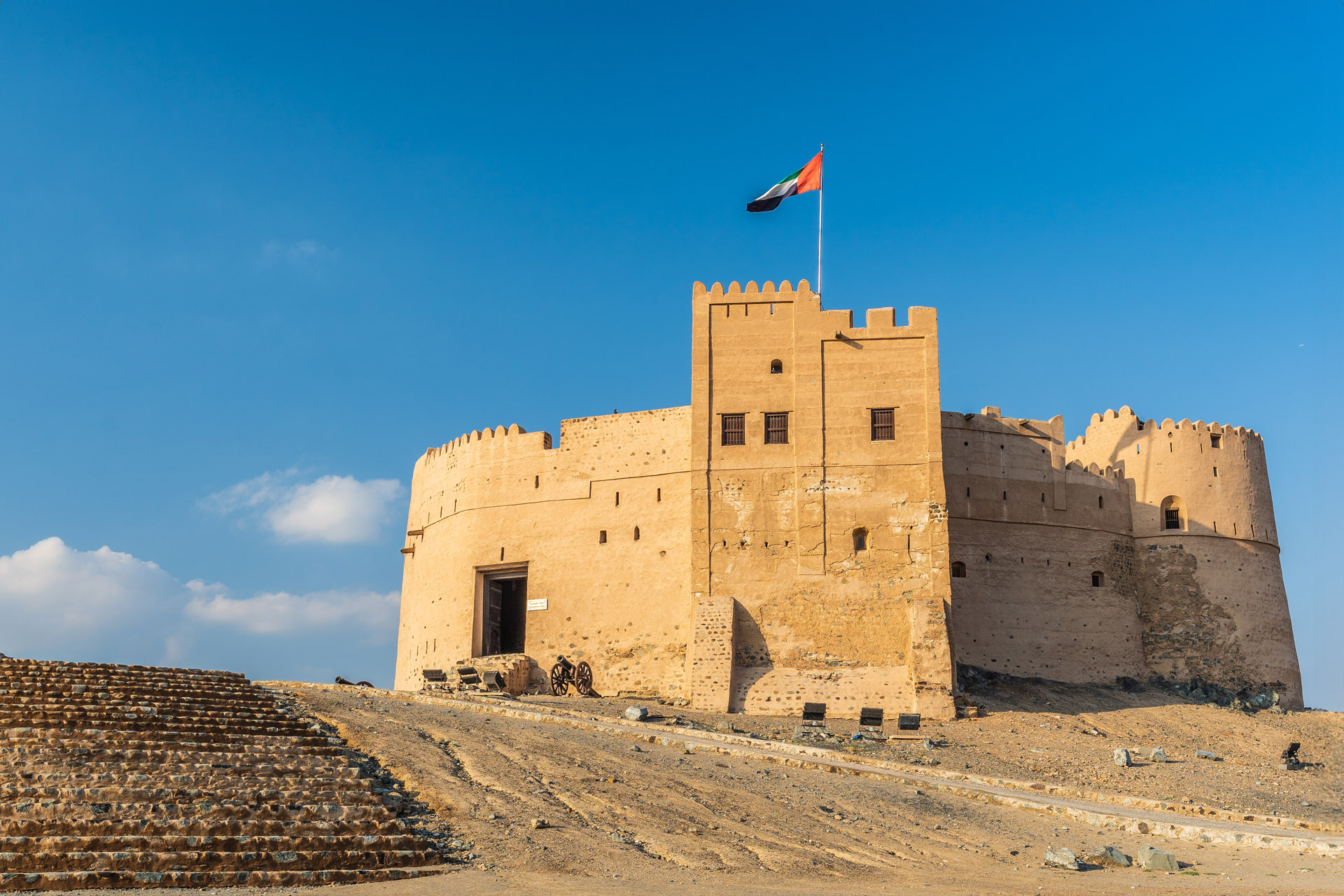
Fujairah Fort
[Lyrical middle Eastern flute] Marhaba and welcome to Fujairah, one of the seven emirates of the United Arab Emirates. From this vantage point above the beautifully restored Fujairah Fort, you can gaze down across the vibrant heritage district. Nestled between the rugged Hajar Mountains and the crystal-clear waters of the Gulf of Oman, this area is a testament to the Emirate’s living heritage. Surrounding the fort are traditional houses and mosques—all vivid illustrations of the emirate's dedication to preserving and celebrating its distinctive culture. As you walk these storied grounds, local experts Jamela Farhan, Salah Hasan, and Amrik Plaha as well as longtime residents Fatima Al-Kaa’bi and Hmead Al-Mtawwaa will share their stories and insights, helping you connect with the vibrant history and traditions of this remarkable community.
Stop 1. Entering the Fujairah Fort
You have just been transported to the grounds facing the Fort. The two wooden doors and staircase, replicas of historic originals, now welcome visitors who come to admire the fort, which was completely restored in 2000. The Fujairah Fort is considered one of the oldest and most significant historic forts in the UAE and is home to a mosque and a restored old village that highlights the traditional ways of life in this region. As you delve deeper into the old village, consider the building materials—clay, mud bricks, wood, coral, and limestone. These materials emphasize the fort's embodiment of traditional Arabian architecture and building techniques, offering a tangible link to the past.
Jameela Jumah Farhan
Welcome to Fujairah Fort. We are currently at the main door of the fort, which was historically known as the Gate. It consists of two separate doors. The smaller door is called the Farkha. Our guards previously used the Farkha to enter and exit discreetly, ensuring confidentiality. Now, let's continue our tour of the castle.
Humaid Ali Obaid Al Yammahi
The fort played a crucial role in protecting the emirate 100 years ago. After that, it became primarily a lookout for fires, God forbid. It was considered one of the symbols of the emirate, representing its pride and heritage. This fort was a significant symbol of the emirate, with soldiers stationed there around the clock, ensuring continuous vigilance and protection.
Salah Ali Hasan
Fujairah Fort is one of the most important and largest forts in the region. It is unique because it was built on an irregular rock formation. The fort dates back to the early 15th or 16th century. Over the years, it has undergone many phases and several restorations. However, most of the previous restorations were unscientific and not systematic. In 1998, we began a scientific restoration project, which continued until the year 2000.
Amrik Plaha
This material is basically built with stones, gypsum, and sarooj (plaster); those are all three materials, all this one, you know. But then when I restored this, I used steel. I used cement also, white cement also all these things I have I have used it to just make it more reliable, more long-living, you know. But outside we, we are always using sarooj or gypsum. We cannot use gypsum close to the ground because gypsum has a tendency to attract water. But if you say lime, you know, sarooj is a lime-based material you know, it's a lime-based material, lime is calcium oxide, so there's no water in this one. And sarooj is clay and limestone burnt together with a palm log fire. They don't remove the ashes of the palm logs; they mix them with this one because ash is a water repellant also. Then you have lime in this one, and clay is burnt up to, I think it's 500° or 600° Celsius, and then it becomes Sarooj, you know, then they grind it. That sarooj is better than gypsum but it is close to the ground you know it does not let the humidity suck from the ground.
Stop 2. Narrow corridors
As we step through the grand doors, the fort's narrow corridors unfold before you, highlighting the ingenuity of its builders. The fort in this location was built in the 16th century and has been restored several times. It is considered a historical landmark, playing an instrumental role in resisting colonialism by fortifying its defenses with three circular watchtowers and a square tower connected by a main courtyard. The fort's strategic location, built on a knoll, overlooked the old village. Today, the fort symbolizes the ruling family's enduring legacy and commitment to protecting the population's cultural heritage.
Jameela Jumah Farhan
In the name of God, the Most Gracious, the Most Merciful. We are currently in the main corridor of Fujairah Castle, where the guards used to sit and place their weapons on pegs on the back wall, alongside the niches where they placed lanterns. Entering this corridor, one can sense the beautiful past and appreciate how our people maintained security and safety in the emirate.
Humaid Ali Obaid Al Yammahi
The fort was struck by a cannon in 1925 and was initially rebuilt using adobe, a mixture of mud and hay. However, by the mid-sixties, it began to erode. It was then reconstructed with bricks and cement. In 1997, the restoration aimed to preserve its original appearance, so it was rebuilt using the same red gypsum material that was used the first time. This effort ensured that the fort retained its authenticity.
Salah Ali Hasan
The beginning of the restoration of the Fort brought joy and pride to the citizens because the fort represents a historical and national memory for them. Most generations had only seen the fort in its dilapidated state. The restoration was not just well-received; it was met with great enthusiasm and praise. There was immense joy and happiness after its completion, as the community witnessed the castle being restored to its former glory from 500 years ago.
Amrik Plaha
Restoration is not my profession; it's a passion for me, you know, for me. And now people have started understanding also. Now the children love to come here when they see the houses of their grandfathers & great grandfathers. They feel happy from inside, you know, and you cannot describe that happiness with words, you know. I also have a very special connection with the heritage of Fujairah, but I don't know why. It's 27 years now, but I have a feeling when I come here, I will feel relaxed. (deep sigh) I'm here.
Stop 3. The Courtyard and Defense
Today, the courtyard within the Fort is a serene oasis nestled within the ancient walls. However, in the past, this area was off-limits to everyone except for the guards who kept watch over it. During raids or times of danger, locals would take shelter in the mountains or valleys (wadis) behind the fort, while soldiers stayed behind to protect the site and the surrounding village. As you explore the courtyard, imagine growing up here and what life might have been like 200 hundred years ago.
Jameela Jumah Farhan
We are currently in the central courtyard of Fujairah Fort and can feel the calm that permeates these grounds. The weather is pleasant, and birds are flying above us. However, the fort was also a first-class defensive structure, featuring three circular towers and a fourth square tower, all connected by a wall. The wall features numerous small windows from which soldiers could defend the fort and surrounding area.
Humaid Ali Obaid Al Yammahi
Here, there used to be a wall with palm tree trunks positioned right in front. If, God forbid, enemies managed to enter the courtyard from above or through the door, the soldiers would push the trunks down to block their entry into the undefended square. This was a crucial defensive measure. It's important that these palm tree trunks, are preserved as part of our heritage, as they were essential for the fort's protection.
Stop 4. Madbasa - Date Molasses Room
Off the main courtyard is the Madbasa, where date molasses (dibs) was prepared—illustrating the region's enduring agricultural traditions. This room, with its floor grooves and depressions for collecting the syrup, showcases the traditional methods used to create this staple food. Dates, integral to the local diet and culture, continue to thrive in the neighboring groves, representing the importance of this sweet, nutritious product in both past and present-day culinary practices.
Jameela Jumah Farhan
We are currently in the Madbasa, or date molasses room. This room is notable for the grooves in the floor where dates are pressed, and the sweet molasses flows down into the circular hole and is collected in jars. Adjacent to the Madbasa is a small prison that was used in the past. Dates are a vital ingredient in both our traditional and modern dishes. As in the past, today, they are still used in sweet treats such as qaymat and churros.
Fatima Rashed Mohammad Al Kaa’bi
We use [dibs] for "girs" (a type of bread). Some people prefer it on large round flatbread, and this is what we use for that. Some enjoy it with honey, while others like it with date syrup. We use pure, clear date syrup filtered from dates. It's very good. For example, we make bread with roasted date syrup by adding the syrup to the bread dough while cooking. Some people prefer to add the syrup afterward, pouring it over the bread along with Arabic ghee. They say it's delicious.
Salah Ali Hasan
Processing dates to create molasses is very common here. In the past, people even did it in their homes. Why? Because date syrup, or date honey, is a very important part of the diet. It's especially relied upon for breakfast, particularly in the winter. People used to rely primarily on dates and fish, as these were essential foods. This practice continues because date syrup is a clean and nutritious food.
Stop 5. The Northern Tower
As you ascend the Fort's north tower, you have the opportunity to view the stunning surrounding landscape in all directions - a panoramic view that showcases the rugged beauty of the region. The fort's walls and surrounding area give way to a lush expanse of date palms amidst the arid surroundings. Looking away from the sea, the majestic Hajar Mountains stretch towards the horizon. The sharp peaks of the mountains cast long shadows in the afternoons, forming a natural defensive barrier. From this vantage point, you can see the unique geographical diversity of the region, from its fertile valleys to its stark mountain ranges.
Jameela Jumah Farhan
We are now in the North Tower, one of the most distinguished and remarkable towers in Fujairah Fort. This tower is characterized by its central circular column and offers a breathtaking view of the Emirate of Fujairah. From this vantage point, we can gaze upon the lush farms encircling the fort, the clear sea, and the majestic, picturesque mountains.
Stop 6. Home of the Sheikh
Located just 150 meters south of the Fujairah Fort lies the house of Sheikh Mohammed bin Hamad Al Sharqi, a traditional house built in the old Emirati style, characterized by its solid sturdy walls made of stone and mud. The house consists of several rooms grouped around a central inner courtyard. It is known for its low roof, which was designed to cool the building during the hot summer months. The house is also distinguishable by its small, hand-carved windows, which reflect the traditional craftsmanship of the region. These houses are an important part of the UAE's heritage and are considered cultural landmarks that invite visitors to explore the history and culture of the UAE.
Jameela Jumah Farhan
Now we are in the grand house, known as the House of the Sheikh, specifically the house of Sheikh Mohammed bin Hamad Al Sharqi This house was a central place for the people of Fujairah, where they could come to meet the Sheikh, greet him, or request assistance. It was always open to everyone, whether they were guests from near or far. Our current ruler, Sheikh Hamad bin Mohammed Al Sharqi, was born and raised here. He had his own room where he lived and studied, creating many cherished memories of this place. The house has many notable features, including the courtyard where the Sheikh sat and held council, welcoming guests. There is also a private office where he attended to important papers and matters concerning the emirate. Although it is the ruler’s house, it also served as a family home, connecting the people of the eastern region with the ruler’s family. We like to bring visitors here to show them how life used to be, highlighting the simplicity of living in the past. This house, despite being large, shares the same building materials and details as the surrounding houses. I mean, the only difference between it and the other houses is that it is the size of the house and the compound. This closeness signifies that the Sheikh did not distance himself from his people but lived among them, opening both his heart and home to everyone in the region.
Salah Ali Hasan
Locally, it's very beautiful to see these generations learning about the old Fujairah village. They can see how the village was, how the locals lived, and how they struggled for a decent living. They also learn how the villagers utilized local resources and the natural environment for their development. This history shows the journey from those times to today's prosperous community. For the young ones, it opens their imagination, It actually brings them back or connects them connecting them to the past and bringing history to life.
Stop 7. Community Architecture
Located east of the fort is the house of Sheikh Abdullah Bin Hamdan Al Sharqi, a distinctive architectural structure consisting of two floors held up by thick walls. The front facade opens onto the interior courtyard of the house. The old village in Fujairah is characterized by its rich heritage and traditional architecture that reflects the authenticity of life in the emirate during those periods.
Jameela Jumah Farhan
We are currently in the house of Sheikh Abdullah bin Hamdan, known locally as the House of Art. This house has been taken over by the Culture Authority and transformed into a center for educational courses and cultural workshops as well as manual workshops affiliated with the Culture Authority. It also hosts heritage and national celebrations.
Humaid Ali Obaid Al Yammahi
Among the things I remember now is the way houses were built, either as a storehouse or a larder. These start with clay. Here, locally, they used to call it "toul," and in Arabic, it's called "al-laban." It's basically regular clay put in a mold to make bricks. This clay is mixed with straw to give it strength. When they build with the bricks, they make what we call "al-salha," which is in English, "the plaster," also mixed with straw.
Fatima Rashed Mohammad Al Kaa’bi
We made lots of memories in this area, especially at the Sheikh's house. In the mornings, we would have breakfast there, knocking on the door to join them. My mother, may Allah have mercy on her, used to work for them before coming home to her children. It seemed like everyone worked at the Sheikh's house. My father, may God have mercy on him, was given a piece of land with palm trees by the Sheikh. We planted and worked there, my father, my mother, and I. We were always around this area, eating and drinking together Every house had food, and sharing was normal.
Stop 8. Religion and Community
Just a few steps East of the fort is Muhanna Mosque, often called "the old mosque" by locals. Built at a modest cost, it remains a cornerstone of community life for the residents of the historic village. After prayers, people linger to inquire about each other's well-being, noting who attended and who might need assistance, fostering a strong sense of community. This tradition of care and community connection persists, with mosques throughout the country serving as vibrant hubs of spiritual and social life.
Jameela Jumah Farhan
now we are at the old mosque, which has more than one name: The Old Mosque, Muhanna Mosque and Ibn al-Haytham Mosque. This mosque has changed over time, especially in its size. It includes a prayer hall for men, a well, and some space for prayer. Outside, there is an exterior courtyard. Over the years, the mosque has expanded, and now it covers a larger area than before. Additionally, a women’s prayer hall has been added in recent times.
Humaid Ali Obaid Al Yammahi
Yes, the mosque really did serve as a gathering place, especially on Fridays. On Fridays, everyone prayed together and checked on each other. However, back then, people met daily unlike now. Today, people only meet in the mosque or at events, often for condolences or on Eid. Unfortunately, people have become isolated. In the past, people would meet anytime. They would pray Fajr, have breakfast, and then go to the farm, the sea, or wherever they worked. They would meet again at noon, in the afternoon, and after Isha. Now, people don't meet as often. Before, everyone knew each other without needing the mosque. Now, people rely on the mosque more than ever.
Fatima Rashed Mohammad Al Kaa’bi
The old mosque, they used to call it Muhanna Mosque, had a minaret. My grandfather used to lead the call the prayer from there. It was close to our house, and you could hear the call to prayer from here. Praise be to God.
Stop 9. The Sablah - Community Mediation
To the far south of the Fort is the Sabla, an age-old Emirati term that refers to the place where the Sheikh gathers with the residents of the village to confer on daily matters and community issues. The Sabla is part of the famous Emirati culture of hospitality and generosity, where guests are welcomed, Arabic coffee is served, and news and information are exchanged. It serves as an integral social center in traditional Emirati life, facilitating discussions on various issues and decisions critical to the community. Additionally, the Sabla hosts popular events, celebrations, and social gatherings.
Jameela Jumah Farhan
One of the important sites in the heritage village is Al-Sablah, which is a place where the sheikh used to sit after daily prayers and hear from local residents.
Humaid Ali Obaid Al Yammahi
People used to sit in the majlis, each one in front of his house, or in the "sabla", which is a paved area in front or under the shade of a "ghaf" tree or a sidra (date palm). This is where people would gather to discuss, what they did that day and where they went, reflecting their simple way of life. Yes, there used to be specific times or occasions when people gathered to tell the sheikh their problems and complaints So he could solve them. However, there wasn't always a specific time; anyone who wanted to could go at any time. Life was very simple back then, and minor issues wouldn't reach the sheikh. Each person would handle their own complaints. For major problems, such as tribal conflicts, they would go to the sheikh. However, minor problems were usually resolved among themselves without involving the sheikh.
Stop 10. Conclusion
The fort and the surrounding old village are framed by Fujairah's unique and modern skyline, providing a glimpse into the emirate's past. The village is a testament to the emirate's dedication to preserving its history, with heritage houses, antique collectibles, and artifacts that shed light on the lives of the people who called this place home. As our virtual exploration wraps up, we extend an invitation to truly immerse yourself in the warmth and hospitality of Fujairah by visiting in person.
Jameela Jumah Farhan
Thank you for joining us on the virtual tour. We hope you can join us in person for a real tour in the Emirate of Fujairah. During your visit, you will meet many friendly faces and discover even more of the landmarks in Fujairah.
Humaid Ali Obaid Al Yammahi
What I wish for them [young people], and I pray to God Almighty, is that He guides them and reconnects them first to their religion and their country, their customs and traditions, and their relatives. The distance between religion and family has increased so much that people don't know their brothers, their fathers, or their own country. It has become a tragedy in the present time. My wish is that people return to their roots, fostering social cohesion and promoting strong community bonds.
Salah Ali Hasan
What makes us proud and fills us with admiration and pride for this community is the growing awareness of the value of heritage. We see it becoming stronger and stronger in society every day. Even young children are deeply interested in heritage and regard it with great affection. Alongside this immense love, we hope that this interest will continue to rise, fostering feelings of care, pride, and love for our heritage.