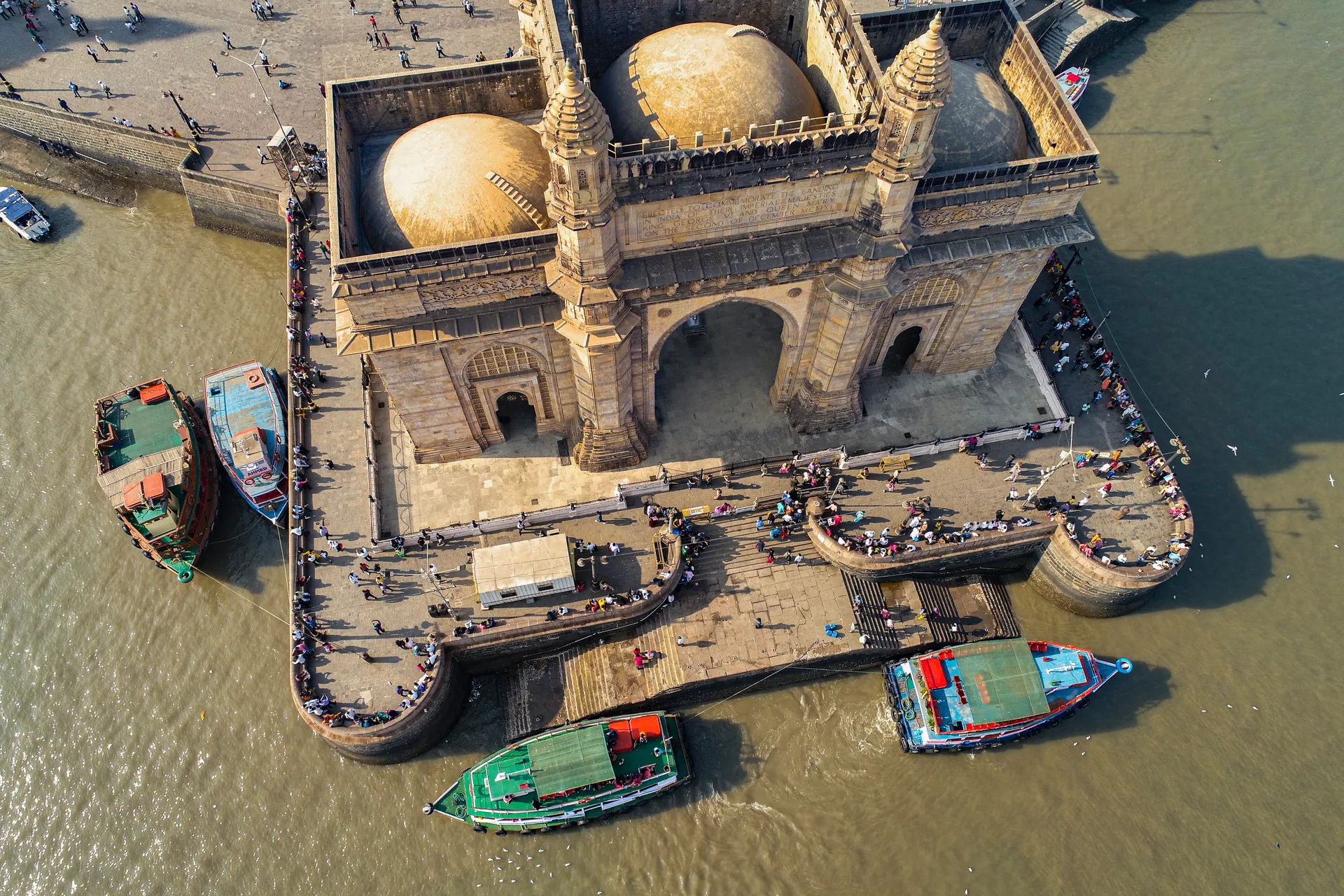
This is a companion guide to the interactive 3D virtual tour: Gateway of India. You can click here (Opens in new tab) to begin the tour.
Story outline
Each stop is a location within the virtual tour. Use the "Explore in 3D" button to jump straight to any stop.
-
Welcome to the Gateway of India
Explore in 3D: Welcome to the Gateway of India (Opens in new tab)Perched on Mumbai’s bustling harbor, the Gateway of India embodies colonial-era architecture and civic memory. Built during British rule, it has witnessed arrivals, departures, and public life; today it stands as both preserved monument and vibrant focal point of the city’s waterfront. -
Stop 1. An Imperial Gateway
Explore in 3D: Stop 1. An Imperial Gateway (Opens in new tab)Though commemorating the 1911 royal visit, the Gateway began as a temporary plaster arch; the enduring stone structure was later erected on Mumbai’s waterfront to project imperial ceremony, authority, and a monumental entrance shaping the city’s colonial identity. -
Stop 2. Gateway to the Harbor
Explore in 3D: Stop 2. Gateway to the Harbor (Opens in new tab)From the harbor, the Gateway stands as a dynamic waterfront threshold where ferries and boats unite Mumbai with distant shores. More than a landmark, it marks arrival and departure—its meaning forged by history and the continuous movement of people across land and sea. -
Stop 3. A Place to Gather
Explore in 3D: Stop 3. A Place to Gather (Opens in new tab)The Gateway of India is both monument and meeting place: a waterfront agora where locals and visitors gather, photograph, and linger. Everyday use has animated its colonial origins, transforming it into a living symbol of Mumbai’s communal life and evolving identity. -
Stop 4. Built to Last
Explore in 3D: Stop 4. Built to Last (Opens in new tab)Carved from durable yet workable trachyte, the Gateway combines structural strength with finely modeled details. Its monumental presence reflects both scale and the practical choice of volcanic stone, marrying robustness and refinement in a lasting architectural statement. -
Stop 5. Weathering the Waterfront
Explore in 3D: Stop 5. Weathering the Waterfront (Opens in new tab)Sea air, humidity, and pollution have darkened and eroded the Gateway’s stone. Ongoing conservation by the Directorate of Archaeology and Museums—repeated cleanings and care—protects its appearance and underscores that preservation is a continual part of the monument’s life. -
Stop 6. Shape of the Monument
Explore in 3D: Stop 6. Shape of the Monument (Opens in new tab)The Gateway’s central arch flanked by two pavilions uses pointed arches and symmetrical composition to create a formal, ceremonial silhouette. Drawing on regional Islamic architectural traditions, it commands Mumbai’s waterfront and remains an instantly recognizable civic landmark. -
Stop 7. Ornament and Architectural Detail
Explore in 3D: Stop 7. Ornament and Architectural Detail (Opens in new tab)The Gateway’s delicate jali lattice frames the threshold between interior and exterior, admitting light and breeze while linking the monument to South Asian architectural traditions. Such details reveal how regional materials, forms, and crafts shaped its design alongside colonial influences. -
Stop 8. Changing Meaning
Explore in 3D: Stop 8. Changing Meaning (Opens in new tab)Erected under British rule as imperial symbolism, the Gateway of India later witnessed the 1948 departure of British troops, transforming into a layered monument. It now embodies both colonial legacy and post‑independence memory, reshaped by public life and evolving meanings.
Voices
Hear Stories From Locals & Experts
-
Dr. André J.J. Baptista (PhD)
Lecturer and Consultant
CyArk
André Baptista is a lecturer and consultant in Ancient Indian History, Culture & Archaeology. His research interests include prehistory, man-land relationships, landscape evolution on the one hand and colonial history, urban development and shaping of socio-cultural spaces on the other. He has a doctorate in Landscape and Environmental Archaeology from the Deccan College Postgraduate and Research Institute, Pune, India. André has represented Universities as well as the Archaeological Survey of India at a number of explorations and excavations at sites ranging from the prehistoric to the early medieval.
Gallery
Partners

About the Project
This Tapestry experience was developed using 3D data collected by CyArk in 2017 and combined with expert interviews with archaeologist and professor Dr. André Baptista. It is designed to share the history, architecture, and meaning of the Gateway of India, offering a closer look at one of India’s most recognizable monuments.
Related Links
Credits
The 3D documentation of the Gateway of India was made possible through a grant from Seagate. Special thanks to Dr. André Baptista and the Directorate of Archaeology and Museums, Maharashtra, for their support and collaboration. Translation and voiceover work by Ms. Riddhi Joshi.