Welcome to the Gateway of India
Welcome to the Gateway of India, one of Mumbai’s most familiar landmarks. Set along the harbor in one of the world’s largest cities, this waterfront is alive with motion: waves against the shore, boats crossing the water, and the steady rhythm of people gathering at the edge of the city. Built during British rule, the Gateway carries a layered history of empire, architecture, and public life. Today, it remains both a major historic monument and an active part of Mumbai’s waterfront, cared for by the Directorate of Archaeology and Museums. As you explore, consider how this place connects past and present through movement, memory, and the enduring life of the city.
Stop 1. An Imperial Gateway
The Gateway of India was built to commemorate the 1911 visit of King George the Fifth and Queen Mary. Yet the story is more complicated than the monument’s plaque suggests. At the time of their visit, the structure standing here was only a temporary ceremonial arch made of plaster and cardboard. The stone monument we know today came later, built as a permanent statement on Mumbai’s waterfront. From the beginning, the Gateway was meant to do more than mark an entrance. It was designed to project ceremony, authority, and imperial presence at the edge of the sea.
Dr. André J.J. Baptista (PhD)
The plaque installed on the Gateway of India on its land facade, and its sea facade read that the gateway was constructed to commemorate the visit of George V and Mary of Teck, King and Queen of England to India in 1911. However, the plaque conceals more of its history than it reveals. So while George V and Queen Mary of Teck visited India to attend the Delhi Durbar, a coronation ceremony that would declare him Emperor of India, only a makeshift structure stood in its place. This makeshift structure was built of plaster and cardboard
Stop 2. Gateway to the Harbor
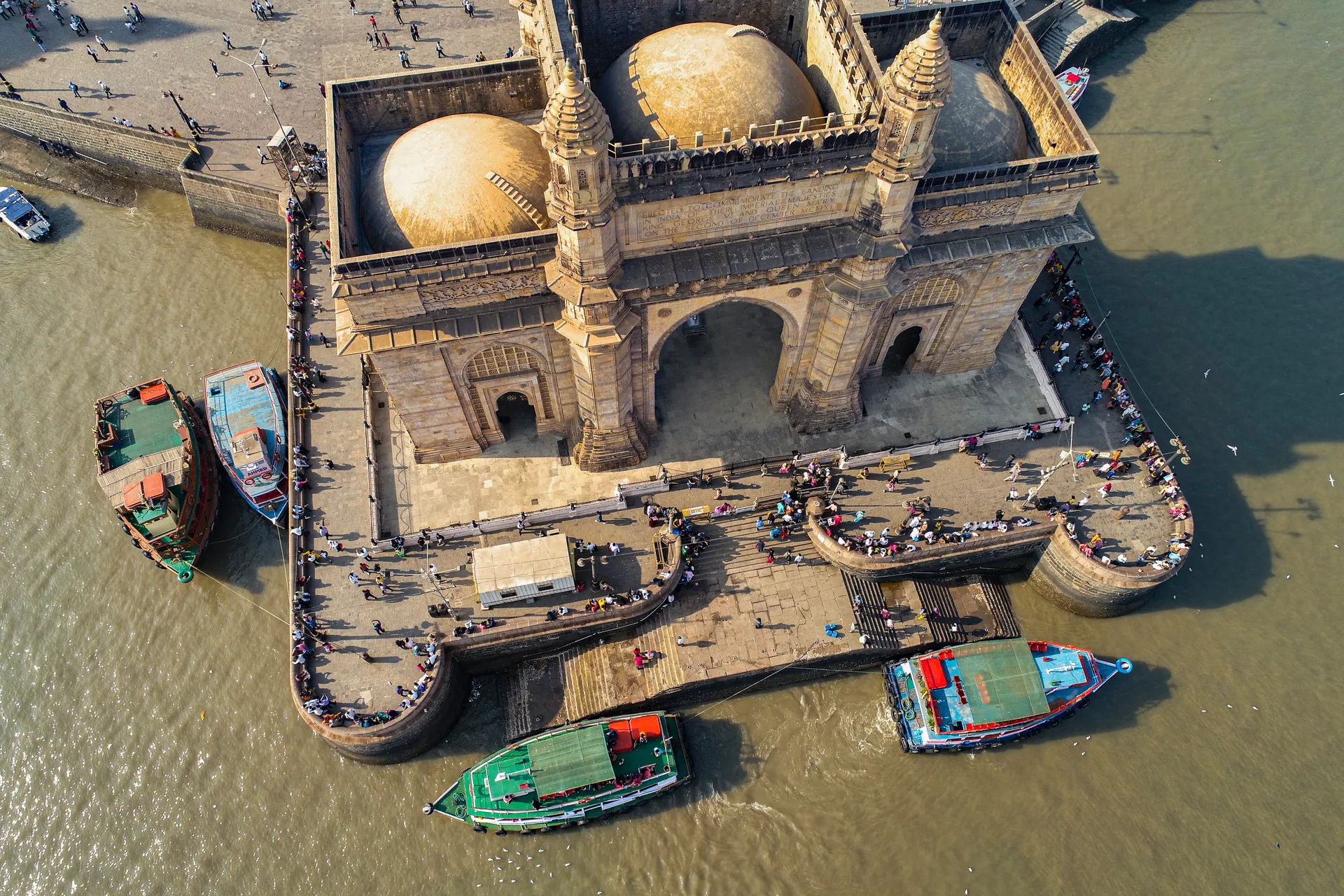
From the harbor, the Gateway appears as part of a waterfront in constant motion. Boats and ferries move in and out, linking this edge of Mumbai to destinations across the bay and beyond. Here, the monument marks a point of connection between land and water, arrival and departure. It is both a landmark and a working threshold, shaped not only by history, but by the movement of people through the city and across the sea.
Stop 3. A Place to Gather
For many people, the Gateway of India is also a place to gather. Locals and visitors come here to meet friends, walk along the waterfront, take photographs, and spend time in one of Mumbai’s most iconic public spaces. That everyday activity gives the monument a life far beyond its original purpose. It is not only something to look at, but somewhere to be: a place where tourism, routine, and shared experience continue to shape its meaning.
Stop 4. Built to Last
The Gateway is built from trachyte, a volcanic stone that is both durable and relatively easy to work. That combination made it especially well suited to a monument like this one, where builders needed strength in the overall structure as well as a material that could be shaped into crisp architectural details. The choice of stone helped make the Gateway both sturdy and refined. Its monumental presence depends not only on scale, but on the practical qualities of the material itself.
Dr. André J.J. Baptista (PhD)
The Gateway of India is built in trachyte, a form of basaltic rock, igneous in origin. Its tactile strength as well as its workability make it an immensely easy rock to use in construction
Stop 5. Weathering the Waterfront
Life on the waterfront leaves its mark on the Gateway. Humidity, sea air, and pollution all affect the stone over time, including the dark crusts that form when atmospheric pollutants combine with moisture. Preserving a monument like this requires ongoing care. The Directorate of Archaeology and Museums has overseen repeated cleaning efforts to help protect the Gateway’s appearance and condition. These signs of weathering remind us that conservation is never finished. It is part of the monument’s continuing life in the city.
Dr. André J.J. Baptista (PhD)
One of the problems that most buildings in Mumbai face on account of its high humidity, as well as pollution levels from vehicular traffic, is the problem of black crusts. These black crusts attach themselves to the side of monuments and are nothing but a product of sulfur dioxide in the pollution mixing with water vapor in the atmosphere.
Stop 6. Shape of the Monument
The Gateway’s design is organized around one large central opening and two smaller side pavilions. Pointed arches give the monument its height and ceremonial presence, while the overall composition creates the balanced silhouette seen from both the city and the water. These forms draw on architectural traditions associated with Islamic design in the region. Together, they give the Gateway its distinctive profile: formal, symmetrical, and instantly recognizable on Mumbai’s waterfront.
Dr. André J.J. Baptista (PhD)
The Gateway has one central or main pavilion and two subsidiary pavilions. These pavilions are also a typical feature of Islamic architecture. They have on them pointed archways that help support the sheer height of these structures.
Stop 7. Ornament and Architectural Detail
Look closely, and the Gateway reveals smaller details that shape how it is experienced. One of these is the jali, or lattice screen, which defines the threshold between inside and outside while allowing light and air to pass through. Details like this connect the monument to architectural traditions found across South Asia. They show that the Gateway’s design was shaped not only by its colonial setting, but also by regional forms, materials, and ways of building.
Dr. André J.J. Baptista (PhD)
Latticework or jali as they are known in India, were meant to serve as grills they demarcated exterior and interior spaces and also allowed for the passage of light and air.
Stop 8. Changing Meaning
Over time, the meaning of the Gateway of India has changed profoundly. Built under British rule, it first stood as a symbol of imperial authority. But in 1948, it also became associated with the departure of the last British troops from India, marking a very different moment in the monument’s history. Today, the Gateway carries both of these histories at once: a legacy of empire, and a place redefined by independence, public memory, and everyday life. As you look at it now, consider how monuments can outlive the purposes for which they were built, taking on new meanings as the world around them changes.
Dr. André J.J. Baptista (PhD)
The various features that one can observe on the Gateway of India. The various features that comprise the idea of India herself. The pluralism, the inclusivity, the amalgamation, and the absorption of various culture to create this resplendent form of a melting pot of culture. The Gateway of India was built by the British and represented for that subjugation. It was also the site that saw the withdrawal of the last of the British troops stationed in India in 1948, and at that point represented independence. It is this paradox that really comes across when one stands before the Gateway of India. It is a testimony to the legacy of empire. It is a testimony to the British Raj. But at the same time, it is also a testimony to the Hindu labor and the hands of sweat and toil that went into its construction.