Welcome to Lincoln County, Nevada
In Southeastern Nevada, just a few hours north of Las Vegas, you’ll find the quiet and sparsely populated area of Lincoln County. Once a bustling mining region, the county is now most famous for the presence of Area 51. However, taking a walk through the wilderness offers a different insight to the county’s past—sheepherding. Similar to petroglyphs which are carved into rock, arborglyphs are carvings in trees. These tree carvings can be found throughout the Western United States, telling a story of sheepherders that used to spend weeks and months moving sheep across the mountainous region. Throughout this experience, you’ll hear from arborglyph experts, a representative from the Bureau of Land Management, and a local landowner.
Stop 1. Sheepherding in the U.S.
Following the California Gold Rush, sheepherding became an important industry across the American West. It was especially common in states like California, Nevada, Idaho, Utah, Oregon, and Wyoming, where the open range and mountain pastures supported large flocks. Some cities are well known for this history, including Bakersfield, Reno, Elko, Boise, and Salt Lake City. That legacy is still still visible today in many of these places through Basque restaurants, festivals, and other local traditions. This project helps shine a light on a lesser-known part of that story: the history of sheepherding in Lincoln County. Sheepherding was often a lonely life. Herders could spend months alone in remote landscapes, watching over hundreds of sheep. To pass the time, many carved names, dates, images, and messages into the aspen trees. These carvings, known as arborglyphs, give us small but powerful clues about the people who once lived and worked here.
John Bieter
The Gold Rush brings so many, and obviously they're after gold, but the more stable opportunity is to feed those that are coming for the Gold Rush. And so what happens is a lot get into sheep and cattle, sheep often called the inferior animal, but one that I think obviously has a huge presence here. So what happens? They begin to migrate again West to East. The migration movement is into Nevada, it's one of the key spots, and Lincoln County in the southern part of that becomes really one of the key spots of it. We know that there were huge demands for wool in particular, consequently the sheep industry, but it's the meat itself, but it's also the wool. And the heyday is Civil War, World War I, and right in between it has the highest number of sheep that the U.S. has, 51 million. Now let's zoom in on Nevada, at that point, Nevada has 1.4 million sheep in 1910, just to give you an idea. Lincoln County has about 3,500 people and Nevada as a whole has 82,000 people. All of this is in 1910. So you've got 1.4 million sheep and you've got 82,000 population on the whole, which means it's a big part of the economy, it's a big part of what folks are doing, and Lincoln County plays a key role in it just because of the size and the opportunity for sheep to feed in that area.
Jake Northup
These arborglyphs are considered cultural resources. BLM has a protocol for recording cultural resources where they're found in an effort to document and possibly preserve that information. So depending on the area, the carving, the context of the situation, it may be appropriate to change some of the other designated land uses. If this was a very sensitive cultural site, we may adjust recreational uses or other uses in an effort to safeguard and preserve those resources.
Stop 2. Learning from Arborglyphs
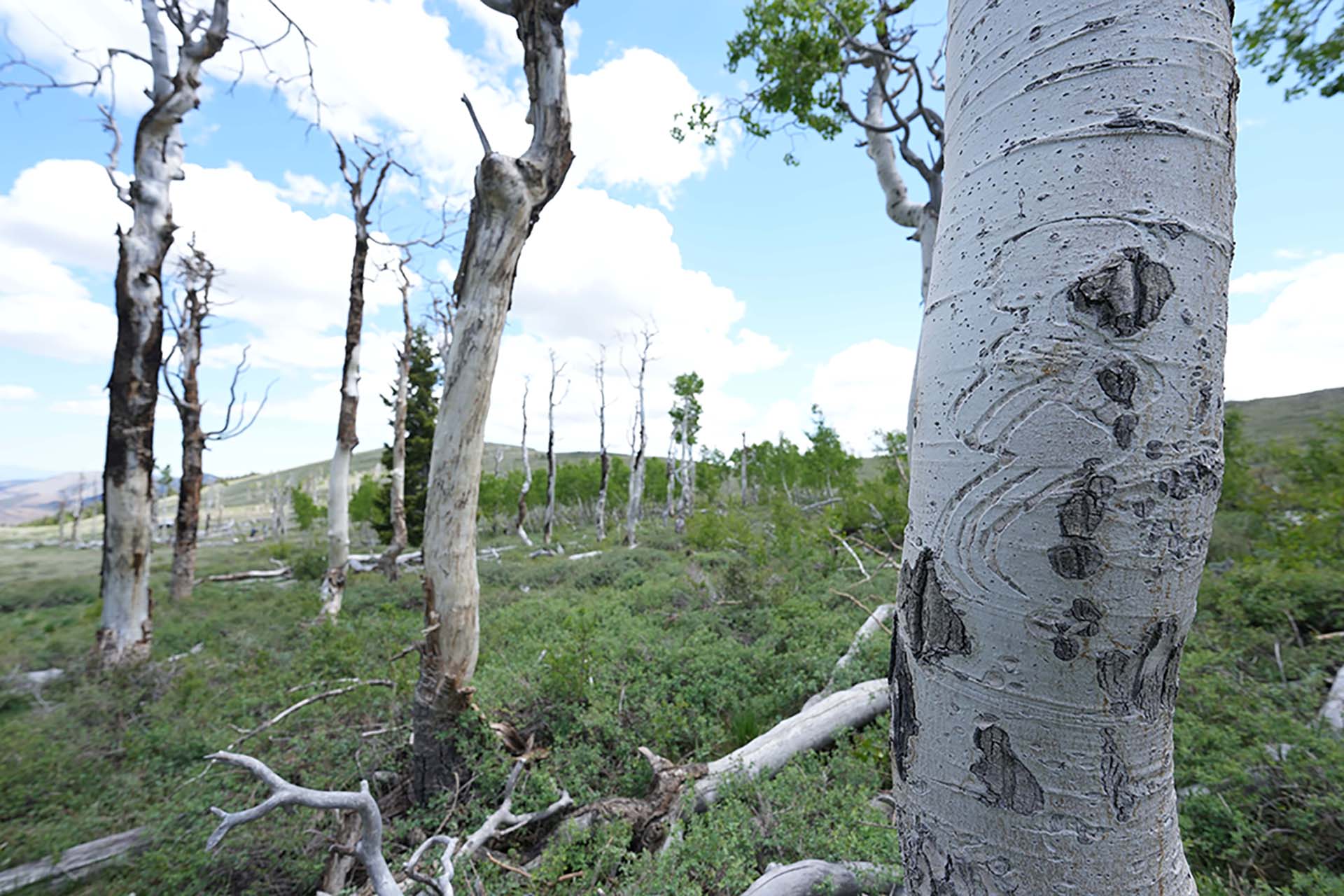
Across Lincoln County, you can find groves of Aspen trees that thrive in the high elevation due to their ability to grow in low temperatures, reduced oxygen, and with limited soil nutrients of mountainous areas. “Quaking aspens” , so named for the constant fluttering of their leaves, are also characterized by very smooth, white bark—making them the perfect canvas for carving. Arborglyph carvings are well documented across the Western United States. These physical markings provide insight about who the sheepherders were, when they were there, and information about how land use has changed over time. There are many challenges associated with documenting arborglyphs though. One being that aspens are short-lived trees, only living an average of 100 years. Changing environments, wildfires, wildlife, logging, and modern graffiti also threaten the carvings.
Iñaki Arrieta Baro
The use of aspen trees is opportunistic. First of all, they will camp in aspen groves. Aspen groves usually will have water and obviously shade, which makes them ideal for sheep herding camps. So while they stay there for two days, three days, a week maybe, they will take advantage of the qualities of the bark of the aspen tree. Aspen tree's bark, especially when they are young, is very much paper-like. It feels very smooth, very, very smooth, and it's also white, almost white. So it seems like it's a good match, that need of expressing yourself and having a tool that could be used for that, specifically in the place you are working.
John Bieter
Because it's not always clearly legible, we're looking at some of the arborglyphs, you know, that we've found are 100 years old. And so it's tough. But what you try to do is, this is when it's helpful to have different languages, well, trying to determine the background, if you can, of that person. But you just try and get- the goal is to try and honor as best you can whoever carved on the tree. You do that by deciphering as much as you can. And some are amazing. I think, as we saw, some of their cursive handwriting is better than mine is. I mean, some of them get really good at it. And they take some time. But others are just really hard to see, because the bark is split, because they were in a hurry. And it's hard to discern. The bark gets darker in some spots. It just happens. So it's far from exact science. You do the very best you can to interpret it, and again, honor the person that created it. But you're never sure that you, I mean, some are really clear. But a lot, it's really hard to determine.
Jake Northup
With all cultural resources, and especially with these arborglyphs, it's important to respect them and the history that they represent. Even though you may be inclined to carve your initials in the tree and do as they did, it's really important to refrain from doing that. These are a snapshot in time from a culture and history, and they provide a lot of valuable information as well as awareness of the past. So it's important we don't erase that history.
Stop 3. Types of Carvings
On this tree you can see the outline of a woman. While women and people are frequently found, the most common arborglyphs are names or initials, often accompanied by the date. There is a very wide range of types of text, images, and subject matter found across documented arborglyphs. The meaning behind the carvings also varies. Sometimes just a simple claim to note that the carver was there, but others make political statements or depict places of significance to the carver. As with all forms of art, the intended words or image of arborglyph carvings is subjective and not always clear. A large part of identifying arborglyphs can be very subjective or require some “best guess” work to discern if the date includes a one or a seven, or if there is actually an image carved or the tree has just sustained some trauma that healed in an odd way.
Iñaki Arrieta Baro
Among the thousands of tree carvings we find in the American West, the most usual ones by far are the ones that contain a name, a date, and usually a place name too. We will also see jokes about other herders. We will see political statements, all of those in writing. And then in regards to drawings, there is a full spectrum of topics that are covered. We find animals, horses, or deer, or bears, and we don't see sheep. They don't seem to be interested in reproducing the sheep. We see the scenes of the community life in the Basque Country. We see drawings of Basque farms or Basque towns. We see a number of drawings connected to that melancholy, to that missing the place, with that missing the people, missing the family. References to siblings, parents, moms, they are very much missed. And also connected to that missing the family, we need to very much take into account that we are talking about a population of very young men. Many of these sheep herders were 17, 18 years old. So women, nudes, and erotic drawings are also very usual in these drawings.
John Bieter
One of my favorites, it's of his, you imagine, it's of his home back in the Basque Country. Baserri is the word for it. The home is where you get your name. You don't name the farm, the farm names you. And he did it in a relief, so it's kind of, you can see all side, you know. He just did a masterful job of carving. He's one of the ones that I think I've most appreciated for his art. You often find references to home. Not a big surprise there. I found one where it was a poem, a six stanza poem. I have no idea how much time he had to be able to do that. It was hard to really decipher it all, but it had a poetic flair to it. And I found others that are, what would I say, probably artistically and emotionally particularly powerful. So the areas that I worked in was primarily with Basque sheepherders. And Basque sheepherders were here during a time when Franco, the Franco dictatorship was active in Spain. And so it's not unusual to find trees with words in Basque that are saying, that are contrary to that. So for example, I saw one and I just, it totally baffled me. It's because it starts out in Spanish, which these guys didn't usually use. And it starts out with, "Arriba España," up with Spain. I'm like, what the heck? And the second part of it says, "baina euskadi gaineatin" So up with Spain, But with the Basque country on top of it. And I thought, these guys are, you know, 6-7,000 miles away from home, but politics is on their mind, their homeland is on their mind.
Stop 4. Carving Techniques
Creating carvings that heal to leave clean, clear arborglyphs that are identifiable and legible for others to see requires special technique. Using a sharp knife or another tool such as a railroad spike, sheepherders would carefully carve into the bark. Clear arborglyphs require a balance between carving not too deep or too shallow, too wide or too narrow, too big or too detailed. Additionally, arborglyphs are a slow art. It’s possible that carvers never even saw the final results of their work as the aspen bark can take years to heal. Not knowing how they would turn out made it difficult for them to adjust their technique.
Iñaki Arrieta Baro
For carving the bark of an aspen is very interesting. You will think that you need to be very forceful with the bark, but it's just the opposite. You need to be very careful and very smoothly move whatever tool you are using. Assuming that it's a knife or you need to be very careful not to go too deep on the bark because otherwise what will happen is that the bark as it tries to heal itself will outgrow and the carving will become invisible or indistinguishable at least.
Jake Northup
When we went out looking for these arborglyphs, I was fascinated when we found them, thinking about the person, the history, who was standing in that spot carving on these trees. I was also very interested in how they happened. Some of the arborglyphs are very detailed, some of them are very hard to read. There was definitely a technique that some of these sheep herders learned over their years returning to the same site about how deep to carve to make their desired art, because these really do strike me as art.
Stop 5. Sheepherder Shelters
This cabin was built by the landowners in the early 1930’s when the family homesteaded the land and herded their own sheep. While the Salt Springs Hut may not have specifically been built for sheepherders, similar huts were often used by herders passing through certain areas. These huts provided shade and protection from the elements. However, huts weren’t always available, and sheep herders often slept under the stars or in wagons. Around the cabin are a number of carvings left by many generations of the family. These carvings are accompanied by others that indicate that sheepherders used the land for decades before the Devlin family owned the property. Repeat names associated with different years indicate that some of these individuals routinely returned to this property. Arborglyphs tell us that it was a common practice for sheepherders to return to a location year after year. This likely indicated an ideal location featuring both food and water for their flock—often creating a similarly ideal environment for aspens to grow, providing a carving canvas for sheep herders to pass the time.
Iñaki Arrieta Baro
When you are taking care of sheep flocks, the need for a refuge, for a safe space, is a necessity. There is no way you can survive a place like the mountains in the American West during a summer if you don't have a safe space. So the huts that we have seen these days, first of all provide a refuge where you can find a safe place in case of necessity. They provide also space for storage, for the tools you will need, for cooking, for everything related to taking care of the flock. So those first, those two needs are covered by the hut. They are a refuge and they are a storage space.
John Bieter
I think we're creatures of habit. They also, because they had the rights over the land, would go back to it. I also think they knew when they return, they know the spots where grass is likely to be high. In other words, they're familiar with it in the same way that you and I might be familiar with around the house, or if we've hiked to a particular spot again and again, there's a familiarity with it. You know the spots, you know the best spots where to keep the sheep, you know when it's time to move them, you know how to work through that. So there's just, I would say, a kind of efficiency and comfort because you've been there before, literally, consequently on the trees. We see kind of calendar trees, they call them, where you see year after year after year when the herders are returned to the same spot.
Dan Devlin
I can remember the first time I saw my grandpa John's name there. I was probably in my 20s, and it was kind of special to know that they'd even carved anything up there. I'd never known it before. It was the first time that I'd— I never even thought about it, really, you know what I mean? But to see his name up in the tree and think of how long ago it was, because it was like— I think it was carved in there in 1938 or something. It was kind of— I was taken aback to see your name carved in the tree, you know what I mean? Your last name. And then you get to thinking about how tough it would have been up there. Even working that land in the summertime would have been tough, because it's straight up and down hills, and you're trying to push sheep around and get them to good grass. It would have been rough. It wouldn't have been easy. Even on a horse, I don't think it would have been too easy.
Stop 6. Snapshots in Time
Arborglyphs give us insight and a more personal connection to the past. These carvings help us learn a little about who these sheepherders were, what they may have been thinking about, where they came from, and how they passed the time during a lonely and demanding job. In Lincoln County, they also help tell an important history that is not widely known. Although the carvings will fade with time, the stories do not have to. Documenting them now gives us the chance to keep learning and asking questions, and the ability to share this history with future generations.
Iñaki Arrieta Baro
The cultural groups that have created arborglyphs in America and the West, Basque for the longest time, but also Peruvian or Mexicans, are small cultural groups, not always well represented in the archival record. So Arborglyphs represent an opportunity for better documenting not only the Arborglyphs themselves, not only the articles, but also the experience of those vibrant communities. The arborglyphs, the three carvings, lertxun-marrak, in that sense, from the point of view of how we approach them, go beyond the carving itself. The carvings are a lens that allows us to look into the experience of those herders, to look into where they were moving around, where they were coming from, their questions, their needs, their wills, what were their aspirations. So we can learn about those communities using the arborglyphs as documents of that experience. That is why it's important to preserve them, not only because of the visual interest of those artifacts. That is there, it's part of that interest too. But also because we will create a new archival record for those communities.
John Bieter
I believe it's important to find and document and maintain and to share the arborglyph carvings for a number of reasons. One is because it marks history, and it's often a history that people don't know much about. A lot of times these people may be fairly anonymous, they may be immigrants that came over or those that homesteaded in the area and are just getting started. And so that story is the link to them, to that area, and to subsequent folks that come after them. Two quick stories that have happened for us, one just in the last week. We got a guy who I've known for a long, long time who found an arborglyph of his father that was 50-some years old. I have another student that —I took students on trips. She did not know her father was a sheep herder. She didn't know him very well. He died when she was pretty young, and she went out with us to find the arborglyphs, found her father's, she comes back to the camp and she had tears running down her eyes and I think, oh my gosh, what happened? But she found her father, you know? And so it was a tie or a link there. I just think that these things crack open the human experience. And what I mean by that is, they're in quiet spots. Solitude is often a big part. There's something about us as humans that wants to create. There's something about us as humans that wants to leave a mark, in this case, literally. It touches on a whole bunch of things that they're thinking about, and that's the richness that I think it provides. Whether or not you're directly tied to them or indirectly tied to them, again, because they played such an important role in the economy.
Jake Northup
These arborglyphs are cultural resources that aren't going to last. They're on trees that don't grow for more than 100 years or so. They're susceptible to wildfires. They could be cut down by unaware people. They could be damaged in lightening strikes. It's important to preserve that history while they're there, because they won't last forever.