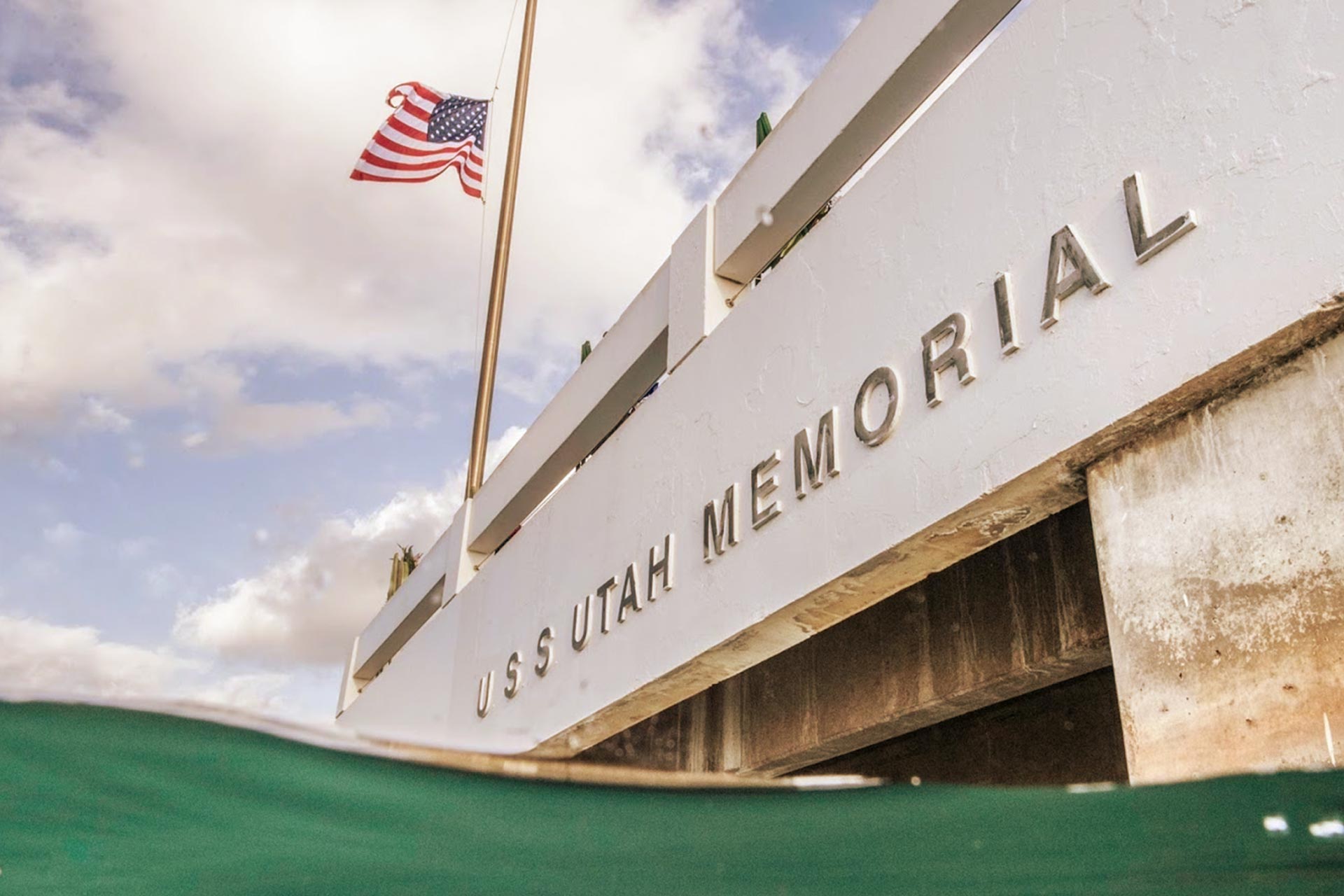
The USS Utah Memorial
Welcome to the USS Utah Memorial at Pearl Harbor, sometimes referred to as the “Forgotten Ship”. Found on the tropical island of Oahu, Hawaii, Utah is less than one mile from the more commonly known national memorial, the USS Arizona. Together, these two sites represent the only remaining preserved shipwrecks from the attack on Pearl Harbor on December 7th, 1941. On this tour, we will explore above and below the ocean to hear stories from Navy historian Jim Neuman, National Park Service interpreter David Kilton, and a selection of USS Utah survivors.
Stop 1. US Military at Pearl Harbor
The USS Utah Memorial is situated in the heart of Pearl Harbor on Ford Island, a historically significant and strategically positioned landmass serving as a vital hub for the United States Pacific Fleet. The island houses key military installations, barracks, naval facilities, and formerly an airfield.
Jim Neuman
The establishment of the Pearl Harbor naval base really began in August of 1919, when then Secretary of the Navy Josephus Daniels came out to Hawaii and dedicated drydock one at the Pearl Harbor Naval Shipyard and beyond. Just dedicating drydock one, I think there was an understanding that this could be developed into a world class naval base. So over the next two decades, as the US focus shifted to the Pacific and we had a lot more interest in the Pacific, you had ships coming from the West Coast of the United States to Pearl Harbor, and then they could make their way over to the Orient, to the Philippines, Guam, places like that. And it was really the presence of the United States fleet here at Pearl Harbor. And our ability, the United States ability to project power towards the interests of the Japanese Empire, that really led to their launching that air attack on December 7th, 1941.
Survivors
Honolulu in those days was not, Waikiki was not a favorite port because there were no women. There were 2000 men or 1000 or 2000 for every woman. So we liked it stateside better. Being in Honolulu, I wasn't much of a guy for going on on shore, on liberty or shore leave I just pretty much stuck pretty close to the ship most of the time. Well anyway, the attitude at the time was just no big, no big deal. The Japanese weren't any threat to us as far as we're concerned. Everybody kind of looked down on them. It was always some kind of a story that some commander claimed, “Well, I got the Japanese fleet surrounded. What will I do with them?” And said “I’ll just let them go.” They weren't they weren't going to sink the Japanese fleet at that time because I had a lot we we just didn't have any respect for them like we should have had as part of this surprise that they they were so good. They did such a job on us here at Pearl Harbor.
Stop 2. In the Line of Duty
It might be hard to imagine the USS Utah at its full might, classified as a Florida class dreadnought. It was launched in 1909 with ten impressive 12 inch guns and five twin turrets, two torpedo tubes and 12 boilers capable of producing a massive 28,000 horsepower. The Utah would serve first in the Mexican Revolution in 1914. In Europe during World War one, and finally on a Peruvian tour before being taken out of active duty.
Jim Neuman
So the USS Utah was a Florida class battleship launched in 1909, just a few days before Christmas. And being a dreadnought battleship, they were designed, really to compete with other navies in the world, particularly the Royal Navy, because having a navy, a world class navy that could project power around the world, was really a very important point for all the nations in the world at the turn of the 20th century. When the USS Utah was commissioned in 1911, her ten 12 inch guns, the latest in fire control technology, her steam turbines that could generate a great deal of speed, made her really the most powerful ship that the United States had produced up to that date, if not the most powerful ship in the world. she spent the first few years of her active service just doing training exercises and getting ready to be a crew of a powerful battleship like that. But it really was in April of 1914, when the Utah was called to the east coast of Mexico to intervene in that Mexican Revolution to land American Marines and sailors in Mexico so that we could exert a presence there during that revolution. That was really a real world example of the United States exerting naval power in the Americas, which is what our world class Navy was intended to do.
David Kilton
The Utah played a significant role in what was known as the The War to End All Wars. World War One, and it, along with the USS Arizona and the USS Oklahoma, were selected to escort, the USS George Washington that would carry President Woodrow Wilson out to France in order to be able to sign the Treaty of Versailles. That would be the official end of World War One, and that those three ships there together protected and and in peace in a time of peace, not firing their guns, just there to just, kind of end the war were the first tragedies, and the only ships that would not go back into service in the start of World War Two is just kind of you can't make it up that that's the reality of what would happen if they were there to help escort and try to bring what would be a the hope of a lasting peace between these countries, these that had been caught up in that that drama and the trauma and fire of war, would be the first casualties for the United States in the next war.
Stop 3. A Ship Reborn
In 1931, the USS Utah was removed from active service. But it had not passed from usefulness. The Utah was instead recommissioned as a fleet targeting ship, Auxiliary General AG 16, trading its naval guns for the latest technology and remote electronic controls. A crewed vessel provided realistic training exercises for newer ships and bomber pilots to operate against. And by 1941 it was home to the fleet's anti-aircraft school, and was a mainstay of the Navy's training regime.
Jim Neuman
So in 1931, the Utah began her second phase of being an active Navy ship. Her hull number went from BB-31 to AG-16, “BB” being the designation for a battleship, “AG” being the designation for an auxiliary ship. And what that meant was Utah became a target vessel. And that might sound kind of inglorious, but it was really, really very important for the development of the United States Navy because aviation is getting more powerful, longer range and much more of a concern for ourselves. And, something that we also want to develop. But aviation is still kind of in its infancy. And the Utah played a very, very important role in in not only our surface fleet knowing how to avoid or how to defend against an air attack, but also our aircraft or pilots, being able to practice how to attack a ship like that. there was actually an anti-aircraft school on the Utah. Sailors from battleships, sailors from cruisers, and other other Navy ships could now go on the Utah and practice our anti-aircraft defense. So again, even though the Utah was no longer a combatant vessel, all of that training that was done defending against aircraft, that's going to be extremely valuable when we are in the heat of World War Two.
David Kilton
So another component of what would happen following the Treaty of Versailles was other treaties, political maneuvering to try to basically stop the building up of militaries to such a point, a point that a similar act of war that would encompass and draw so many into it, would be established. And one of the treaties that was passed would actually limit the sizes of, of Navy powers for different countries. So the Utah would be decommissioned as a battleship, be converted into a training ship, and eventually sail a different purpose for the United States military in allowing for, honing of skills and the developing of new technology that would allow, the United States Navy to, and military in general to be more effective, more efficient, and, be able to keep up their, ability to respond to future threats.
Survivors
Well, we had two trips when in February- or March rather, we went to, came to Pearl Harbor and we were a gunnery school as well as a bombing target, and we would usually have six, seven, eight weeks of gunnery. We would take gunners from the different ships. We had the latest guns in the fleet, incidentally, and we would get gunners on Monday and then they would shoot down drones, you know, learn the gunnery and and after about a couple of months at that, then we became a bombing target. The guns were covered and some of the valuable guns were removed and stored below deck. So when we were a bombing target, of course, everything, all the guns were covered. And then we had two layers of timber on the deck to soften the impact of bombs. The modern Navy has its aircraft and airplane carrier. They're all part of the United States Fleet. In wargames, there must always be an enemy or target ship. The Utah has been equipped as a radio controlled enemy. The signal “Abandon Ship” and all hands go over the side. Aboard another vessel is a delicate control mechanism, which sends radio waves to the abandoned battleship, and the Utah is navigated without a man aboard.
Stop 4. Attack On Pearl Harbor
On the morning of December 7th, 1941, the Imperial Japanese Navy launched a surprise aerial attack on Pearl Harbor. The devastating assault involved over 350 Japanese aircraft targeting battleships, cruisers, military installations, and aircraft on the ground. The attack resulted in the destruction of numerous American vessels and aircraft, as well as over 2400 military and civilian casualties, which ultimately led to the United States entry into World War Two. While the attack inflicted significant damage on the fleet, the aircraft carriers were absent from the harbor on operations. The USS Utah was instead moored where the carriers were usually located. It drew torpedo fire when Japanese bombers mistakenly identified covering boxes on the deck as the turrets of an active duty warship. 58 sailors lost their lives, and 461 survived.
Jim Neuman
So there was a great deal of heroism on display on December 7th, 1941. A great example of that would be Chief Watertender Peter Tomich, who served in the boiler room on the Utah at the time of the attack. He recognized what was going on. He could sense that the ship was starting to list, and he was concerned about that cold water of Pearl Harbor hitting those boilers, which could cause a massive explosion. So he had the presence of mind that he had to shut down those boilers. But before he did that, he called out to the other crew members that were in the boiler room. He told them, get out, get out of here. You know, don't stick around. So they're all leaving the boiler room. And as they turn back, they look back and they see Chief Tomich. He's there turning the valves and pressing the buttons. He's closing down those boilers as the Utah completely capsizes. And he will be one of the crew members that was lost on the morning of December 7th. He would actually receive the Medal of Honor for his actions posthumously, obviously, but he would be a medal of honor recipient because of his actions and not only having the presence of mind to shut down those boilers, but having the presence of mind to get his crew members out of there, I would say that's heroism.
David Kilton
In a lot of people's mind. It wasn't even intended. It was unintended, that the that the Utah would be hit that morning. There are speculations of why it might have been targeted. Some is that haze and also the dog houses that were over the anti-aircraft guns, may have, caused enough question that oh, maybe that is one of the battleships that's been moved over to this side. We're going to hit it. also, there is speculation that just because the complete surprise had been achieved. Okay, let's go ahead and hit the ship and and they just dropped the torpedo and and they weren't sure if they peeled off, if they would be, shot down or find another valuable target. So go ahead and hit the Utah. But this would cause that six torpedoes would be launched on the far side of, of, Ford Island towards the Utah and the other ships that were there, two of them would strike the Utah when they hit the Utah, it starts to roll. And when the ship does roll, individuals are trapped, similar to what happens on the Oklahoma. Smaller cruiser so not as many individuals in fact, over 400 of the 500 crew members escape and and are able to swim away. but there is the loss of 58 lives that happens on the Utah, 54 of them being trapped and unable to be recovered from the ship. There is one individual that is able to be rescued due to the tapping, of him with a wrench, letting those that want to try to help and pull those out. If there's any way to being able to narrow in and find him below decks.
Survivors
I happened to be looking out of a porthole, and actually, I was looking at Ford Island, and there was some activity there. I don't remember what, but somebody said, what are all those planes in the air, you know, where what are all those planes doing out on a Sunday morning? The first notice- a friend of mine was laying on the deck writing a letter, and he said “Hey K-O, something happened up forward”, and I said, “ah, you’re crazy jigger”. And he said, “No I felt the ship shake”, but I didn't. And then all of a sudden we took the first torpedo and, excuse me. I stood up and started over towards the ladder, and the second torpedo hit us, maybe 20 or 30 seconds later, and I was knocked over and I landed on my jaw and I busted 16 of my teeth. I didn't know at the time. About that time someone hollered “Japanese air raid!” Honest to God. The first bombs that hit, hit on the hangars at Ford Island, at the tip of Ford Island. And so I stood there and saw the bombs drop, and then I saw this huge red flame and black smoke and I thought, oh my God, somebody really goofed because those are real bombs. We were used to being bombed with duds. And then I thought, My God, somebody really made a mistake. Those are real bombs. And just about that time, I felt the ship lurch. And then of course I was standing right next to that when the torpedo hit sent a column of water I suppose 100 feet, and then all of it comes down on top of me standing there in my white uniform, knocked me down. And I just didn't think I was ever going to stop coming. It just kept pouring and pouring down on top of me. And I got to because I kind of panicked when that happened, just when is this going to end anyway. And I couldn't believe my own ship would. We weighed 27,500 tons. I didn't think they could sink her. And I certainly didn't think she'd roll upside down in seven minutes. The odd Saturday I had gone Christmas shopping and all the flags were out. They called it ‘airing bunting’. And I thought, what a beautiful sight it was. To see all those different colored signal flags. Because we went around the front, the top side of Ford Island past Battleship Row to get over to Mary's Point. It looked beautiful. And I remember thinking, what a hell of a mess now. It was a bad situation.
Stop 5. Conflict in the Pacific
After the surprise attack on Pearl Harbor, the United States found itself thrust into World War Two. The conflict in the Pacific became a pivotal theater of war, marked by intense naval battles, vast island networks, and brutal landing assaults. The strategic importance of the Pacific Islands and the need to safeguard vital sea routes fueled a relentless and grueling struggle against Japanese forces. Because of this, salvaging damaged ships for materials or repair was of the utmost importance, and the USS Utah was no exception. Her hull was winched by cables from shore in the aftermath of the attack, but unfortunately the angle of the wreck meant she would dig deeper into the mud. Once it became clear the effort to salvage was more expensive than the materials the older Utah could provide, she was left in her current position underwater.
Survivors
[Interviewer] Tell us about your efforts in trying to get off the ship. Well, you couldn't get on topside because- I now know it was the first wave that hit and it was almost nearly impossible because of the strafing. So I went back below decks part of the ship up forward and wasn't able to get up at all, it was clogged. Fellas trying to get through the hatch. While we were picking up people, there was one other spot back by what's called a shaft alley. And we- I could hear a tapping in that but you can also see bubbles of air coming up. After a while it quit. So I imagine a man in there was probably drowned. The Arizona is busted in half, her mainmast and and foremast were twisted like this, and she's burning fiercely. The stern of the Tennessee is on fire. The West Virginia sunk the, California is down with the bow and the port side looking like she's going to sink. And the Nevada had beached herself farther out. [Interviewer] And the Oklahoma- Oh and of course yes and the Oklahoma was over. Yeah. I'd forgotten. And the Oglala was laying over. Earlier, We always said we're going to have to fight them. Let's do it and get it over with we can lick’ em in six months. And then when we looked at that mess, I, you realize, hey we didn't have a, an opponent that couldn't fight. We were going to have a tough fight on our hands.
Stop 6. A Final Resting Place
Beneath the waters of Pearl Harbor, 58 sailors who lost their lives when the USS Utah was sunk by Japanese bombers on December 7th, 1941, silently guard the remains of an unexpected shipmate. The ashes of a baby girl. Chief Yeoman Albert Thomas Dewitt Wagner had been waiting for a chaplain to be assigned to the Utah, hoping for a proper burial ceremony at sea for his deceased daughter. When the Utah went out on maneuvers, an urn carrying her ashes was in his locker in the Utah's chief's headquarters. But the surprise attack changed everything. Wagner was among those who survived the bombs that day, but he and Navy divers were unable to rescue the urn. Baby Nancy would be the only female interred on any ship in Pearl Harbor that day.
Jim Neuman
So one of the Medal of Honor recipients during World War two, during the attack on Pearl Harbor, was actually Chief Watertender Tomich. Unfortunately, his medal had to be awarded posthumously because he had died during the attack, and the Navy could not identify a family member for Peter Tomich because he actually came over here in his 20s from the area that is now Herzegovina. So his medal traveled around the country. It actually went to the USS Tomich, and there was a destroyer named after him as a legacy of him. It went to the Utah State House, it was in the Navy Museum in Washington, DC. And then it ended up at Tomich Hall in the Senior Enlisted Academy. That's in Rhode Island. That's where the Medal of Honor ended up. In 1997 there was a, a project to try to identify a family member of Peter Tomich so that a medal could be presented to that family. It took a decade, but there was a lieutenant commander in the Croatian Army, by the name of 'Tonić' [Herceg] because that was Tomich's original name. It was changed to Tomich, who was identified. And the USS enterprise was in the Mediterranean in 2006, and a replica of that Medal of Honor that was presented to Peter Tomich was presented to Lieutenant Colonel Herceg And so that replica medal resides with him to this day.
David Kilton
One of the very unique components of the story of the USS Utah. Chief Yeoman Albert Wagner would have his life impacted in 1937 when his twin girls that would be born, would unfortunately have one of them not be able to survive past two days. Baby Nancy would be a source of tragedy for that family, and Chief Wagner would eventually decide that he wanted to have her ashes and remains buried at sea. So he would place her urn in his foot locker on his ship, the USS Utah. His intentions were to be able to honor her in that way, but unfortunately those goals would never be accomplished due to the attacks. On December 7th, 1941, Baby Nancy would be the only female that would have her remains go down with one of these sunken ships, and because they were lost in that ship and unable to be recovered. She is the only female entombed in the harbor today. Nancy's sister Mary reflected on what would be this end of her life and end of her story, in that she could feel no more fitting tribute and honor for her twin sister than to have her to be ever protected by the 54 men that are also entombed in that ship and are in eternal service, and knowing that she is there, gives her a beautiful respect and connection to the USS Utah, to Pearl Harbor, and to the memorial that is there today.
Stop 7. Forgotten No More
The National Park Service is committed to preserving and interpreting tangible and intangible historical resources and the memories, significance and traditions associated with the December 7th, 1941 attack and the Pacific War. Friends, family and loved ones come to pay homage to the sailors who gave their lives here. Even today, with permission from the NPS, servicemen and women are interred during special memorial ceremonies.
Jim Neuman
So the USS Utah has been called the “Forgotten Memorial”, because not a lot of people are going to get a chance to see the Utah because it's on an operational naval base. But the Navy has not forgotten the Utah. So every December 6th, we have a sunset ceremony at the USS Utah Memorial, where we remember the crew of the Utah, we will read the names of all 58 crew members who were killed in the attack, will ring a bell in their honor. And then the participants in the ceremony, those who were guests of the ceremony will actually take flowers out, and they can have a private floral tribute there on the USS Utah Memorial with a beautiful Hawaiian sunset. Also, there's plenty of reenlistments that happen there. A lot of commands will go out to the Utah. That's an opportunity for them to talk about, general military training and the importance of legacy and the importance of history. What better place to do that than the USS Utah? Every ship that passes the USS Utah, the crew will come out. They'll man the rails, no matter how big the ship is. Even our white boats that take visitors to the visitors to the Arizona memorial. They'll also do it as well. When they're passing that memorial. The crew is going to render honors to the crew of the Utah to honor them. But probably and I think perhaps the most important legacy of the USS Utah is the dozens of Pearl Harbor survivors and World War Two veterans who have had their ashes scattered at the USS Utah memorial and will always tell the family that even though this was not a Utah crew member, their ashes are being scattered with those who died at Pearl Harbor. So obviously that individual who wanted to have their ashes scattered, they, that was such an important part of their life, such a critical point in their life. They want to have their ashes scattered at the harbor. What better place to do it than a place where you actually have the remains of Utah crew members right there. Again, as many as 49 crew members that are still on board that ship today. In serving as the platform for the burial of the members of the Greatest Generation, the wreckage of the Utah and her crew that remain aboard continue to inspire this generation and remind us of the core values of the United States Navy. Honor, courage, and commitment.
David Kilton
As a part of the National Park Service. Pearl Harbor National Memorial is committed to the mission of our agency to protect and preserve these resources, telling the stories, protecting the beautiful landscapes and other components that make these sites a unique part of this country, and resources that individuals from all over the world can come connect with and enjoy, not just for our current time, but for generations to come. As part of that mission, specifically for Pearl Harbor National Memorial, we have the ability to tell the stories that would lead up to the attacks on Pearl Harbor, the events that would play out that day, and the further stories searching for peace and reconciliation. As part of that mission, it is fitting that a quote and an effort to build the Utah Memorial and highlight elements of, desire to seek for peace and reconciliation were stated by Senator Frank Moss from the state of Utah as they moved forward with the plans to design, build and eventually dedicate the USS Utah Memorial. His with me, just paraphrasing, states that he hopes that one day we will not have to continue to build memorials for those that lost their lives in war, but we can eventually build memorials for those that lived their lives in peace.
Survivors
[Interviewer] In the years since the attack, [Interviewer] when you've heard or read the the expression or the words Pearl Harbor, [Interviewer] or December 7th. [Interviewer] Does it bring back memories immediately? Yeah, absolutely. Sure. It brings back. And I'll tell you what it reminds me. We were so woefully unprepared. We were so naive sitting there getting ready to go to church, play football, baseball, reading the Sunday paper, writing letters home. [Interviewer] Hearing these words, though, did it suddenly transport you back in time? [Interviewer] Were you suddenly back aboard the Utah? I think when I come out here, like in 71, when we went out for the groundbreaking of the Utah Memorial, and in 76, when we went over there and took pictures of it to see the old ship. Yeah. It tugs at your heart.
Stop 8. A Place of Reflection
Pearl Harbor serves as a memorial to peace and reconciliation by preserving the memory of the tragic events that transpired on December 7th, 1941. Encouraging reflection on the devastating impact of war. We hope that you enjoyed your visit to the USS Utah and have broadened your knowledge about this historic battleship, solemn memorial, and the enduring spirit of resilience that defines this sacred site. Your virtual presence here honors the memories of those who served and sacrificed during pivotal moments in history. And for that, we thank you for your time. For more information, please visit the National Park Service website for Pearl Harbor National Memorial.
Survivors
[Interviewer] Some people who lived through the attack [Interviewer] have some bad feelings about Japan. [Interviewer] Bad feelings about Japanese. [Karl] I know the- yeah. [Interviewer] How do you feel? Well, first of all, they were doing the job like we were. The average military person that hit us was taking orders like we were. I had a lot of hate in my heart for the Japanese at first, but, until after the war ended. And then, I guess it's like anything else hurt goes away. [Interviewer] What if you had the opportunity to talk to some other Japanese veterans of the war? would you avoid such a meeting, or would you look forward to such a meeting? I think it'd be nice to exchange, experiences. See what, see how they felt, see what it was like to them.