Wat Arun
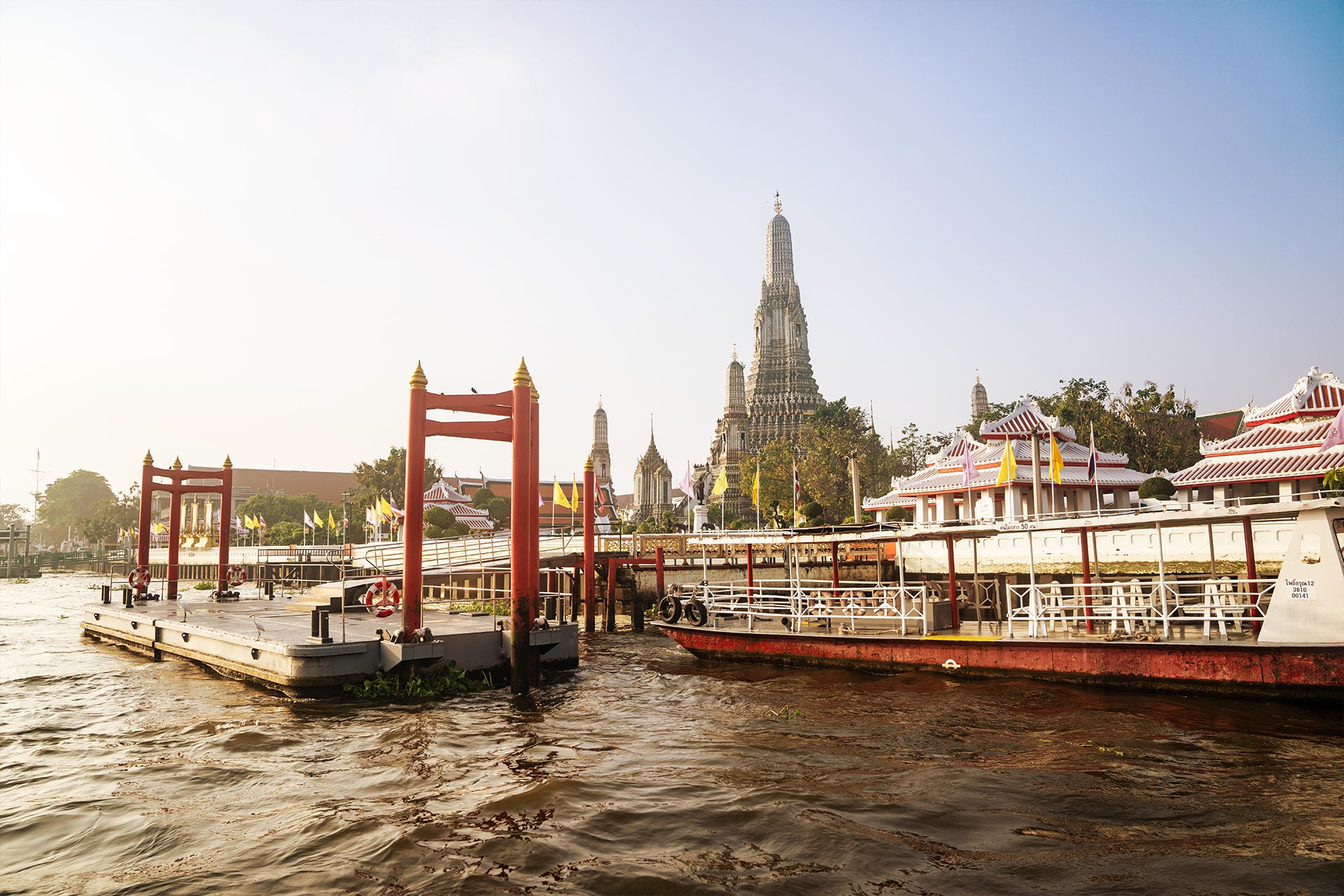
Sawadee krub. Welcome to Wat Arun located in Thailand’s capital city Bangkok, in Southeast Asia. Thailand boasts many wats, or temples, throughout the country. Wat Arun, also known as the Temple of Dawn, is one such Buddhist temple and monastery. It is located along the banks of the Chao Phraya River in Bangkok and is a masterpiece of Thai Buddhist architecture. On your exploration of the outdoor public areas of the Wat Arun temple complex you will hear from Kaew, Pitchaya, and Monk brothers To and Ta about their special connections to this sacred place.
Stop 1. Temple Layout
Wat Arun Ratchawararam Ratchawaramahawihan, commonly known simply as Wat Arun, is a Buddhist temple complex that contains many different buildings and shrines. Here you can see the tiered central prang, or tower structure, used in Hindu-Buddhist temples throughout the region. There has been a Buddhist temple at this site for a long time. What is now known as Wat Arun was built up over many years, under the direction of several different kings. The temple was first established by King Taksin in the 18th century. The central prang symbolizes Mount Meru, the mountain that is home of the gods and believed to be at the center of the world. The four prangs around it represent the four continents of Buddhist cosmology. The cross-shaped buildings in between the prangs are called mondops. They mark North, East, South, and West. This tour will visit these prangs and mondops, which are only part of the overall complex.
Samanera Natthapol Wongchampa
My name is Samanera Natthapol Wongchampa. I have been ordained as a novice monk for about 5 months. My nickname is Kaew. This place is called Wat Arun Ratchawararam. It's located in Bangkok Yai district in Bangkok. To collect alms, I have to get up around 5:30 in the morning. Get out and walk to the pier at about 6 o'clock. After returning from receiving the offerings, I have breakfast and do morning chanting.
Pitchaya Gleebsuwan
Hello, my name is Guitar, Pitchaya Gleebsuwan. I'm come from Phuket, Thailand.
Pramaha Piyanat Soma & Pramaha Wachara Soma
My name is Pramaha Piyanat Soma I'm 26 and come from Ubon Ratchathani. My name is Pramaha Wachara Soma I'm also 26 and also come from Ubon Ratchathani. 7 years. Yes, 7 years, too as we entered the monkhood at the same time. Wat Arun Ratchawararam is the temple in honor of King Rama II and is said to be the symbol of Thailand, because the Prang is widely used to represent Thailand tourism. When people visit Thailand or even seach in google, they will find the Prang which is the symbol of Thailand. Wat Arun is a tourist attraction. Therefore, it is obliged to have monks supervise the main chapel, the Prangs and other areas around the temple.
Stop 2. Threshold
The first recorded temple here was known as Wat Makok. The primary prang, seen behind this entrance gate, was completed in 1851, under King Rama III. On the outside of the gate, you can hear all the noise from the busy city of Bangkok. Once you pass through this gate, the atmosphere is very different with quiet sounds and the beautiful temple.
Samanera Natthapol Wongchampa
It is important because it is a peaceful place. The bells sound pleasant. This temple is beautiful because of the main Pagoda and the Giant Guardians. Inside the chapel... Inside the chapel, there is a Buddha image of the Grand Hall, and then you will see the fans of royal rank for the monks in the Grand Hall. Inside each chapel, you will see colourful wall paintings. For the Chulamanee Chapel, it's the place where the replica of Buddha's hair is kept.
Pitchaya Gleebsuwan
Well, here is Wat Arun Ratchawararam. It has existed for hundreds years. There are beautiful painting and sculptures here. This is the place where many people, regardless of age and sex, as well as foreigners, come to visit and admire its beauty Additionally, the architecture of this temple is integrated from many countries, for example, integration of Chinese and Thai architecture.
Pramaha Piyanat Soma & Pramaha Wachara Soma
I truly enjoy meditation. Literally, meditative postures aren't always strict. You don't have to always sit like this. When you have stress or when you have anxieties, you can focus on the pace of your breath by inhale deeply and exhale slowly. Alternatively, you realize that you are stressed at that moment, you are currently anxious. Observing your breath and reminding yourselves what you're doing can make you feel more at ease and... and let you not focus on what makes you anxious. Consequently, you become calmer. This is what I appreciate and feel like this is the thing I'm good at. Me, too. Well, I beleive that meditation enchances my positive thinking.
Stop 3. Altar
As you make your way down a walkway lined with lotus flowers toward the central prang, you will see a large container filled with sand for burning incense and a flat, rectangular stone altar. Many visitors use this location to pay their respects, pray, and ask for permission to enter. Some Buddhists may light incense. Others leave offerings on the altar such as lotus flowers or food items, and many will wai -place their palms together as a sign of respect and devotion. You will find lotus flowers and designs throughout the temple as several aspects of the lotus flower's growth and appearance are used as metaphors for the path of a Buddhist practitioner.
Stop 4. Central Prang
The central prang at Wat Arun is known as the Phra Prang. Practitioners will move around it in a clockwise direction. This movement symbolizes progress and growth, demonstrates respect, and maintains harmony. Statues of deities and demons ring several of the tiers with their arms holding up the next layer of the prang towards the sky. The angular base of the prang is decorated with panels depicting the trees and mythical creatures of the legendary Himavanta Forest at the base of Mount Meru. This is another detail that makes the central prang a symbol of Mount Meru.
Pramaha Piyanat Soma & Pramaha Wachara Soma
The prang is a model of the universe. The universe that is believed, in Buddhism. It might be mixed with Brahma. At first, the Prang was called Prang as it came from Brahma-Hindu since Khmer Empire. Later it was evolved and became the Buddha Prang as today. It was built during the regin of King Rama II. At that time, we had trading with China. Then, there were decoration with tiles those those were made in various forms, mixing between Thai, Chinese and Khmer. As well as some flowers those seems to be influenced by European art at that time. The top of the Prang is a crown with lotus petals.
Stop 5. Subsidiary Prang
The smaller prangs are on the four corners with Phra Prang in the center. Decorations of many-colored plants and flowers represent the Himayanta Forest. These prangs represent the four continents of Buddhist cosmology and are all dedicated to Vayu, known as Phra Pai in Thailand, the Hindu wind god who serves under Indra. There are four places near the top of these prangs containing a sculpture of Vayu, riding atop his horse.
Pramaha Piyanat Soma & Pramaha Wachara Soma
Mount Meru is said to be the central of the universe, regarding cosmology of Buddhism. Additionally, there are four continents. One of them is called Jambudvīpa. Jambudvīpa is this world. According to cosmology of Buddhism, it's believed that there are three more continents. These three continents are the other three worlds those we haven't discovered. They might be the world where aliens live or where people like us live. Those are the other three worlds. All together are 4 worlds or continents.
Stop 6. East Mondop
North, south, east, and west are marked by four small cruciform-shaped structures, known as mondops. Each of these four mondops represents a different stage of the Buddha’s life from birth through enlightenment to teaching and nirvana –or the end of suffering, when the cycle of rebirth ends. The mondop in front of us represents enlightenment, with depictions of enlightened Buddha inside. The enlightenment stage reminds practitioners of the moment when the Buddha gained great wisdom and understanding, and it inspires all to seek knowledge and goodness in their lives. Buddha is not a god and does not need offerings, but practitioners give them because it provides the opportunity to purify themselves of negative traits like greediness.
Stop 7. Conclusion
Wat Arun is now a popular tourist destination in Bangkok and attracts many people from around the world. However, it is still an active Buddhist temple and monastery as well. As a result, tourists visiting the site may see Buddhist monks practicing their faith. The temple community and the Thai Fine Arts Department work hard to preserve the structures at Wat Arun so that it will continue to serve as a place of spiritual enrichment for both monks and visitors for generations to come.
Pramaha Piyanat Soma & Pramaha Wachara Soma
For me, I would like to tell American people that Thailand is one of the countries that has its own arts and culture, and Wat Arun is one of the places that everyone should visit and see it once in their lives that how beautiful it is, how ancient it is. It's a kind of... root of Thai people that is not Thai only. It's an integration of many countries, including Chinese, Khmer, Thai - And some parts are... - European They mix together fascinatingly. Additionally, Buddhism itself is the religious that everyone can learn. It's not obliged that you have to become Buddhism and learn. Moreover, the Buddha teaching is something incredible. He taught us to be a nice person, observe the precepts and always think about other people positively, and don't harm others. That's all. His teaching is so simple. There is a Pali word said that "A-hi-passi-ko" which means Feel free to come and learn.