Weaverville Joss House State Historic Park
Welcome to Weaverville Joss House State Historic Park located in Trinity County of northern California. A term used by westerners in the early 20th century to refer to Chinese places of worship, the Weaverville “Joss House” is one of the oldest surviving Taoist temples in North America. Today, this rare temple remains a place of religious practice and provides a window into the history and resilience of Chinese immigrants who established communities here. In this experience, explore the temple and hear from experts and community members about the importance of this place in both understanding the past and shaping the future.
Stop 1. Nature, Balance, and Protection
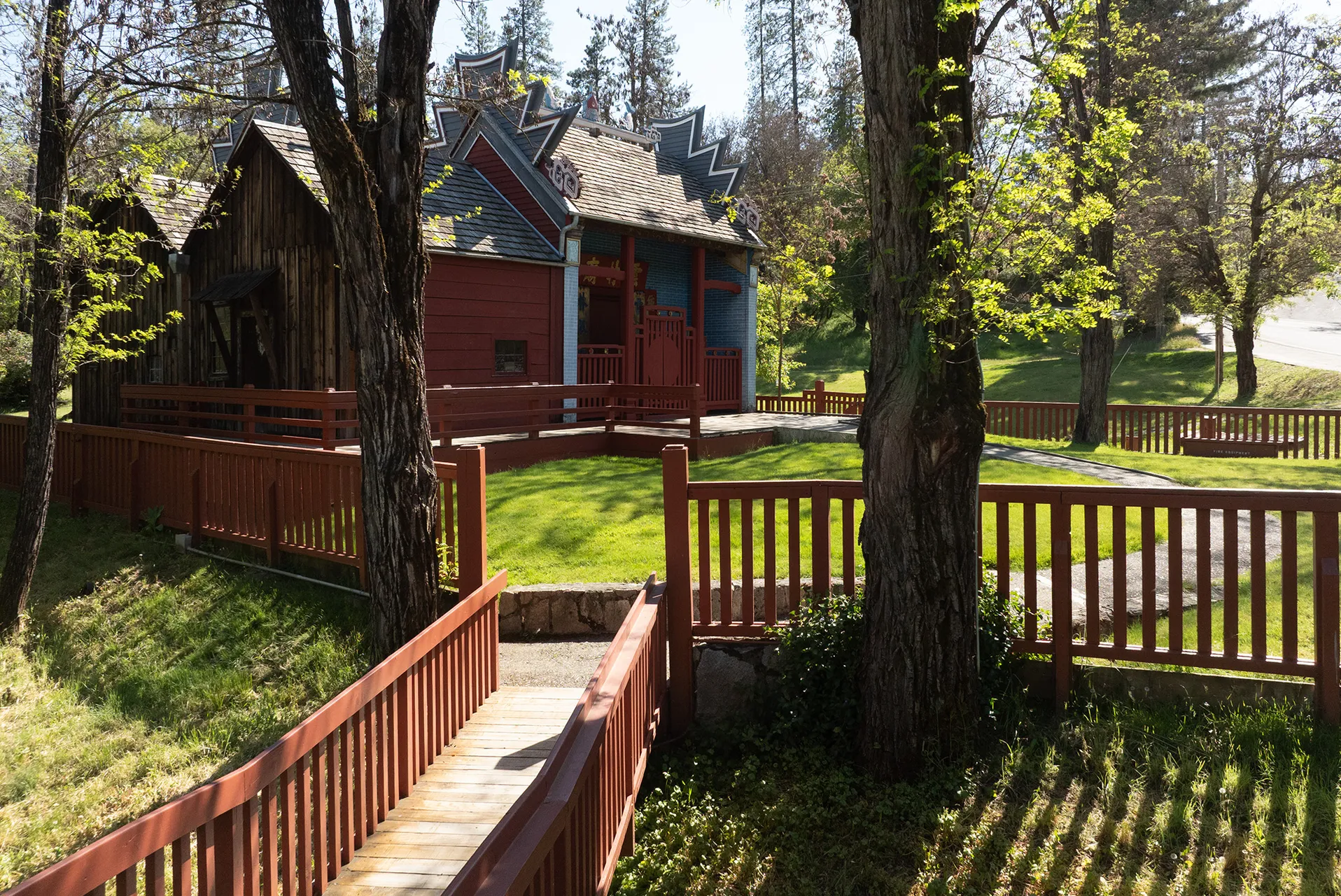
As we move across the temple grounds, take a look around. Following Taoist beliefs, every part of the temple was designed with purpose. Taoism, an ancient Chinese philosophy and religion, teaches living in harmony with the universe, and the temple incorporates features believed to promote balance, good fortune, and protection. The curved footbridge and pathway were designed to slow evil spirits, while the red fence and year-round creek symbolize good luck. The temple standing today was built in 1874 after two earlier temples on this site were destroyed by fire. When building this temple, they designed the roof with stylized ridgeboards along with waves, a dragon fish, and water lotus flower to represent a small pond believed to protect the temple from fire. As you explore, look for recurring colors, curved forms, numbers, and symbols, each reflecting Taoist beliefs and strengthening the connection between practitioners and the gods.
Jack Frost
Well, the temple is very unique. It is identified on the front of the building as Tao, because there are Chinese characters in the front that identify a phoenix bird and a dragon, which in Cantonese, the dragon is yang and the phoenix bird is yin. So the yin and yang symbol, which looks like a round circle with a curved path that separates it into two equal parts that look like teardrops. So the Tao, T-A-O, or pronounced D-O-W, it's basically the path, and it's represented in that Taoist symbol as that curved path between those two pieces. The Chinese are very superstitious. They believe that there's evil spirits, there's hungry ghosts, and that we need to try as best we can to avoid them. So the path that we should follow should always be a curved path, one that has effort and change, yin and yang. You could divide that symbol. The round symbol represents the universe. You could divide it into two equal parts with a straight line. But the Chinese believe that evil spirits and hungry ghosts are extremely lazy. They like a path with no change and no effort. So here at this temple, the path to the temple is curved, not straight. And when you walk in the front door, your straight path is stopped by a false door that you have to walk around. So in yin and yang, the whole universe is in balance. People today are more likely to use the phrase feng shui, where everything is in perfect balance with nature and with humanity. In this temple, the building itself was designed that way. When you look at the areas behind me, you'll see a green sign on the right side of the room, but you'll also see a green one on the left side. So everything is supposed to be in harmony with nature.
David Lei
Taoism talks about nature as yin and yang. Yin being the negative, female, dark, cold. Yang is the sun, is warm, is male, and it's the balancing of the two. If you see the Tai Chi symbol, it's a circle with a dividing line, an S-shaped line in the middle. One side's dark, one side is white, but within each is the other color to say that there's always an imbalance, and you're trying to balance. It is not good to be too positive or too negative. And this is with medicine, that the food you eat, there's cooling food, and there's hot food, like fried things would be considered hot food. And you have to have cooler food, like more water, watermelon, certain vegetables, they tend to be cooler to balance for health and to keep your body balanced. And that's the whole concept, that you don't go too far one side, and you go with the flow. You never resist. Whatever is natural for you is okay. So that's Taoism, and harmony is what you seek, and that's very Confucius as well.
Stop 2. A Political History
While the temple in Weaverville is often seen primarily as a religious space, Chinese political history is also woven into the name and fabric of the building. Poetically named "The Temple of the Forest Beneath the Clouds,” the name of the temple includes references to Chinese revolutionaries easily recognized by Chinese speakers of the mid-19th century. Lin Feng which literally translates to “forest phoenix” and “Wan Yun Long” which translates to “cloud dragon” are the names of two Chinese historical figures well known for their opposition of the Manchu-ruling class in China. Visible when entering the temple, the gold and blue vertical boards on either side of the front door present a poetic couplet referencing these names. Similar poems inside the temple also directly challenged the legitimacy of China’s emperor. The boards were provided to the temple in 1874 by a Chinese Mason secret society later known as the Chee Kung Tong, which in the past had a strong influence over the temple and the Chinese American Weaverville community.
David Lei
This temple in 1874 was very much influenced by the Chee Kung Tong. This is the mother tong, mother of all the other tongs here in America, and it was founded to be anti-Manchus. The Manchus conquered China in 1644, took over all of China. Manchu was an ethnicity in the north. They comprised about 2% of the Chinese population at any one time, no more than 2%. And yet they rule all the Chinese, 95% of which were the Han ethnicity. So there was always a desire to revolt, and here in America, they could be openly anti-Manchus. So this temple has a lot of hidden symbols, some not so hidden for the Chinese, if you can read Chinese, to be anti-Manchu. At the entrance to the temple, there's two signs in blue that invite you in, that has a date that is very disrespectful of the reigning emperor, because all Chinese dating system is by the emperor's reign and his year of reign. But they use what they call Tianyun cycle name. So it's very disrespectful because in China, only the emperor can come out with a calendar, because he's the Son of Heaven. He controls earth and heaven and the calendar. So if you're to come up with your own calendar, this is treason. And then the name of the temple, Forest and Cloud. There was two very famous anti-Manchu people that the Chee Kung Tong venerate. One was the Forest Phoenix. His name was Lin Feng or Lam Fung in Cantonese. So Lin, Forest, was part of his name, the Forest Phoenix. The other one is the Wan Yun Long, the Cloud Dragon. So they borrow the cloud and the forest and put it together and name the temple after two anti-Manchu people that they venerate. They're heroes because they were anti-Manchu. So even the name of the temple is hidden, and they have couplets inside that mention these two people's name. So quite openly anti-Manchu, if you were Chinese and can read these and know Chinese history. So the temple itself was a statement, political statement of the Chinese here wanting to overthrow the Manchu dynasty.
Chuimei Ho and Bennet Bronson
The person who wrote the couplets in front of the temple, which is not very long, but is very poetic because the couplets, one line he can use the word dragon, and then the next line he can use the word phoenix. And those are very balanced way of bringing images together. So yeah, it's basically not just being poetic, forest, and cloud. It's also making a not too hidden reference for people who read Chinese to be able to make the association very easily, that it's a reference to the heaven and earth society's legendary heroes. So that's the way I understand it. Actually, this Forest Phoenix Eye was a notorious pirate. Oh. But a revolutionary, too.
Stop 3. Connections to China
As we enter the temple, we pass through two doors and around a third, all designed to keep evil spirits from entering. This lobby serves as a gateway to the main temple, caretaker quarters, and meeting rooms. It also reflects the temple's strong connection to China. Nearly 90 percent of the building and its furnishings were crafted in the Toisan region of China and shipped across the Pacific, through San Francisco, and up the Sacramento River to Weaverville. During the Gold Rush, thousands of Chinese immigrants, primarily from Guangdong Province, settled in Trinity County, where an estimated 2,500 worked in the placer mines by 1854. The Weaverville Joss House was one of more than 230 Chinese temples built in California between 1850 and 1920. These temples were essential centers of worship, community, and cultural identity, and in many mining towns they were built before Christian churches.
Jack Frost
Here in California during the Gold Rush, the communities were established all over the state. And they were established by individuals that spoke the same dialect. In the early days of immigration, there were Chinese arriving in San Francisco, and they could speak up to 120 different Chinese dialects. So this particular community here was referred to as the Seiyap community, and that existed on the Pearl River Delta to the west of the Pearl River, and there were over 2,000 Chinese here in Weaver Valley, all speaking Seiyap Cantonese. Once they arrived and they established communities and their populations grew, like here in Weaverville with over 2,000 Chinese, they kept in contact with the homeland. Everything that we're seeing here inside the temple was made in an area called Taishan, China. It wasn't made here in California. It wasn't made in San Francisco. They wanted this to be exactly the same as what they would have built back home. So it took over 21 years to do this, and the biggest difficulty here in Northern California was transportation. So the Chinese here in Weaverville, they worked with the Chinese in the town of Red Bluff, 85 miles to the south of us. They worked with the Chinese companies in Sacramento and in San Francisco also. Together, it was like a flow of information, a flow of goods. You decided you needed a specific thing for your temple, so you'd send the order to Red Bluff. The Red Bluff group would put it on a riverboat, send it to Sacramento. It would then eventually arrive in San Francisco with the Six Companies of Canton, which then would ship it across the Pacific Ocean to Hong Kong Harbor, and then to the factory in Toisan. Now, maybe two years later, what you ordered reversed that, coming back through that channel, and it would arrive back here in Weaverville for this particular temple.
Yvonne Smith
Hong Kong has got lots of temples. So I grew up in Hong Kong, and I had to follow my mom. We have so many holidays, like Buddha's birthday, the time when they are gone. And yeah, we got so many reasons we need to go back temple. Almost every month, if we want. I like this temple, the history, many years ago, about the Gold Mine, and lots of Chinese people here. And just remind me that I'm back home. It's all the Chinese, they can come here. They can come all over. They're from Oregon, San Francisco, Sacramento, Los Angeles. They can go someplace, vacation, they pass here. At least we got the temple. We are back home. We are home. Temple is our home. Yeah.
David Lei
So if you look at this temple, anyone that walks in will say, "Wow." The art, the carving, all these Chinese characters. Everything has meaning, hidden meanings, different levels. And some were imported from China, I think most. And so the Chinese were stating, "We have a long culture, long tradition, and we're organized. And we're able to, together, raise the money to do all this." We're global. We have a homeland that can produce these, and we can bring them over." And the 49ers that came relied on China and Hong Kong for their food and the equipment, because China and Hong Kong was the nearest port. They got some from Hawaii, but Hawaii didn't have much manufacturing. The East Coast was too far away, five months by boat, whereas Hong Kong was only two months, and the speed record was 33 days. So the Chinese, the first wave, were mainly merchants. Then by 1852, '53, the gold miners came and the laborers came. And so gold was discovered in Trinity County, so they were in Lewiston and Weaverville, that whole area, mining, because that's where the gold was with everybody else
Stop 4. A Community Hub
In the mid 19th century, this temple stood at the heart of Weaverville's Chinatown. This caretaker's quarters and meeting room adjoining the main temple, served as a community center, functioning as a social hall, courtroom, school, hostel, and registry. In Weaverville, Caucasian members of the community participated in some temple events, such as those around the Chinese New Year. The donation boards on the walls reflect the size and resilience of the local Chinese community. The larger board above the door, recorded in 1878, lists 999 temple donors, while the smaller board above it, recorded in 1908, shows the decline in population and the names of those who endured increasingly discriminatory laws, including the Chinese Exclusion Act of 1882. At a time when Chinese immigrants were denied many rights and access to public institutions, spaces like this provided essential community support, preserving cultural traditions, and strengthening social networks in the face of violence and exclusion.
Jack Frost
It functioned for their religious needs individually. It was the place where they kept track of the lunar cycles here. In the temple, amongst the elders and amongst the caretakers. Every lunar month has a specific celebration and specific duties for the Chinese. We have a side adjoining room, which was the community hall, where they held most of their meetings, making these decisions. Once we had everything translated here that's actually recorded and pasted on the walls, we found that that room was used as a school, a puppet theater. It was used for a courtroom, and on some Saturday nights, it was the Shanghai Kino Palace. So many different types of entertainment. On that first day of the first lunar month, if the community had prospered and had enough money, they would hire and pay for a Chinese opera company to come from San Francisco up to Weaverville to provide an opera, a Chinese opera, to entertain the citizens of Weaverville, but also to entertain the spirits of the gods of the temple.
David Lei
So the temple was a center for the community. All the celebrations, all the important meetings. If you have frictions, the two sides would gather at the temple, and you will be more polite because the deities and the ancestors are watching. So you tend to swear less to give face to the deities. They have problems with the non-Chinese, and they were always pushed aside. There was the Chinese miners tax that only the Chinese paid. There was a tax that if you're a miner, started off to be $20 a month. Keeping in mind that you made a dollar a day. That was the average wage. So it was prohibitive, and Chinese very soon could not place the claim. They have to buy claims from White people or rent. So there were a lot of anti-Chinese legislation already. But the Chinese always felt superior, and they always considered the Whites to be barbarians to treat them so poorly because they said, "We in China, we treat people from overseas as guests, and we have laws, we have traditions. We have Confucianism, and we have long traditions of how to get along." And so they felt unjustly picked on, and they would group together to push back. So the temple was really messaging that we are organized, we have a long tradition, we have art. The calligraphy, they're gorgeous if you understand Chinese calligraphy because you have to be highly educated and disciplined to write like these. And we will say these were illiterate miners, but many of them have at least first-grade education and could read and write to some degree, first-grade level, but they could communicate because they would need to write home. They weren't highly educated, but they could read and write. And even Mark Twain in the 1860s, he wrote in "Roughing It" that he had hoped that the White electorate would be as educated as the Chinese. He said all the Chinese he knew could read, and he says the White people making the decision, electing officials could not. So the Chinese built this temple. It was important for themselves and to show White people what they could do
Chuimei Ho and Bennet Bronson
Ben, you should describe the Bomb Day. Now what- It was fun... yeah, well, that was the big hit for everybody, Chinese, non-Chinese, everybody in the whole region. They loved Bomb Day. And Bomb Day, which happened once a year, was a celebration of the temple and of the gods in the temple, but it took the form of bombs. What the bomb was, was it was a giant firecracker, which was in a tube. It exploded, and it blew up way up into the air. It blew up a small, I guess in this case it was a message on a weight with something like a parachute on the top. And what- There's a sample of it. The local museum- Yeah, right. There is... people can see it. And what happened was, so it would explode, and the parachuted token would come back down, and there would be a great big struggle for it there. Originally, it was all Chinese. Eventually, some whites got involved in it, too, seeing who was going to get it when it came down. Only strong young men, of course. And the strong young men, the one who got it would grab it and rush to the temple. And when he got into the temple, then he was kind of free. No more danger of somebody taking it from him. Then he would get a small prize. But there was a lot of gambling. I hate to say it was a lot of gambling going on. And probably quite a lot of spirituous liquor was changing hands, too, on the part of Chinese and non-Chinese. But everybody had a really good time. And this happened once a year, and everybody looked forward to it. It was one of the great days in the history of Weaverville. Well, it's usually being organized at the end of the Chinese New Year celebration, so it's quite cold. And then they have to climb up towards a hill, not right next to a temple. You have to go some distance to do it. And as expected, in the beginning, it's all Chinese, and then gradually some younger local residents, white people, join in. And towards the end, I think 1910 or something, then there was one year it was all white. No Chinese because they're too old, I think. So it was interesting. It's one of the fun thing that everybody look forward to
Stop 5. Spiritual Center
In front of the main altar, we are surrounded by objects and artwork that support Taoist practice. An ancient Chinese religion and philosophy, “Tao” translates to the “path” or “way,” observed as an unknowable source of all creation. Rituals carried out in the temple are meant to unite earthly and spiritual dimensions as an ongoing practice of creating balance and harmony. Offerings of fruit are one way practitioners honor and communicate with ancestors and spirits. More than symbolic gifts, these offerings, often arranged in sets of three, are understood as providing provisions for those in the spiritual realm. Oranges and other golden-colored offerings are commonly associated with prosperity, reflecting the hopes of many Chinese immigrants who came to California, known as "Gum Sahn" or "Gold Mountain". Burning offerings is another ritual believed to transfer physical items to the spiritual realm. The historic prayer furnace beside the altar was once used for this purpose, while the smoke from burned sandalwood incense is believed to travel to the heavens, notifying ancestors that they are being remembered and honored.
Yvonne Smith
I think I'm very lucky to live in Weaverville, and have a temple like that. And people working here so nice. I feel so welcome, and I love it. I can't ask for anything else. This my dream. Each time I go to temple, come here, I always bend my knees, bow three times, and you have to put three incense each time. So you bend it down three times, you bow three times, you ask the god. And every time when I ask for question, after that when I back home, I feel God is help me. So everything is going to be okay. Everything is going to be okay. Don't worry. Be happy.
David Lei
All the temples they built in America were Taoist. And I'm a Lee, and Taoism was founded by a Lee, Laozi, about 2,500 years ago. And so my family association is very Taoist because the clan we claim, that Taoism came from our clan. And Taoism is do as you wish. Anything goes. There's no one telling you what to do. No one's giving you sermons. It's normally your parents would teach you what to do. There's all kinds of deities, something for every occasion. If someone's sick, you go to the deity that will cure sickness. If you want to have a grandson or a son, you will pray to certain ones that present sons. Or if you want wealth, there's a wealth god. Something for everybody, basically. And you just light incense and make your wish. I think it's good for mental health. When science was not as rational as it is today, you don't know why people got sick and die. You don't know why certain things happen, why the environment would change, why there's no rain, why there's too much rain. So this is wish for auspiciousness, peace, harmony. So it's more mental than anything else. And today, if you talk to psychologists, they say this is actually quite healthy to wish for auspiciousness. This is your hopes and aspirations to outwardly express this
Chuimei Ho and Bennet Bronson
In the Chinese community of those old days, the religious aspects also functioned oftentimes as a kind of a legal position that one wants to take. And it's not only in Weaverville, in many other places, back in China and in Chinese communities in other parts of the world, too, that how do you honor your words? Yeah, sometimes you can write down as a contract, but even writing it down doesn't mean that you're going to do it. But if you say it in front of the god or you burn incense in stakes and witnessed by other people and say that's what you're going to do, that is you're giving your word not only to your partners, but to the god, and you are not going to give up so easily. So the religious aspect is having the god to witness what your intentions are, and that is something very important in the older generations of the Chinese in those days, I think.
Stop 6. Taoist Deities
Behind the main altar are three ornate wooden shrines that comprise the back wall of the temple. These shrines reveal a unique combination of ancient Chinese and California Gold Rush history with Taoist traditions. Crafted from locally sourced mud, the clay statues in the shrines represent 13 Tao deities. Most Chinese deities are mortals representing admirable qualities such as bravery and loyalty. People maintain reciprocal relationships with deities, with practitioners providing offerings of food and paper money with the expectation that the deities will grant specific wishes such as prosperity and good health. Some sculptures dating to the 1870s represent some of the oldest surviving objects crafted by Chinese Americans. Explore the shrines to learn more about the deities represented in the temple.
Jack Frost
Those clay statues represent real people that lived back in the Three Kingdoms period. Which was 220 to 285 AD. The one that you see that's on the left, there are three men depicted in that. One, his name is Hua Tuo. He was one of the most famous herbal doctors in China's history. Another is the God of Fortune, and the other is Honorable Chin. There are two wooden placards on that particular spirit house that has over 100 individual names, and they're all Chins. They all lived here. They sponsored that to honor one of their ancient ancestors. But Honorable Chin was the administrator of the imperial exams, and for every position that you wanted in life, in a company, there was an exam. It was like the civil service exams. So you would always pray to him to help you be successful in passing those exams so that you could become more prosperous. Here recently, I was trying to explain the imperial exams to a group of kids that were visiting here, and they just didn't understand, and so I connected it real quick. I said, "The imperial exams are called SATs now." So they understood that part. Hua Tuo, the herbal doctor, he was basically honored because of all of the efforts he did during his lifetime for people's health, and it was mostly herbal. And then the God of Fortune, well, you have to decide what is fortune. What makes you a wealthy person? You can go yin or yang. There's always a good or a bad. You can feel that you're wealthy because you're the richest person in the community because you're stingy and you always hold everything to yourself, or you might be the richest person in the community because you help the community, and you help the people, and everybody has a favorable attitude towards you.
Yvonne Smith
This is part of my religion. We got so many gods. So each god, they have the power. They can help people get well, get happy, make people be a good person. And yeah.
David Lei
The deities, these Chinese deities, most of them were mortals, and they are historic figures that did something that the Chinese respected, values like loyalty, justice, bravery, or caring for the general masses. So these were ministers, generals that did good deeds that the Chinese elevated to venerate. Very few are actually born deities. And because the Chinese religion is quite different, these are veneration values, what's valued, teaching the next generation these values. And these deities are not all-powerful, all-knowing, because they rely on the living to present them with food. What kind of deities are these that need the living to just feed them? And they need us to burn money for them so they have money to spend. So the Chinese really have a tit-for-tat relationship with these deities, and if they don't perform for you, you go to the next one. Very practical. And so you're born into this religion with certain deities that's meaningful to your locale. And there's some friction between the different locale because they have different deities and different values.
Stop 7. A Living Legacy
The temple and its collections survive today because of generations of dedicated caretakers and preservation efforts. The Weaverville temple is one of the few surviving temples of its kind. In the US and China, most historic Taoist temples were lost with changing demographics and the Chinese Cultural Revolution. Moon Lee, whose grandfather helped build the temple, played a vital role in its preservation. He became its caretaker in 1933 and donated the temple to California State Parks in 1956. He continued to care for it until his death in 1985. California State Parks has preserved the site ever since, ensuring it remains both a place to learn about Chinese and Chinese American history and an active temple where people continue to practice today. An annual Lunar New Year celebration and other events throughout the year help keep the temple's cultural and spiritual significance alive.
Jack Frost
I think the most important reason for protecting this represents a culture that has had unbelievable change in China. We deal with older people that remember what China was like before the revolution in 1950. And we have younger people that are going to school here in California at the different universities. They visit here, but because of that revolution, they can't read anything that's here in the temple because the Chinese government decided to go to a simplified version of the Chinese characters. And I can only imagine the difficulty that those young people had. Their parents, their grandparents couldn't help them with their education because the grandparents wrote in a completely different style than what the kids were learning in China. This facility represents that older time period, especially the 1850s, 1860s. So it gives them the opportunity to visit their culture from the past here. It's kind of funny because younger Chinese from China, they'll use their cellphone to translate the characters, and it works for them. But I find that if they can read this very quickly and they're young, they're more likely from Taiwan or Vietnam because those countries stayed with this older style of calligraphy. So maintaining that and protecting it so that it's here for the future, that's important.
Yvonne Smith
I think very important because especially Chinese people, our culture, our religion. I hope that generation continue, pass, never end because the gods here. The god, they stay here forever as long as the people come to visit, and put incense, and please the god. I think we should keep all the temple in United States forever. The Chinese people, we can go everywhere, every one of the temples. We can visit here, we can visit different temple. So I think it's very important. Otherwise, we cannot continue teach the kid what kind of religion, what kind of culture, because we don't have the temple, we cannot show the kids, show the next generation, this is my god, so many 13 god behind me. So I think very important, and I don't want to lose our religion and culture. I hope that for future we can pass, pass, like I say never end
Chuimei Ho and Bennet Bronson
But there was an interesting connection, I think, as a part of the Americanization of Chinese religion without changing the religion itself. Actually, a good sign of the, a good mark of this is what you heard about before, the theft or the clearing out of all the furniture of the temple by a dishonest dentist from Redding. That was the 1930s, though. That's right. But the interesting thing was that not only did he take all this stuff, a couple of big wagon loads with his gang back to Redding, and he was seeing it, planning to sell it and get rich. But the inhabitants of Redding, the white inhabitants, not of Weaverville, the white Weavervillians, were outraged. They loved their temple. They wanted the stuff back. And the local sheriff was prodded into action, and they got it all back. And I don't know what happened to the dentist. Was he put in prison? Possibly. He was actually slapped on a very large scale. But it's remarkable that the local people, the local European American community, was actually quite interested and fond of. They loved their Chinese temple, and they helped protect it. Right. And that really is one of the reasons why the Weaverville Temple can still be there intact, and it's just because the community loves it, then, now, and then. Yeah. Amazing. Yeah.
Stop 8. Thank You for Visiting
Thank you for visiting Weaverville Joss House State Historic Park. This is one of a number of California State Parks that highlight Asian American history. We encourage you to learn more through visiting the temple and museum in Weaverville and through exploring other historic sites in California.