Welcome to The Great Mosque
The Great Mosque is located on Kilwa Kisiwani, a small island off the east coast of Tanzania. About 300 km south of Dar es Salaam, this stone mosque is the oldest standing mosque in sub-saharan Africa. The Ruins of Kilwa Kisiwani, along with the ruins on the neighboring island, Songa Mnara, are a designated UNESCO World Heritage site. These islands were once important ports along the Indian Ocean trade routes. While Kilwa Kisiwani is most well known for its ruins, there is still a vibrant community that occupies the island. Throughout this tour, you will hear from multiple individuals that work with the Kilwa Kiswani Ruins or are members of the local community on the island.
Stop 1. A Rich and Layered History
The site is actually made up of two mosques. The original mosque was built in the 9-11th century and the extension was added during the island’s peak in the 13-14th century. The use and architectural structure of the mosque extension are evidence of the pivotal role that Kilwa Kisiwani played in the Indian Ocean trade route, the spread of Swahili culture, and the Islamisation of East Africa. In the 16th century the island was occupied by the Portuguese and the mosque fell into disuse. Following this, sediment filled the mosque and it was buried up to the domes. It wasn’t until Neville Chittick (a British scholar and archaeologist and the Director of Antiquities during the British Colonial Rule) led an excavation to uncover The Great Mosque between 1958-1965, that the site was restored and used again.
Revocatus Weja Bugumba
To me, The Great Mosque is a beacon or a symbol of our great heritage in our country because it has added value to this area, firstly as a national heritage and also as a world heritage. One of the reasons this area was included in the world heritage list is because it has buildings with excellent and modern architecture that required great intelligence to construct. And also its rarity or absence in other parts of the world— for example, the great mosque’s major feature, as others explain, is that it was the largest mosque south of the Sahara Desert before the 16th century, and its distinction is that it’s a mosque that has endured for many years—nearly 700 years. It has been in use for 700 years, so I don’t think there’s any other mosque in Tanzania that has been used continuously for 700 years.
Mercy Mbogelah
The Great Mosque has a long history, starting from the 11th century when a small mosque was built, and later in centuries such as the 13th and 14th, expansions were made, leading to a larger structure. One major story I have heard about the Great Mosque is that it remained the largest and oldest mosque until the 16th century. At that time, it was the largest mosque on the East African coast, compared to other historic mosques. But the story I love the most about the Great Mosque is the tale of Ibni Batuta, a renowned scholar of the past, who visited Kilwa, was welcomed by the sultan, and used the Great Mosque for prayers.
Masoudi Issa Abeid
The Kisiwani area right now has great importance and holds immense significance, because even Kilwa itself is entirely supported by this Kilwa Kisiwani. If you look at it, all the resources that were here are what sustain the whole of Kilwa, it gained a great name and even received recognition from the United Nations and as a world heritage site, Kilwa as a whole is carried by Kilwa Kisiwani, so this area is very important.
Abdalla Ahmadi
The great mosque was built in earlier times, the first phase was in the 10th and 11th centuries. The second phase was in the 13th, 14th, and 15th centuries. Why exactly—one mosque for two purposes, or was it built in two different periods? Because in Kilwa Kisiwani alone, they built ninety-nine mosques, like the names of Almighty God, it’s a great mystery. So, for this first mosque that was built in the 10th and 11th centuries, it was insufficient for the Friday prayers and Eid celebrations, so they added another one, and they began conducting prayers simultaneously.
Stop 2. Cleansing Before Worship
Similar to modern practices, anyone who enters the mosque must first pass through the ablution area. The ablution area is a dedicated space for purification and cleansing before entering the mosque. Muslim traders and community members would pass through this space as they prepared themselves for prayer. The water that once filled these water basins was obtained from wells near the mosque. After washing their feet, worshippers would use the two large, smooth stones to dry their feet. This practice is followed by a short prayer before entering the mosque and beginning worship.
Masoudi Issa Abeid
When I visit the great mosque, I feel a great sense of joy, but at the same time, sometimes my mind still gives me dreams of understanding how that mosque was built up to now, for example, perhaps that question will come up later, for instance, maybe the areas for ablution where water was taken, there are stones there that can weigh up to five tons, even four tons, but those stones are found in mainland areas, at that time, there were no car technologies or any modern technology, so how did those stones get there? If you go there, you’ll see them, and even now, it’s not like you have to search for them, you’ll see them, and up to now, its scenery is absolutely beautiful. And so, even when I visit there, I always love to just look at the things that were done at that time, and there was no modern technology—how was it done? So you’ll find those stones bear evidence there. One stone can weigh eight tons, seven tons, but it’s there, and all those stones are found on the mainland, not the coast, on the coast, you find coral stones, coral rivers, which are soft, you can cut them with a saw and use them for repairs, but those are hard stones.
Mzee Said Hamisi
It differs slightly, it differs because nowadays, let’s say technology has advanced a bit, you might find that now they’ve installed pipes, but in the past, there were no such things. They used to use these water-drawing containers... But back then, they would install pipes meant to channel water that were built directly, they were constructed to bring water to a cistern so people could use it. You might find a well over there, but there would be a channel to bring water to the collection area. But nowadays, there are taps that people just turn on—it’s simply a matter of expertise increasing.
Abdalla Ahmadi
In the area of the great mosque, where there is a place for ablution, its main importance is that you cannot enter the mosque to worship, unless you perform ablution, meaning you must cleanse yourself, then you enter inside to carry out your worship. So there, you are in a state of purity, thus it means one section is designated for performing ablution, to enter inside for worship, so it holds great importance.
Stop 3. Exploring the Original Mosque
This structure is the “Old Mosque” and was built between the 11th and 12th centuries. It is believed that there was another mosque beneath it before this one existed, as wooden post holes have been found underneath the mihrab. The architecture of this mosque indicates that instead of a dome, this mosque had a flat roof. Other architectural features include designated areas for placing the holy book (the Qur'an) and traditional oil lamps. And like modern mosques, the Qibla is oriented toward Mecca. Consider how these key architectural elements shown here at Kilwa have continued to be part of Islamic architecture today, 800 years later.
Mzee Said Hamisi
The features present in the mosques of today, have a significant difference compared to the construction of ancient mosques. Many of the old mosques didn’t have metal roofs, but now they do, and there used to be those decorative elements like jars, which you don’t see anymore. And in the past, the pillars were much more numerous in all the old mosques, the pillars were more numerous than in the mosques of today.
Abdalla Ahmadi
The type of raw materials or resources that were used, they used coral stones, they used red clay, white sand, and lime without using iron or cement. Therefore, we find that these people had advanced technology, which is why we see that even until today, it has lasted for a long time, and up to this day, due to the materials they used, it still endures in a beautiful landscape.
Stop 4. Expansion of Trade & Structure
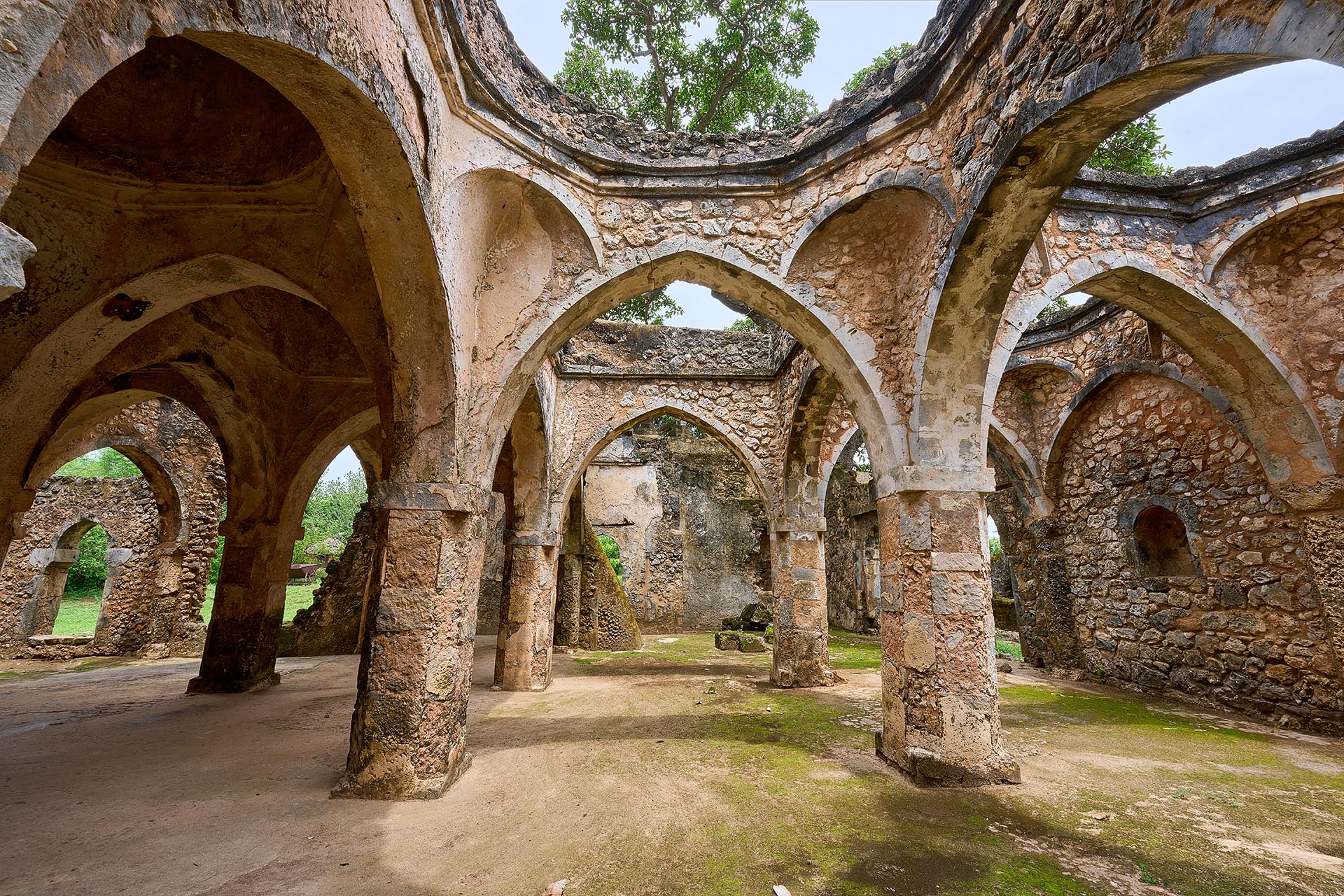
The extension of The Great Mosque was built by Sultan Ali Hassan Bin Sulaiman in the year 1320, following the growth of the local community and the arrival of visitors due to the expansion of trade. The Mosque was constructed with remarkable and unique architectural design, featuring 42 columns and 36 domes. At that time, it was the largest mosque south of the Sahara Desert in Africa. This mosque is a symbol of the growth of the Swahili culture and the wealth of Kilwa as a notable trading port. These factors also contributed to the spread of Islam throughout Africa due to the interactions of many visitors, especially traders, prominent merchants, and the famous explorer Ibn Battuta, who once wrote Kilwa was the most beautiful place he’d ever visited.
Revocatus Weja Bugumba
It was expanded in the 13th and 14th centuries, when Kilwa was now at the peak of its success, when it was an empire ruling the entire region of sub-Saharan Africa, but on the Indian Ocean side, all the islands were under the Kilwa Kisiwani empire. During that period, although it was initially minting its own copper coins, it was during that time it started producing coins inscribed with gold, showing that it had reached its peak, and that’s when they built this great mosque, possibly because the population increased, but also because the economy grew. That’s why, if you look at its architecture, it shows that the people had money. You can look at it—it’s small, but if you translate its craftsmanship into today’s money, with today’s money, if we were to carve and build this mosque now, I don’t think it would cost less than one billion shillings. But if it were still standing today, I think this mosque, in its full glory, looking at its value, could even approach 10 billion, based on its current value. But now, just to get the wood itself—you know, obtaining even a single piece of wood, having it carved by the craftsman who worked on it, ensuring its quality and the time it took— you know, it’s a building of immense value. So it’s a sign that they used that— there were changes and growth in its economy.
Mercy Mbogelah
Trade, in general, played a significant role in the construction of the Great Mosque. Beyond just the construction of the mosque, trading itself played a significant role in the growth of Kilwa Kisiwani, because Kilwa was a major trading center, along the East African coast, from the 12th century to the 16th century, trade contributed greatly to the growth of Kilwa Kisiwani. It was trade that attracted major merchants to Kilwa, and as the population increased, with more prominent traders settling in Kilwa, the ruling sultan at that time saw the need to construct the Great Mosque of Kilwa Kisiwani, to make it easier for these traders as well as the notable individuals residing in Kilwa Kisiwani, to perform prayers inside the Great Mosque. So, as trade expanded, it led to an increase in the number of merchants, which in turn necessitated the expansion of the Great Mosque.
Mzee Said Hamisi
In the great mosque, in the great mosque, its features, the first one, it has two parts, which at the beginning were small, after the needs increased, it was expanded again with a second part. So it has two qiblas, that’s why it’s called, it’s called the mosque of two qiblas. So the mosques nowadays have a chair that you won’t find, but that one has remained like that, and the reasons are those, the increase in needs, so it was built to extend backward.
Abdalla Ahmadi
Ibn Battuta was a Moroccan who arrived here, in the year 1331, equivalent to the 14th century. He came here and greatly contributed to trade, and in his travels, he visited nearly a hundred cities or more, you find first that the decoration is beautiful, shining, and pleasing. The locals welcomed him with high civility and humility, according to the history that the land of Kilwa had inhabitants with a high level of civilization, but he also contributed to the development of the Swahili language, since this land of Kilwa Kisiwani is one of the origins of the Swahili language, so even his arrival helped further enhance the Swahili language, as well as contribute to greater commercial growth.
Stop 5. Architectural Adornments
The architecture and decorations of the new mosque reflect Kilwa’s historical trade connections, as merchants from different regions brought various goods, including plates, bowls, and pottery that were incorporated into the design of the structure. Inside the domes there were once colorful and intricately designed porcelain bowls from Arabia and China. You can imagine the beauty of the domes when the mosque was at its peak. The distinct appearance of each dome contributes to the mosque’s uniqueness. There are two types of domes seen in this mosque: rounded domes and barrel domes. The round ones serve particularly as ornamental features.
Mercy Mbogelah
Honestly, I like two main areas in the Great Mosque. The first area I love is the domes of the Great Mosque, and the way they are decorated with various ornaments, which I find very appealing. But I also love how the Great Mosque is adorned with its pillars, which, when counted, amount to about forty or forty-two. So the way they are arranged and decorated, are things that I really enjoy when I enter the Great Mosque.
Mzee Said Hamisi
Its importance, you could say, is to simply demonstrate the expertise of those times, and the times we are in now. Because back then, we say technology was limited, whereas now it has advanced more. However, they had the ability to create things that were better than what we have today, things more solid than what we have now.
Abdalla Ahmadi
The dome has great importance because it is part of the great mosque, and it was built in a way to show the grandeur that exists in that mosque, as well as the ranks or titles used by the sheikhs, imams, and various worshippers alike. So that large dome there demonstrates the beauty of the landscape and how it was constructed, due to its scenery being beautiful and pleasing, they thus installed that large dome, to show they had the capability to build it in such a fine manner.
Stop 6. Different Perspectives
In addition to the main worship area, characterized by many the small domes and pillars of the New Mosque, there is also one large dome and two ablution areas. In the ablution area that most worshippers would use, ancient wells with spiritual significance would fill the water basins. Many ancient wells exist, but only the main well still contains fresh water. It is said that those who use this water today receive blessings, protection from misfortune, and relief from hardships. The area beneath the single large dome is a point of disagreement between scholars and members of the local community. Scholars describe this area as a special place used by the Sultan during prayers. However, the local community believes that since the Sultan was a highly respected leader, he would not sit at the back of the mosque. Instead, they assert that he performed ablution in the small, designated area before entering the mosque. He would then pray privately, or perform Sunnah prayers, under the large dome before joining the congregation for the main prayer in the front row.
Revocatus Weja Bugumba
There’s also this very large one that stands out, which is near the ground but large, close to that big tree—it’s the largest of its kind. That large one, according to people’s oral traditions, they feel—some say—that doorway was used by the sultan, and that’s where he would perform ablution, according to the stories, suggesting maybe that’s where he passed through and sat there. But according to religious scholars’ interpretations, a sultan couldn’t sit by that large one, because, based on Islamic worship traditions, prominent people sit at the front, in the first row up there, and if he’s not there, even the imam or a distinguished person could lead the prayers themselves. We have a good example—there was Elder Ali Hassan, our late first president, the second president of the United Republic of Tanzania, who sometimes also led prayers during religious activities. So that idea that it was for the sultan doesn’t hold up against Islamic religious traditions. But some people also believe it’s another kind of marker, meaning that people say there are jinn that reside there. So you might sit there—not jinn i know of, love or something else— but that’s where they stay inside, and people believe that; the experts will tell us.
Stop 7. Community Conservation Efforts
Conservation is an on-going effort for the Kilwa Kisiwani Ruins and the local community has actively participated in conservation work, including many projects that took place in the early 2000's with the support of international and local funding. Through these restoration projects, around 22 community members were trained in restoration techniques, including preparing lime and carving specialized stones for repairs to ensure that all repairs are done in a style that is true to the original techniques used to build the mosque. Seven young community members also received specialized training to guide tourists through the site. The community also helps to maintain the ruins by participating in restoration efforts, security, and site cleanliness.
Revocatus Weja Bugumba
And those were the changes, but on the preservation side, it particularly started in 1957. History shows us that Neve Chikt was the first director of antiquities during the colonial period, the British era. So he came with a team of students from Makerere University, who were studying heritage matters, including the first director of antiquities named Amini—the late Amini Mturi—when they were young, they participated in this work along with Chikt. They carried out restoration work, not only here, as Elder Hassan explained, they left here and worked on The great Husuni and various other sites. Because Chikt conducted restoration across all areas, starting from the coastal region, from Tanga down to southern Tanzania. But later, from 1957 to 1960, he focused on the Kilwa area, and into the 1970s, he was writing—there was his desk that he left here, Chikt’s desk. I don’t know if you still have it—that desk I was using, that desk belonged to Chikt. So that’s what he used to write in his office, and up until the 1970s, he was around, and that’s when he started writing his books. But after the 1970s, there was no continuation, not even restoration— they were only doing annual cleanups, just cleaning each year until 2002, when we got a project called the Kilwa Project, which was funded by the French government, the Japanese government, UNESCO, and the Tanzanian government itself. The work done wasn’t just restoration but reinforcement—restoration of the great mosque. What was done included adding carvings to the domes—there are parts where, if you go and read, it’s written 2002, 2004, marked there, those were added during that period to the great mosque, and on the arches, they also added thickness to prevent water that was seeping in. For those large ones, they were reinforced—those that were leaking, not just the ones that look black, but the large ones were also expanded in size and cleaned, along with the mosque we’re sitting in. If you look at this one, it’s the mosque where students who completed restoration work did their training here and were awarded certificates. [Revocatus] It was worked on by students to show that they had completed their preservation training. So the last preservation effort took place during that period, from 2002 to 2004, for the mosque.
Mercy Mbogelah
The Great Mosque of Kilwa Kisiwani plays a significant role in the community. Firstly, there is a connection between the Great Mosque and the faith of the community, specifically Islam. Because there are community members who still use the Great Mosque for prayers to this day, firmly believing that when they enter the Great Mosque to pray, then Almighty God hears them due to the history embedded within the Great Mosque. However, the Great Mosque also serves a religious purpose, as it is used by various visitors from outside Kilwa, including those from other regions of Tanzania as well as international visitors. They come to use the Great Mosque for prayers—not just for tourism, but also for worship. There are visitors, such as groups of Arabs from Turkey, Oman, and other places, who have been coming every year for almost four years now, especially during Ramadhan. They perform prayers together with all the residents of Kilwa Kisiwani, breaking their fast and praying inside the Great Mosque, while also sharing iftar. So, you can see the significance of the Great Mosque and the value it holds— not only for the residents of Kilwa Kisiwani but also for international visitors. Tourists visiting Kilwa Kisiwani come for sightseeing. The local people earn income through the Great Mosque, as there are tour guides, who are local residents guiding visitors around Kilwa Kisiwani, including the Great Mosque, and they earn a living from it. Boat operators who transport these visitors also earn income by guiding visitors to the Great Mosque.
Masoudi Issa Abeid
The great mosque—I was involved in its preservation in two ways. First, providing education, but also monitoring the landscape itself for damage, perhaps from animals and livestock like goats and cows; during that time, we were very involved. But we were also involved again when UNESCO was there, along with antiquities matters, and I was the leader at that time, the chair of the ruins committee, in the very first period before this committee, so I was heavily involved with that mosque.
Mzee Said Hamisi
The benefit to us personally—if you decide for yourself, that you’ll go there to receive blessings, then that’s how you benefit. But you can’t know for sure that perhaps this benefit comes to me because I went there, you can’t know because no one tells you, it’s your faith that builds you up, making you feel that you’ve benefited by experiencing those things.
Stop 8. Conclusion
The mosque holds great importance for both the local community living within the heritage site as well as visitors hoping to worship here and tourists seeking to learn about the ruins. For the community and some Muslim visitors, the mosque is a revered space where they can pray for blessings from Allah and the ancestors connected to this sacred site. Many believe that these prayers help protect them from misfortune, curses, and other distress. Additionally, all visitors to the mosque have the opportunity to learn about its elaborate history and gain insight to the island’s role in the spread of Islamic and Swahili culture.
Revocatus Weja Bugumba
For me, as an antiquities expert, because of what we preserve, first, it’s the intelligence that was used. We don’t preserve antiquities just because of their age, but because of the intelligence, creativity, and artistry that went into making that thing exist. It’s the same as what Elder Hassan says—that is, people used a high level of craftsmanship to design and build that structure. So for me, the great mosque is a place that shows us an incredibly high level of creativity, and our ability to use intelligence, as we should, to preserve other things, which is our goal with antiquities. Antiquities aren’t about being old for the sake of it—no, it’s the intelligence used to create—even that stone we preserve isn’t just because of the intelligence used to carve it. But it also has its history and its importance—its intelligence and its history. Its history is what we say makes it the first mosque, as I explained earlier, in the Zanzibar region, and it’s also the largest with those qualities. So with all those qualities, it makes the mosque, let’s say, our main emblem here at Kilwa Kisiwani.
Mercy Mbogelah
I believe that if we continue to preserve the city of Kilwa Kisiwani, the ruins we see today could last for another thousand years, because what we see today has been preserved. Even the communities that lived here 50 years ago, or long before, had a spirit of conservation and greatly contributed to its preservation. That is why today we see them, and we see how they benefit us, they benefit the community, the government as a whole, and the entire nation benefits from the preservation of the ruins of Kilwa Kisiwani. Therefore, my hope is that the citizens, in collaboration with the government, and various conservation stakeholders from outside Tanzania, if we work together to protect, preserve, and restore them, we can continue safeguarding our national heritage, ensuring that international heritage lasts for generations and benefits future generations.
Masoudi Issa Abeid
First of all, we must have respect for world heritage, this earns us great respect to have things like these that are part of the world heritage. But even now, we benefit, even in terms of individual income, from the years past up to the present, things have been slightly different; now even individuals are starting to see the benefits, like how each child is taken and educated because of these resources. But also, we gain education, we have enthusiasm, and the women too sometimes form groups, they cook traditional foods, and UNESCO also gave us a lot of training back then on cooking local dishes, traditional dances, and group savings matters, UNESCO took charge, we went through a simple process, and we worked with them up to about 83 percent success. We succeeded greatly, so those are still huge benefits, and we continue with them, but there are also young people who take the initiative to ferry visitors with their personal boats—that’s employment too, and we provide guides, all of whom are locals from here, and they take visitors around, all of that is beneficial, and in the past, these things didn’t exist.
Mzee Said Hamisi
I feel a lot of comfort, and I can also go there, to perform my worship, seeking the blessings of the great ones who came before us, so that those blessings may continue to reach us as well, you can go there and pray the noon prayer, or on another day, pray the afternoon prayer or the late afternoon prayer there, to receive the blessings of those great ones and the blessings of that mosque.
Abdalla Ahmadi
The great thing I’m explaining here is about preserving them, maintaining them so that they remain as we’ve quickly said and narrated, meaning that if we fail to take care of them directly, and preserve them further, it means we’ll lose their authentic state, so these are good things to maintain, to respect, to be able to... so they can remain in a beautiful landscape as we found them, and we can leave them for those who come after us.